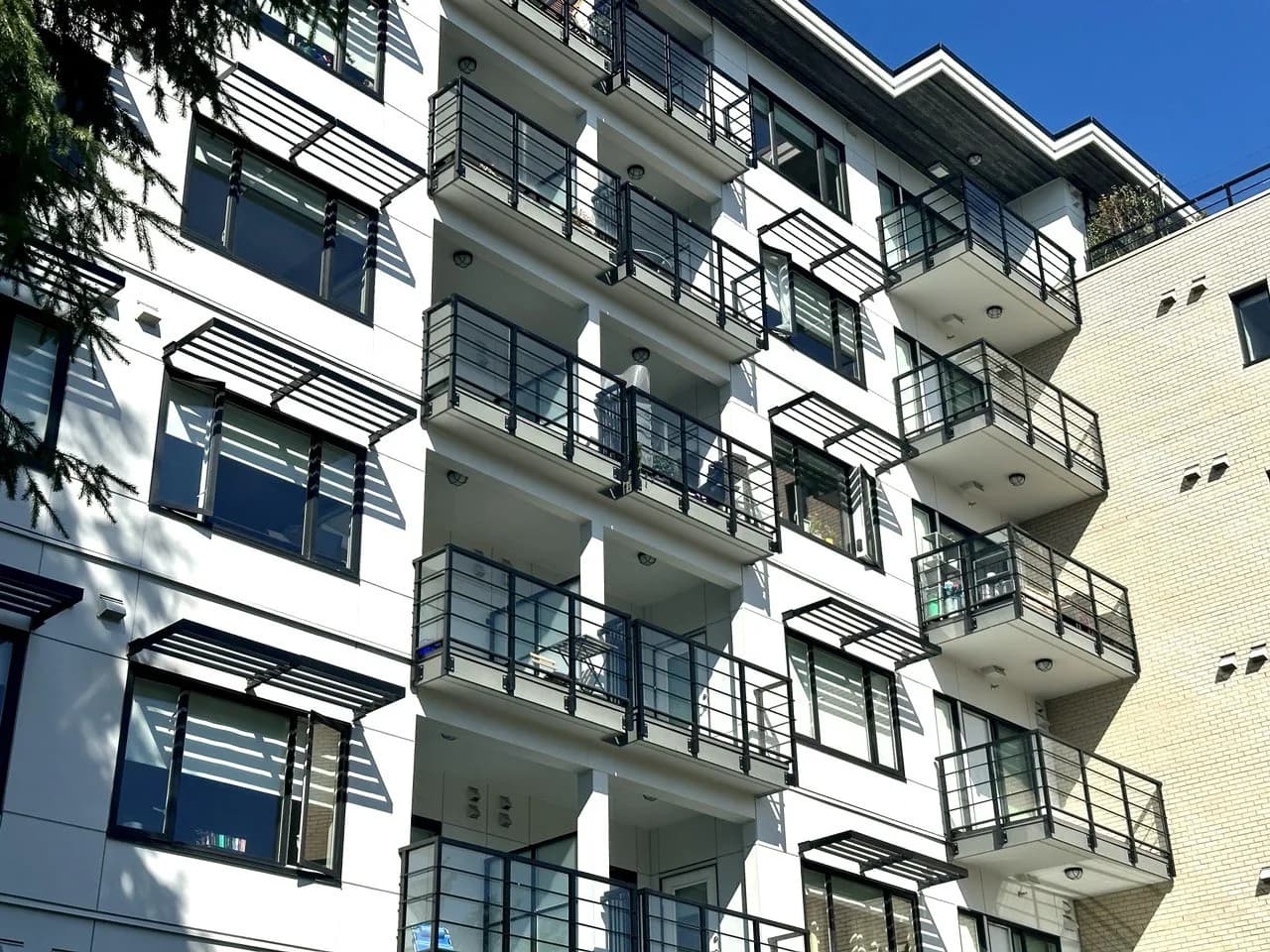
Every year in BC, strata councils go out to tender on exterior renovation work: envelope repairs, stucco re-clads, brick restoration, siding replacement. They receive three bids that look almost identical on the summary page. Same scope. Same square footage. Prices within 15% of each other. Council picks the middle bid, work starts, and 14 months later the strata is paying $180,000 in change orders on a project that was supposed to close on the original quote.
The bids were not identical. The RFP was.
A strata exterior renovation contractor bidding on a vague scope will always underbid a contractor bidding on a specific one, because the vague scope lets them price for the best-case interpretation and charge every ambiguity as extra. This is not fraud. It is what happens when a council writes an RFP that measures the wrong things.
This piece walks through how a BC strata council should structure an exterior renovation RFP so bids are comparable, warranty terms are enforceable, and the contract price at the end resembles the price on the letter of intent. Written for council presidents, property managers, and depreciation report committee members preparing to spend $200,000 to $2 million on their building's next envelope cycle.
What should a BC strata council include in an exterior renovation RFP?
A strata exterior renovation RFP in BC needs six specific sections: a scope of work tied to specific building elements (not "envelope repair"), a materials specification with named products and grades, a warranty schedule broken out by work type, an insurance and licensing minimum (WCB, general liability, bonded), a payment schedule tied to progress milestones, and a change-order procedure. Missing any one of them means the bids you receive are guesses, not quotes.
That is the answer. The rest of this piece is how each section actually gets written.
Why RFP structure decides the project outcome
The BC Strata Property Act requires councils to demonstrate reasonable care in awarding contracts, and depreciation reports under the Act have set a baseline expectation that major exterior work goes to formal RFP rather than handshake bidding. What the Act does not require, and what most councils skip, is any standard for how that RFP is written.
The result is a documented pattern across the industry. On a $500,000 strata envelope project, a well-structured RFP will produce three bids within 8% of each other on price, aligned on scope, and priced against the same warranty terms. Council can compare bids and pick on merit. A poorly structured RFP on the same project produces three bids spanning $380,000 to $620,000, each interpreting the scope differently, with three different warranty structures buried in the fine print. Council has no basis for comparison and defaults to price, and the winning contractor prices every gap as a change order.
The financial cost of a bad RFP is the change-order stack. Industry patterns from BC building envelope work suggest change-order rates run 6 to 10% of contract value on well-scoped projects and 25 to 45% on poorly scoped ones. On a $500,000 envelope, that is the difference between a $30,000 contingency and a $200,000 budget hole.
Scope of work: name the specific elements
The single largest driver of comparable bids is a scope of work tied to specific building elements, not general categories. "Building envelope repair" is not a scope. Neither is "stucco remediation on the west facade."
A workable strata RFP scope reads element by element:
- Remove and replace 2,400 sq ft of failed stucco on west elevation (identified in Attachment A: photo survey)
- Replace all through-wall flashings at 42 window openings on west and south elevations (specifications in Attachment B)
- Inspect and repair sheathing behind removed stucco; assume 15% replacement priced at unit rate on Bid Form C
- Reinstall stucco with new drainage plane, primer coat, and two-coat elastomeric finish
- Replace 380 linear feet of soffit and fascia on west elevation
That level of detail sets a common baseline every bidder prices against. When a bid comes back low, council can see whether the contractor cut a specific line item or priced the whole scope tighter. When a change order lands mid-project, the contract has a defined scope to measure the change against.
Two additions that most strata RFPs miss: a photo survey of every deficiency the RFP references, and unit rates for common contingencies (sheathing replacement per sq ft, window flashing replacement per opening, additional coats per sq ft). Unit rates convert change-order fights into arithmetic, and I have seen them close projects on budget that would otherwise have blown by six figures.
Materials specification: name products and grades
A scope that says "elastomeric stucco finish" gets priced with the cheapest elastomeric on the market. A scope that says "Sto Powerwall or approved equivalent, two-coat application at 0.8mm minimum wet film thickness" gets priced against a real material at a real grade.
Named products matter more on some elements than others. On stucco, coatings, and membranes, the price spread between the low and premium end of a product category runs 40 to 200%. On flashings, screws, and fasteners, the spread is smaller but the quality difference is larger. On any strata envelope RFP, name the products you expect for:
- Stucco base coat and finish coat
- Weather-resistive barrier membrane
- Sealants at penetrations and control joints
- Flashings (metal type, gauge, finish)
- Any insulation upgrade
- Paint or coating systems (primer, finish, mil thickness)
For each named product, allow "or approved equivalent" so bidders can propose alternatives with data. Require the substitution to come with technical data sheets and matching warranty terms. Reject substitutions that shrink the warranty.
Warranty schedule: broken out by work type
Warranty terms are where sophisticated bidders separate from the bottom of the field. Most weak bids carry a blanket "1-year workmanship warranty" clause that is worth less than the paper it is printed on, because it lumps everything together and expires before the failure modes show up.
A workable strata warranty schedule breaks out by work type:
- Workmanship warranty: minimum 2 years on all installed work
- Stucco system warranty: minimum 10 years, matching manufacturer specification
- Membrane and weather-resistive barrier warranty: minimum 10 years on materials, 5 years on installation
- Flashing and sheet metal: minimum 5 years installation warranty
- Sealant warranty: minimum 5 years
- Structural repairs: minimum 5 years
Each warranty needs a start date (substantial completion vs. final acceptance), a call-back procedure (who the strata contacts, what response time), and a documented transfer path if the building sells during the warranty period. A warranty with no call-back procedure is a warranty the contractor never has to honour.
The contrarian point most councils miss: a longer warranty is not automatically better. A 15-year warranty from an uninsured contractor on a job that will outlive their company is worth nothing. A 5-year warranty from a WCB-insured, bonded, financially stable contractor with 10+ years of BC operating history is worth everything. Ask for financial references. Ask how long the contractor has been in business. A warranty is only as strong as the entity backing it.
Insurance, licensing, and bonding minimums
For any BC strata exterior project over $100,000, the RFP should require:
- WCB coverage in good standing (verified by current Clearance Letter, not a claim from the bidder)
- General liability insurance minimum $2 million per occurrence, $5 million aggregate
- Property damage insurance
- Bondability for the full contract value (bidder must provide a bid bond and be capable of performance bond if requested)
- BC business licence in the municipality where work is performed
- Any trade-specific certifications required (envelope work often specifies training on the specific membrane or coating system)
Ask for verification of each with the bid submission. A contractor without current WCB coverage cannot legally have workers on a BC site. Strata councils that skip verification and later discover an uninsured crew on their building carry personal liability exposure the Strata Property Act does not shield them from.
Payment schedule tied to milestones, not months
The payment schedule in a strata RFP should tie draws to progress milestones, not calendar months. On a 4-month exterior envelope project, a workable schedule looks like:
- 10% on contract execution and mobilization
- 25% at completion of demolition and prep on primary elevation
- 25% at completion of substrate repair and membrane installation
- 25% at completion of stucco or cladding installation
- 10% at substantial completion
- 5% holdback per BC Builders Lien Act (released 55 days after substantial completion, minimum)
Milestone-based payments give the strata recourse if work quality drops. A contractor drawing draws against calendar has less incentive to finish; a contractor drawing draws against measurable progress has to earn each cheque.
Change-order procedure that prevents disputes
Every strata exterior project generates change orders. What separates a well-managed project from a runaway one is a change-order procedure agreed to before work starts.
The RFP should require bidders to accept a change-order procedure that includes:
- Written change order required before any work outside the original scope begins
- Change orders priced against unit rates from the bid form where the unit rate exists
- Change orders priced at cost plus a stated markup (typically 12 to 18%) where no unit rate applies
- Change orders over $10,000 require council approval or explicit property-manager authority
- No change order valid without written signature from both parties
The dispute pattern I see repeatedly: contractor discovers rotten sheathing behind stucco, calls the property manager, gets verbal approval, does the work, invoices for it, and the strata refuses to pay. The work is real. The invoice is legitimate. But the contract had no procedure to authorize it, and the council is not on the hook without written authorization.
Fix the procedure at RFP stage. Every strata envelope contract I have seen close on scope-plus-authorized-changes over the last five years had this procedure documented up front.
The bid comparison spreadsheet
Once bids come in against a well-structured RFP, comparison is arithmetic. Build a spreadsheet with rows for every scope line item and columns for each bidder. Add rows for:
- Base bid total
- Unit rates on common contingencies (compared side by side)
- Warranty terms per work type
- Insurance limits (verified)
- Bondability confirmed
- Proposed schedule (start date, substantial completion date)
- Named subcontractors on major trades
- References from three comparable strata projects completed in the last three years
Numeric fields let you sort. Text fields (warranty, references, methodology) require council reading. The middle bid is not automatically the safe choice; the bidder with the specific answers and the verifiable track record is.
Two red flags to price into any comparison: a bid more than 20% below the median (usually a scope misinterpretation that will surface as change orders) and a bid with warranty terms below the RFP minimum (bidder is signalling they cannot back the work).
Working with a BC strata exterior renovation contractor
The strata renewal cycle in BC now runs on 5 to 10 year intervals as buildings hit membrane and coating end-of-life dates set in their depreciation reports. Councils that treat RFPs as a procurement checkbox end up funding two rounds of remediation instead of one. Councils that structure the RFP to measure the right things fund a single project that closes on budget and delivers the warranty coverage the depreciation report assumed.
MV Construction has completed exterior renovation work on 50+ multi-family and strata buildings across the Lower Mainland over the last 17 years, including full-scope envelope projects in Burnaby, North Vancouver, Coquitlam, and Vancouver proper. Every project is fully licensed, WCB-insured, and warranty-backed under written terms broken out by work type. We work directly with property managers and depreciation report consultants, and we walk the building before we quote so the bid we submit is the scope we deliver.
If your strata council is preparing an RFP for exterior envelope work, call 778-375-5672 or request a fixed-scope estimate. We will walk your building, review your depreciation report, and price against a specific scope with the warranty schedule your RFP requires. For the wider scope of work on strata envelope renewal, our building envelope contractor service page covers what a full-scope project looks like, and exterior renovation covers stucco, cladding, and masonry programs across the Lower Mainland.