Abbotsford wears cladding out faster than Vancouver does, and most owners find that out the year the siding starts curling. The city sits where coastal rain meets Fraser Valley cold. Winter outflow winds come down the valley from the canyon, summer sun on a south wall in Abbotsford East is stronger than anything a Kitsilano house sees, and the freeze-thaw count in a normal Clearbrook winter is several times what Vancouver gets. Every exterior renovation in Abbotsford we take on starts from that fact. Cladding that would last 35 years on the coast gets 20 to 25 in this weather, and the failures show up in a particular order.
Why does cladding fail sooner in Abbotsford than in Vancouver?
Abbotsford Airport records about 1,550 mm of rain a year against roughly 1,200 mm at Vancouver Airport, and winter lows drop below freezing far more often. Wet cladding that freezes overnight expands, then thaws by noon. Vinyl goes brittle and cracks, stucco spalls at the hairline cracks, and cedar checks along the grain. Add the 2021 heat dome, which pushed Abbotsford past 42°C, and vinyl siding installed in the 1990s has now been cooked and frozen through more cycles than it was designed for.
The three kinds of houses we see across Abbotsford
Abbotsford grew in waves, and the wave tells us what we will find behind the wall before we open it.
Clearbrook, West Abbotsford and the older parts of Central Abbotsford are 1960s to early 80s ranchers and split-levels. Original cedar shakes, T1-11 plywood or cement stucco on paper and wire lath. No rainscreen, no drainage plane. These houses have lasted because the wall could dry to the inside through unfaced insulation, and because the overhangs on a rancher are generous. Once an owner adds a vapour barrier and new windows without touching the cladding, the wall stops drying and the sheathing goes.
Abbotsford East, Eagle Mountain, Auguston and the McKee Peak subdivisions are 1990s to mid-2000s two-storeys. Vinyl siding on most, acrylic stucco on the rest, with a stone veneer skirt on the front elevation. The vinyl is now 25 to 30 years old. The stucco from that period was often applied with a single layer of building paper and no drainage gap, which is the same assembly that failed on the Lower Mainland condos. On Eagle Mountain the extra exposure matters: those lots sit higher, get the wind first and get the snow first.
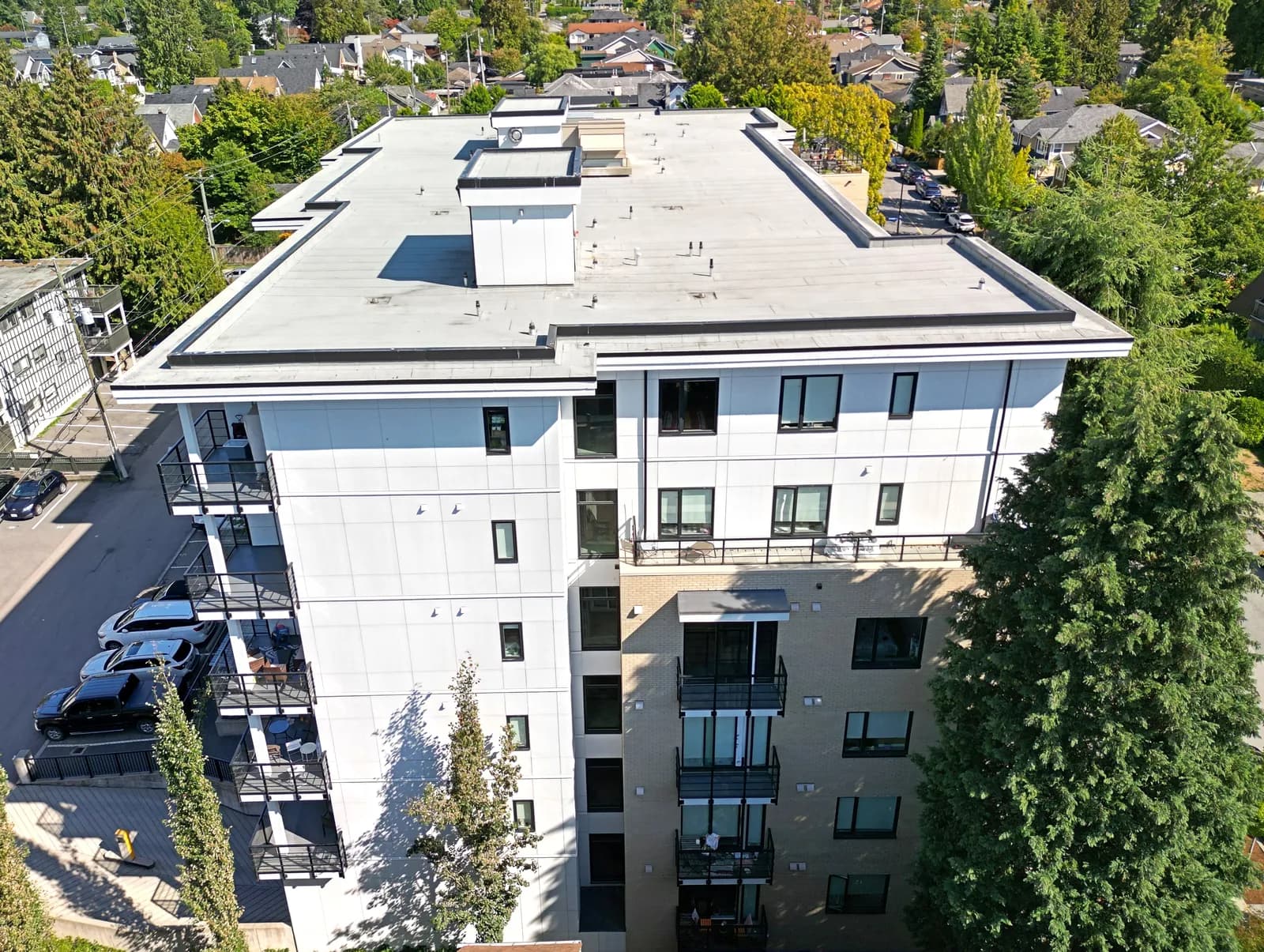
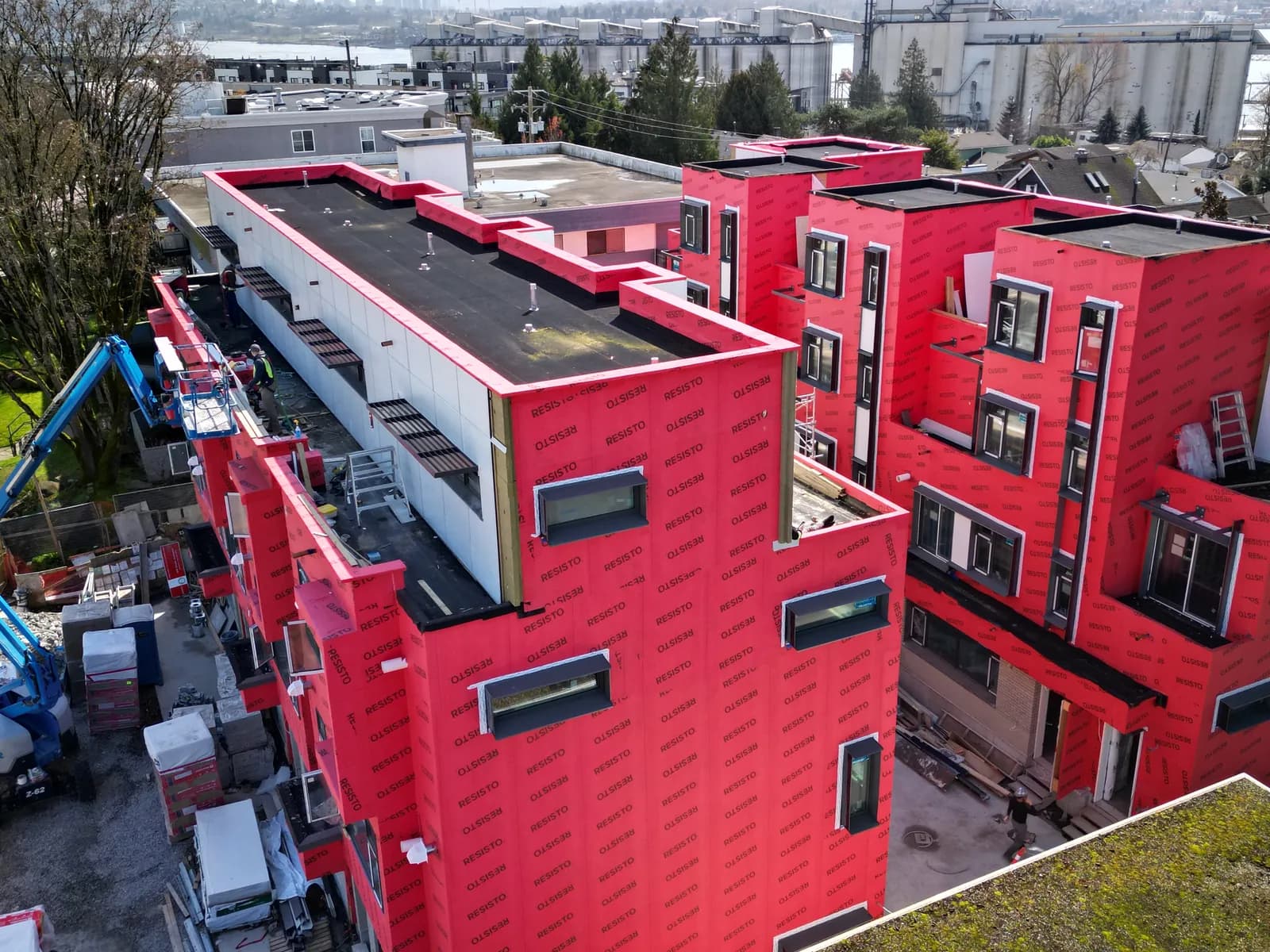
Townhome complexes along the Highway 1 and South Fraser Way corridors, and newer builds in Auguston and Highstreet. Built with rainscreen, usually with fiber cement or vinyl. The assemblies are correct on paper. The failures we find are installation ones, mostly at deck ledgers and around windows, and strata councils in these complexes are now at the depreciation-report stage where the envelope line item has real money attached.
What Fraser Valley weather actually does to each cladding
Vinyl siding is the big one because there is so much of it. It moves with temperature, about 6 mm per 3.6 m run between a January night and a July afternoon, and if the installer nailed it tight in 1996 the panels have been buckling ever since. Cold makes it brittle. A hail event or a stray branch in an outflow storm cracks it instead of denting it. South and west walls in Abbotsford East fade unevenly, so the house looks two-toned from the street by year twenty. None of that is a moisture problem on its own. The problem is that buckled vinyl opens at the laps and lets wind-driven rain reach the paper behind it, and in a house with no rainscreen that paper is the last line.
Stucco does two things here it rarely does on the coast. It spalls at the cracks, because water sits in the crack, freezes, and pops the face off the surrounding finish. And it stains at the base, where snow piles against the wall for a week in February and the parging wicks it up. On a Clearbrook rancher with original cement stucco we expect map cracking on the north wall and spalling at every crack on the south wall, because the south wall is the one that thaws by noon and refreezes at night.
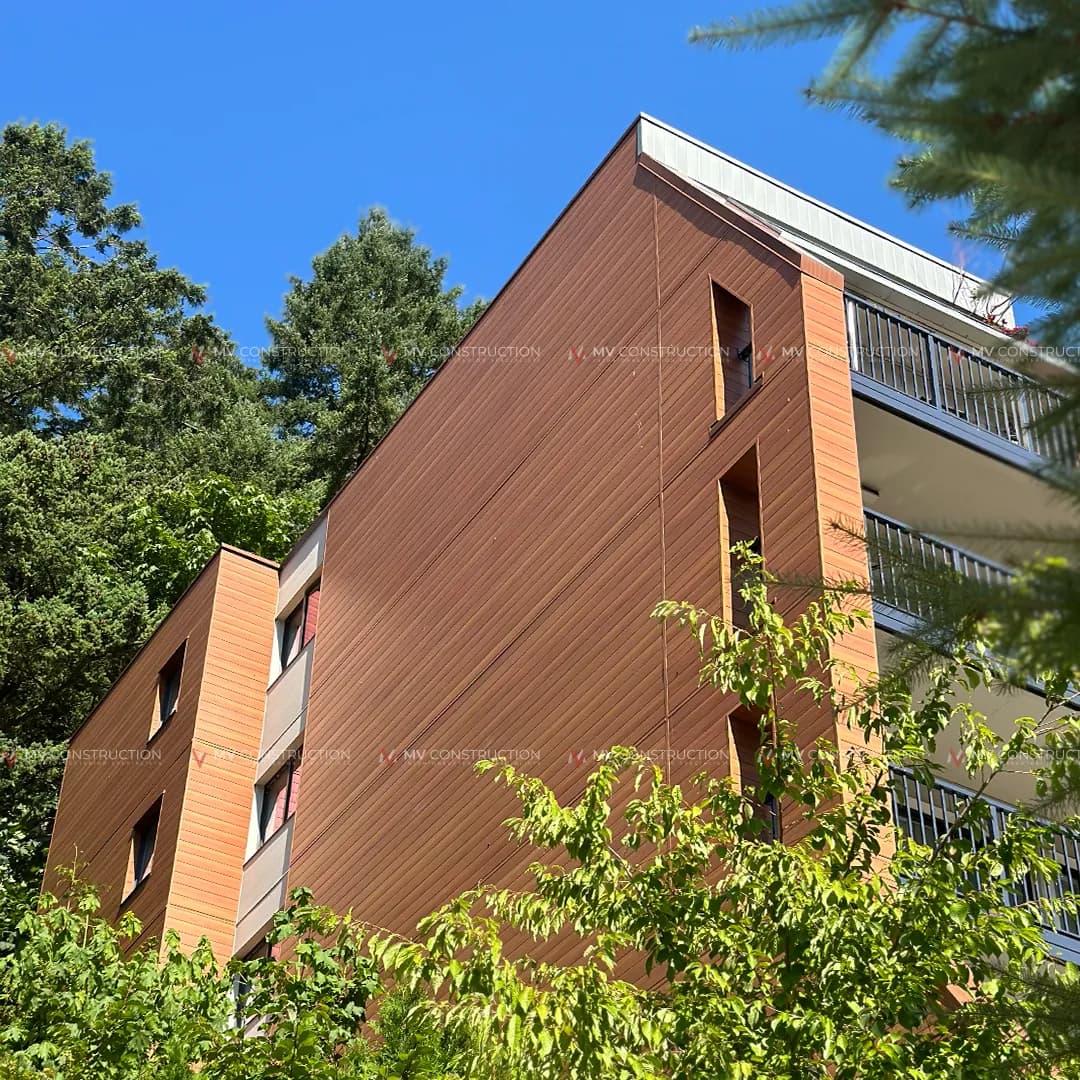
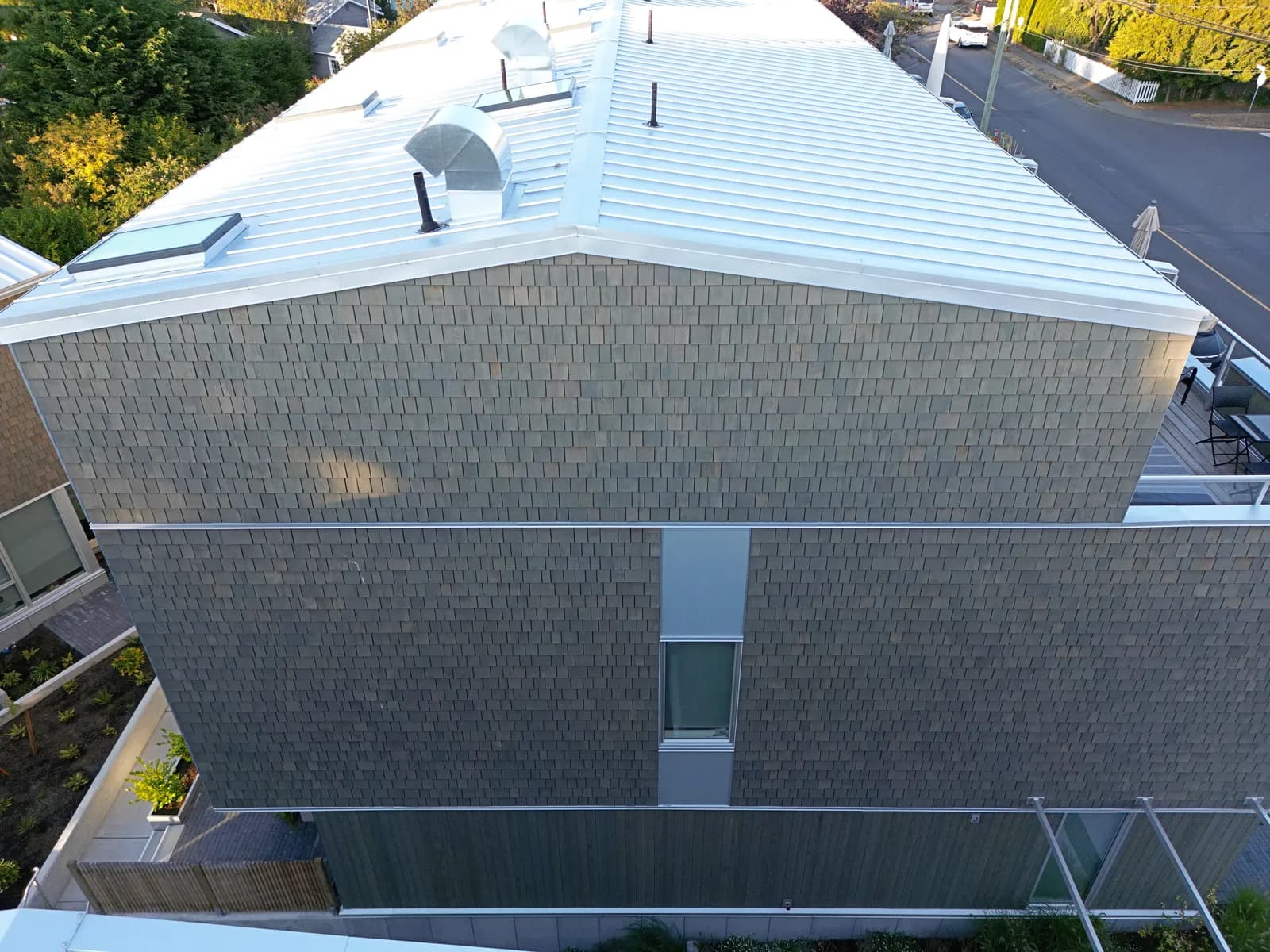
Cedar lasts surprisingly well in Abbotsford if it has been maintained. Where it fails is the north elevation, which in a Fraser Valley fall can stay damp from late September to April. Shakes go black, then soft. Re-staining every five to seven years is what keeps a cedar house alive here, and almost no one does it.
Fiber cement handles Abbotsford weather, the freeze-thaw, the heat and the UV, better than any of the above, which is why it is our default recommendation on a full re-clad. The weak points are field cuts left unprimed and butt joints without flashing behind them. Water gets into the raw edge, freezes, and the board swells. On a townhome complex in the South Fraser corridor we opened last year, roughly one board in twelve had a swollen edge, all on the north and east elevations, all at unprimed cuts.
What a re-clad costs in Abbotsford
Numbers for a typical 2,200 sq ft two-storey in Abbotsford East, based on our 2026 estimates. Vinyl-to-fiber-cement full re-clad, including strip, sheathing repair allowance, new self-adhered membrane at openings, rainscreen strapping, cladding, trim and paint: $70K to $100K. Same house to longboard-style aluminum siding: $90K to $130K. Stucco tear-off and re-do with a proper drained assembly and acrylic finish: $85K to $120K.
Partial work runs cheaper and is sometimes the right call. Elastomeric re-coat over sound stucco on a Clearbrook rancher: $12K to $20K. Single-elevation vinyl replacement after storm damage: $8K to $15K, though matching a 1990s colour is often impossible and the house ends up two-toned in a different way.
Where the money moves is the sheathing allowance. We carry $5K to $8K for it on an Abbotsford East vinyl house and $10K to $15K on a Clearbrook rancher with original stucco. Sometimes we hand most of it back. On the last three Clearbrook full re-clads we used all of it, twice on the north wall alone.
One point on value. Abbotsford detached prices sit well below Vancouver's, so a $90K re-clad is a larger fraction of the house here than the same job would be in Burnaby. It still holds. A house in Eagle Mountain with new fiber cement, new flashings and a written envelope warranty sells against neighbours with 30-year-old vinyl, and the buyer's home inspector will call out the vinyl every time. Owners who plan to stay get a wall that will not be reopened in their lifetime.
The mistake Abbotsford owners make most
They replace windows first. A vinyl-window retrofit is $15K to $25K on these houses and feels like the obvious upgrade. The installer cuts the old windows out, foams the new units in, tapes the flange to whatever paper is there, and re-caulks the vinyl siding around it. The house is tighter and no longer dries to the inside. Three winters later the cladding project we would have done anyway is now a cladding-and-sheathing project, and the windows have to come out again to get the sill pans in.
Cladding before windows, or cladding and windows in one scope. Never windows alone on a pre-rainscreen house.
Permits, floodplain and trees
Same-for-same re-cladding at the existing wall line does not normally need a building permit from the City of Abbotsford. Anything that changes the wall assembly does, and adding exterior insulation is the common trigger. Two things are specific to this city. Most of Abbotsford's land area is inside the Agricultural Land Reserve, and a house on an ALR parcel in Bradner, Mt. Lehman or Matsqui has restrictions on additions that do not apply to a Clearbrook lot. And anything on Sumas Prairie sits in a designated floodplain; the November 2021 flood changed how the city looks at flood construction levels, and a renovation that touches the foundation or lower wall on the prairie should confirm the current requirement before design.
Abbotsford's tree protection bylaw applies to trees above a set trunk diameter. Scaffold and material drops on a treed Abbotsford East lot need to be planned around them.
On the scheduling side, the working season here is shorter than the coast. Sealants and acrylic finishes need wall temperatures above 5 to 10°C depending on the product, and Abbotsford loses those temperatures in mid-November and gets them back in March. We run wrapped scaffolds so cladding continues through the outflow weather, and hold the finish coats for the next warm stretch.
A Clearbrook case, briefly
A 1974 split-level off Clearbrook Road, original cement stucco, new vinyl windows installed by another company in 2019. The owner called about staining below the living room window. We found the north wall sheathing at 28 percent moisture and soft along the bottom plate for 3 m. Scope became full stucco tear-off, sheathing replacement on the north and east walls, sill pans at every window, drained acrylic stucco system over rainscreen. Seven weeks on site, $104K all in, of which $14K was framing and sheathing that would have been $3K had the cladding been done with the windows.
Who does this work
MV Construction has done exterior renovation across Metro Vancouver and the Fraser Valley for over 17 years. We are licensed, WCB-covered and insured for both residential and strata scope, which is the paperwork an Abbotsford strata council is required to see before a contractor can set a scaffold. Every re-clad we do comes with a written warranty on workmanship, and every estimate is a written, fixed-scope document with the sheathing allowance broken out so an owner can see where the money sits. Our siding contractor and stucco and EIFS crews do the same assemblies in Abbotsford that we do on the coast, adjusted for the colder wall.
If you own a pre-rainscreen house in Clearbrook or a 1990s vinyl two-storey in Abbotsford East and want to know what is behind the wall before it becomes a bigger job, request a fixed-scope estimate or call (778) 375-5672. We can usually walk the house within a week and put the numbers in writing within ten days.