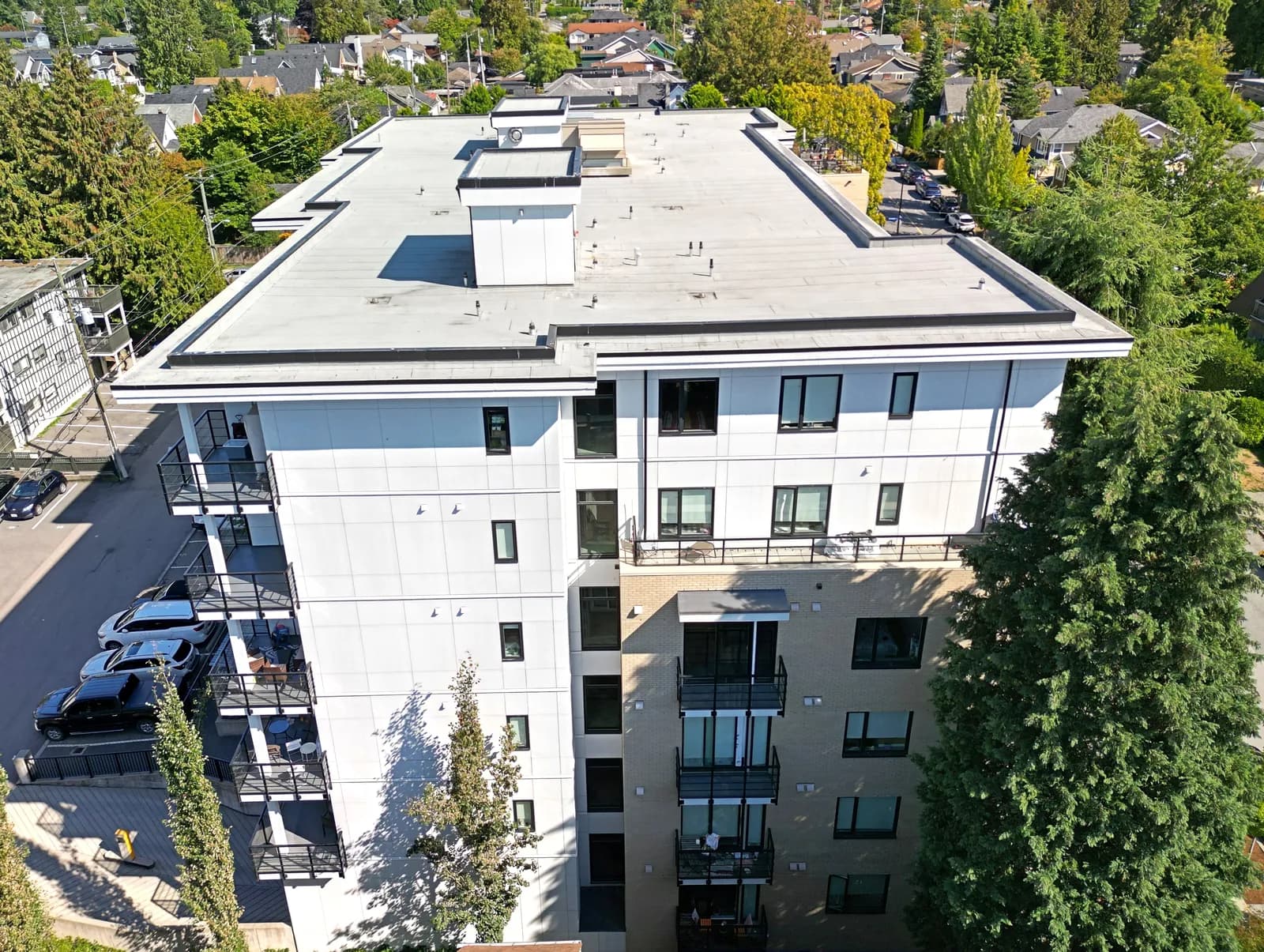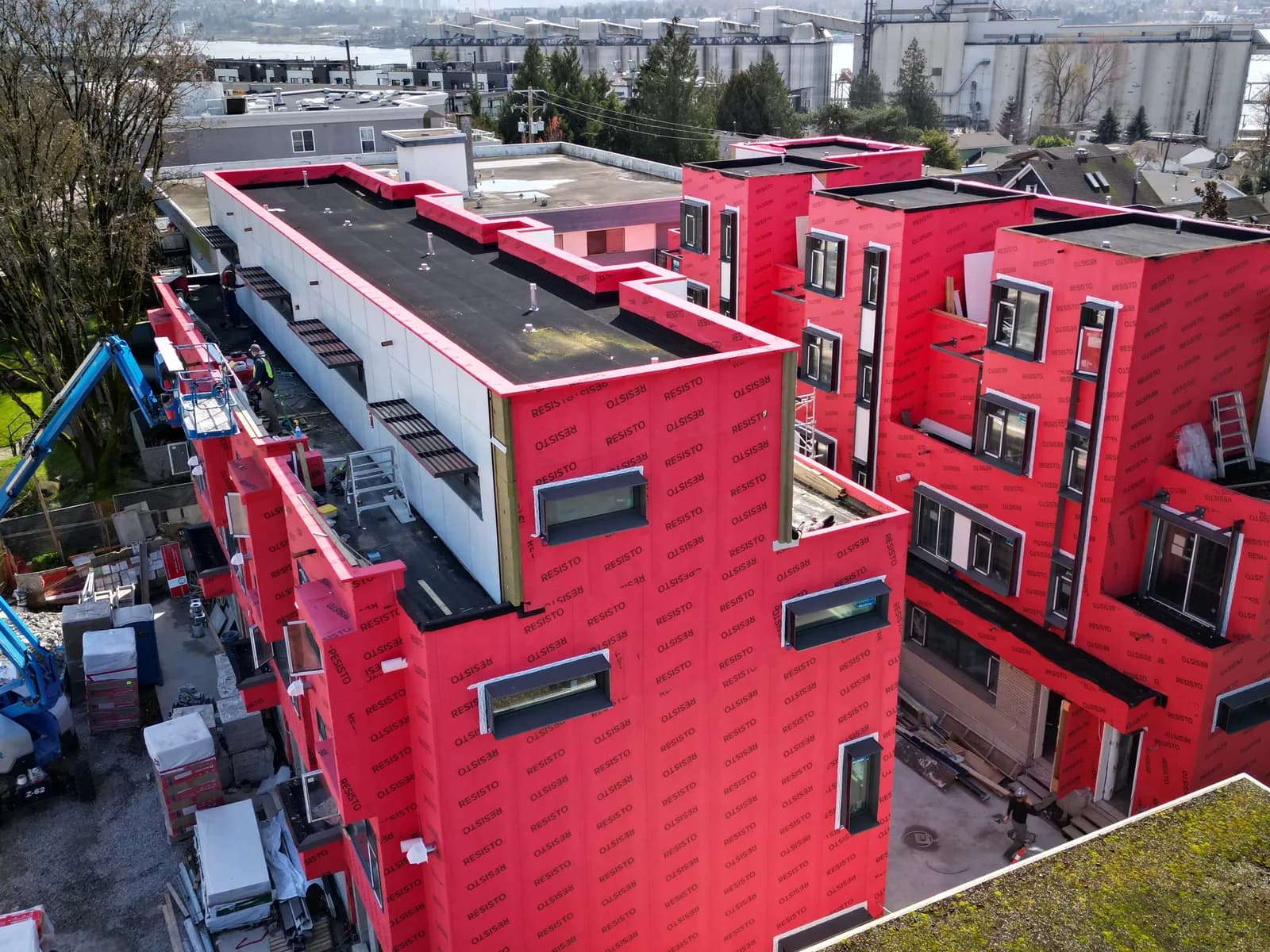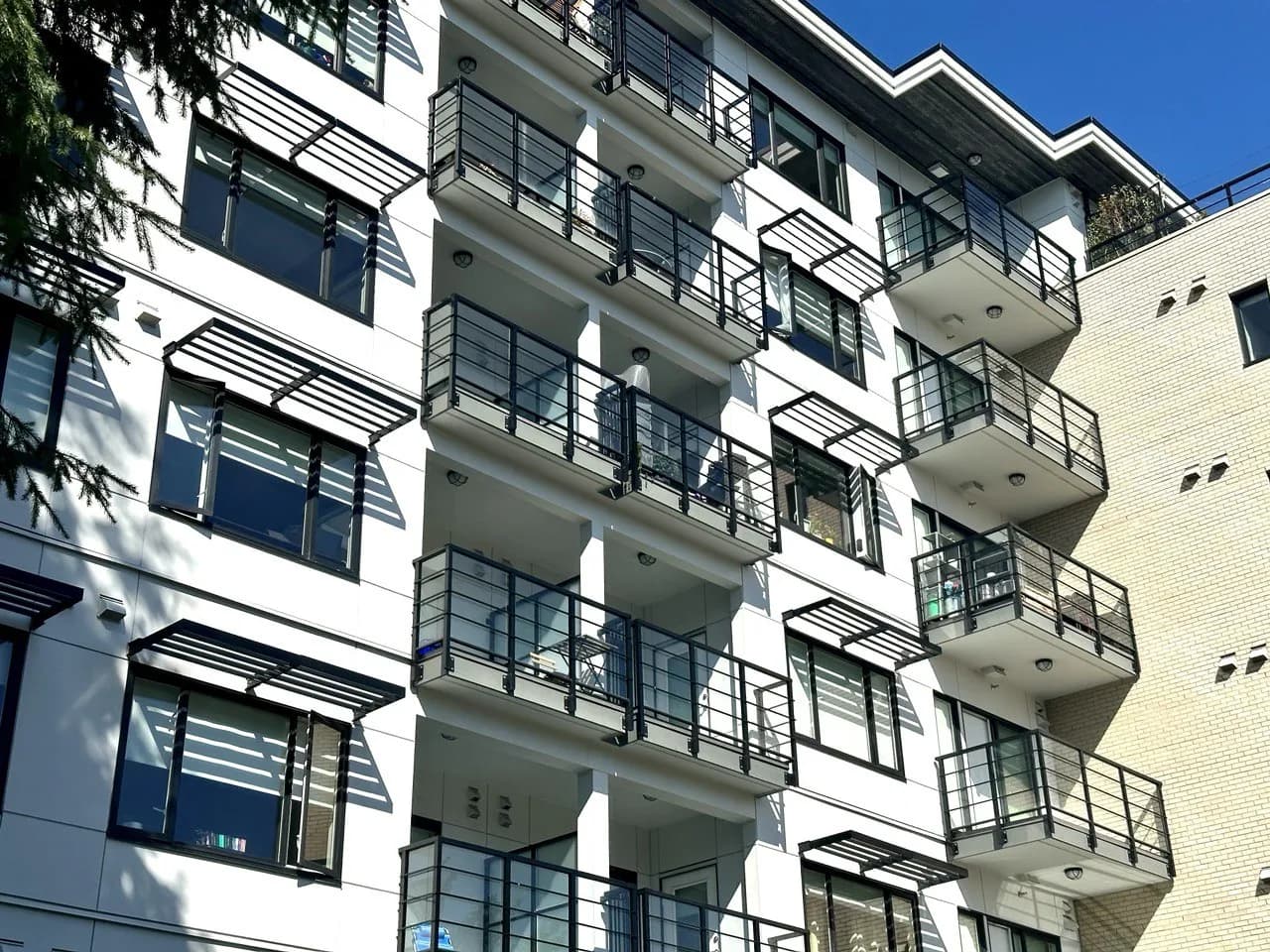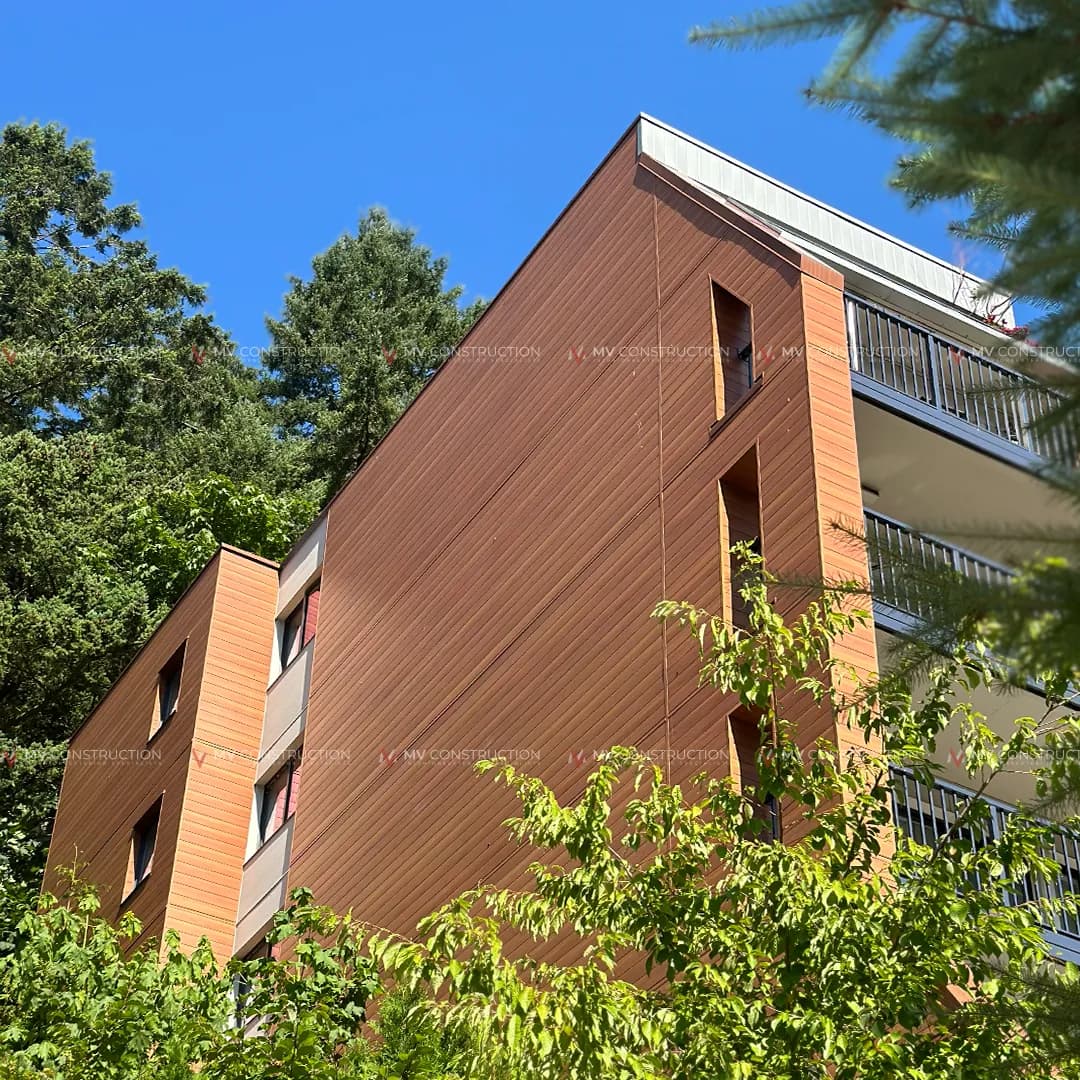
An exterior job on Vancouver Island starts before anyone touches a wall. The crew needs a ferry booking, the scaffolding needs a freight sailing, and somebody has to line up beds for a team that may be on site for two months. None of that is a reason to settle for whoever is closest. It is a reason to plan the job differently. We work as an exterior renovation contractor on Vancouver Island from our base in Delta, and this page lays out where we go, what size of project makes the trip worthwhile, and what changes once the truck rolls off at Swartz Bay or Duke Point.
Does a Lower Mainland contractor work on Vancouver Island?
Ours does, for projects large enough to justify a full crew mobilization. We take exterior renovation work from Greater Victoria and the Saanich Peninsula up through the Cowichan Valley, Nanaimo, Parksville and Qualicum Beach, and west to Port Alberni: re-clads, stucco and EIFS, masonry restoration, building envelope repair and strata projects. Farther north is case by case. Every Island job gets the same written, fixed-scope estimate as a job in Burnaby.
The service area, region by region
Vancouver Island is roughly 460 km long, and the part we cover runs along the Highway 1 and Highway 19 corridor, plus the Highway 4 spur into the Alberni Valley.
| Region | Main communities | Usual ferry route | What we see most |
|---|---|---|---|
| Greater Victoria | Victoria, Saanich, Oak Bay, Esquimalt, View Royal, Langford, Colwood | Tsawwassen to Swartz Bay | Pre-1940 homes, heritage brick, first-generation stucco |
| Saanich Peninsula | Sidney, North Saanich, Central Saanich | Tsawwassen to Swartz Bay | 1970s to 1990s homes and low-rise strata near the water |
| Cowichan Valley and Ladysmith | Duncan, North Cowichan, Chemainus, Ladysmith | Tsawwassen to Duke Point | Acreage homes, older cedar and T1-11 siding |
| Nanaimo and Oceanside | Nanaimo, Lantzville, Parksville, Qualicum Beach | Horseshoe Bay to Departure Bay, or Tsawwassen to Duke Point | 1990s townhome strata, oceanfront custom homes |
| Alberni Valley | Port Alberni | Via Nanaimo, then Highway 4 | Heavy rain exposure, stucco and EIFS |
| Comox Valley and north | Courtenay, Comox, Campbell River | Via Nanaimo | Case by case, larger scopes only |
Two of these regions have their own articles. Greater Victoria holds the oldest housing stock in the province and a separate set of heritage rules, covered in our guide to exterior restoration in Victoria and Saanich. Nanaimo's wind and salt exposure gets the same treatment in the Nanaimo exterior renovation guide. This page stays at the Island-wide level: what is common to all of it, and what separates it from mainland work.
What size of project makes sense for an Island crew
Mobilization is the honest constraint. Every Island job carries ferry fares for trucks and trailers, one or two freight sailings for scaffolding and materials, and accommodation for the crew. On a re-clad that runs six to twelve weeks, those costs spread thin across the scope. On a two-day patch they would be most of the invoice.
So we take Island work at the scale of a stucco or EIFS re-clad, a masonry restoration, envelope repair across two or more walls, or a strata project. We do not take single-crack patches or a day of caulking. We would rather tell you that on the first call than after a site visit, and for small repairs a local tradesperson is the better value.
One mistake we see owners make is comparing an off-island bid with an on-island bid without looking for the travel costs. Travel, freight and accommodation belong on their own line in any off-island estimate, so you can see exactly what the water adds. If a mainland bid comes in suspiciously close to a local one and shows no mobilization line, ask where those costs went. They usually reappear as change orders.
What changes on an Island exterior renovation
The weather is not one number
Greater Victoria sits in the rain shadow of the Olympic Mountains and gets roughly half the rain Vancouver does. Nanaimo is close to Vancouver's total but takes wind-driven rain straight off the Strait of Georgia. Port Alberni, at the head of Alberni Inlet, gets close to 2,000 mm a year, and Tofino on the west coast gets over 3,000. A wall assembly that is adequate in Oak Bay can be under-built in Port Alberni.
That changes the spec. On the drier southeast coast, the risk is slow, hidden decay: a wall stays damp at a window corner for years and nobody sees a stain until the sheathing is soft. In the Alberni Valley and on exposed walls facing the Strait, the risk is volume and pressure. The assembly needs a drained cavity, sill pans at every window and door, and flashings detailed for water that arrives sideways. Within a few hundred metres of salt water, fastener corrosion speeds up, which is why stainless fasteners on the exposed walls are line one on any waterfront scope. The building envelope remediation has to fit the microclimate, not the product brochure.
Freeze-thaw is the one factor that plays in the Island's favour. Coastal winters are milder than in Coquitlam or Maple Ridge, so mortar and stucco see fewer freeze cycles per year. Higher ground inland and up toward the Malahat is the exception.
Permits come from more desks
The Capital Regional District alone contains 13 municipalities, and permit requirements shift from one to the next. Victoria and Oak Bay add heritage review for designated buildings and heritage conservation areas. Nanaimo, Parksville and Qualicum Beach use development permit areas for waterfront and hillside lots, which can add weeks before a building permit is even reviewed. Outside municipal boundaries, in the electoral areas, permits come from the regional district: the Cowichan Valley Regional District, the Regional District of Nanaimo, or the CRD itself.
The BC Building Code is the same everywhere on the Island. The paperwork route is not. Like-for-like siding replacement on a single-family house often needs no permit, while a change to the wall assembly (adding a rainscreen cavity, replacing sheathing, adding exterior insulation) usually does. We check the route with the local building department before the schedule is set, because a development permit review moves the start date more than anything on site.
Scheduling runs on sailings and seasons
A mainland crew can pack up at three and be home for dinner. An Island crew stays with the job. That works in your favour: one mobilization, one continuous crew, and no gaps while the team gets pulled to another site across town.
The trade-off is lead time. Start dates are booked further ahead, and the best exterior season, roughly May to September, fills first. Stucco and EIFS finishes need dry weather and temperatures above about 4°C to cure properly, so winter work means tenting and heat, or waiting for spring. If you want a spring start, fall is when the estimate should be done. For strata buildings that timing lines up with AGM season, when councils put next year's projects in front of owners.
Strata buildings on the Island
Island strata corporations work under the same Strata Property Act as mainland ones. A special levy for major exterior work needs a 3/4 vote at a general meeting, and the depreciation report drives most of the scope discussion. What is different is the contractor pool. It is smaller than in Metro Vancouver, so councils in Nanaimo, Sidney and Langford often end up comparing local bids against mainland ones.
That comparison only works when the scopes match. Ask every bidder to price the same list: which elevations, which details at windows and balconies, what cladding, what warranty, and who carries WorkSafeBC coverage for the crew on site. A WorkSafeBC clearance letter takes a few minutes to request online and is worth checking on every bid, Island or mainland.
What an exterior renovation does to Island property value
Home inspectors on the Island see plenty of older stock, and a high moisture reading at a window corner goes straight into the report. In our experience, an open envelope finding rarely comes off the sale price at repair cost. Buyers price in the unknown, and the unknown always looks bigger than the invoice. A completed re-clad with a written scope, photos of the opened wall and a 10-year workmanship warranty turns that unknown into a documented item a buyer can read.
For strata buildings, the effect shows up in the paperwork buyers and their agents review: council minutes, the depreciation report and the Form B information certificate. A building with a finished envelope project and a warranty on file reads very differently from one with "envelope issues, levy pending" in last year's minutes.
A Port Alberni reference
The wettest location on our project list is Port Alberni, where we completed a stucco and EIFS exterior. That job, with its walkthrough video on our projects page, shows why EIFS keeps coming up on Island projects. The finish can match an existing building's pattern, colour and texture, and the insulation layer sits outside the structure, where it keeps the sheathing warm and dry.
In the Alberni Valley's rainfall, that only holds up as a drained system: a drainage plane behind the insulation board and flashings that carry water out at every floor line and opening. Face-sealed EIFS, the kind that failed across the Lower Mainland during the leaky condo years, does not belong in that climate. For a stucco and EIFS contractor, the drained assembly is the only version worth putting on an Island wall, whatever the local rainfall number says.
The same standards on both sides of the water
Hiring an exterior renovation contractor from the mainland for a Vancouver Island project should not mean a different standard. MV Construction is licensed, insured and WCB-covered, with more than ten years of exterior renovation across BC. Our crews self-perform the envelope trades, and every project carries a 10-year workmanship warranty. The paperwork is identical whether the building is in Surrey or Saanich: a written scope, a fixed price for that scope, and one point of contact from estimate to handover.
Getting an estimate for an Island project
Send photos of each elevation, the address, the approximate year the building went up, and anything you know about past repairs. For strata, the relevant pages of the depreciation report and any envelope consultant findings help. From photos we can usually tell you on the first call whether the scope suits an Island mobilization, then book the site visit. The written estimate typically follows the visit within 5 to 10 days.
Call (778) 375-5672 or request a fixed-scope estimate with your Vancouver Island address, and you will get a written scope you can compare line by line against any other bid.