Drive through Fairfield on a wet January morning and count the scaffolds. There are never many. That is not because the houses do not need work.
An exterior restoration in Victoria, BC runs on a different clock than the same job in Burnaby or Surrey. The buildings are older, often by forty years. The rain is lighter, often by half. Damage that would announce itself on the mainland inside five winters can sit quietly inside a Victoria wall for two decades, doing the same amount of harm at a tenth of the speed. By the time anyone opens the wall, the conversation is no longer about cladding.
What makes exterior restoration in Victoria BC different from the mainland?
Age and rainfall. Greater Victoria holds the oldest housing stock in the province, much of it built before drained wall cavities were standard practice, and the region takes roughly half the annual rain that Metro Vancouver does. That combination hides moisture damage for decades instead of forcing it into the open. Restoration here is usually about heritage rules and slow decay, not sudden envelope failure.
The stock is older, and it was built for a different climate
James Bay, Fernwood, Rockland and Fairfield carry a share of pre-1940 houses that no mainland neighbourhood comes close to. Rockland has Edwardian estates on half-acre lots. James Bay has small workers' cottages from the 1890s sitting two blocks from Edwardian rooming houses that were carved into suites sometime after the war and never fully put back.
What those walls have in common is an assembly nobody builds anymore. Board sheathing, a layer of building paper if you are lucky, stucco or shingle applied straight onto it. No cavity. No drainage plane in the sense the term is used now. The wall was designed to get wet and then dry out in both directions, and for a hundred years in a dry-summer climate, it mostly did.
Then someone insulated it. That is the part that matters and the part that gets missed. Blown-in cellulose or batts into a stud bay that was never meant to hold them stops the inward drying, and the wall loses the only mechanism keeping it alive. A good share of the rot we open up in older Victoria houses traces back to a well-intentioned energy retrofit done in the 1980s, not to the original construction.
Saanich is a different problem entirely. Gordon Head, Cordova Bay and Broadmead are mostly postwar to 1980s, which puts them squarely in the era of face-sealed stucco and sealant-dependent details. Those buildings fail faster than the pre-war stock, and they fail in the pattern the Lower Mainland learned the hard way in the 1990s.
Two municipalities, two sets of rules
People say Victoria and mean everything from Esquimalt to Cordova Bay. Thirteen municipalities share the region, and the ones that matter most for restoration scope are the City of Victoria, the District of Saanich and Oak Bay. The rules are not the same and the timelines are not the same.
In the City of Victoria, the first question on any pre-1950 property is whether it sits on the heritage register, carries a heritage designation, or falls inside a heritage conservation area. If any of those apply, exterior changes go through a heritage alteration permit before a building permit. That process has a review step with real discretion in it, and it can add six to twelve weeks. It also constrains the work: original profiles, original window proportions, matching mortar, matching trim details. The upside is that designated properties can qualify for municipal tax incentive programs, which changes the math on a large restoration.
Saanich rarely presents heritage constraints. It presents slope, trees and development permit areas instead. A re-clad on a steep Gordon Head lot can trigger review for reasons that have nothing to do with the building.
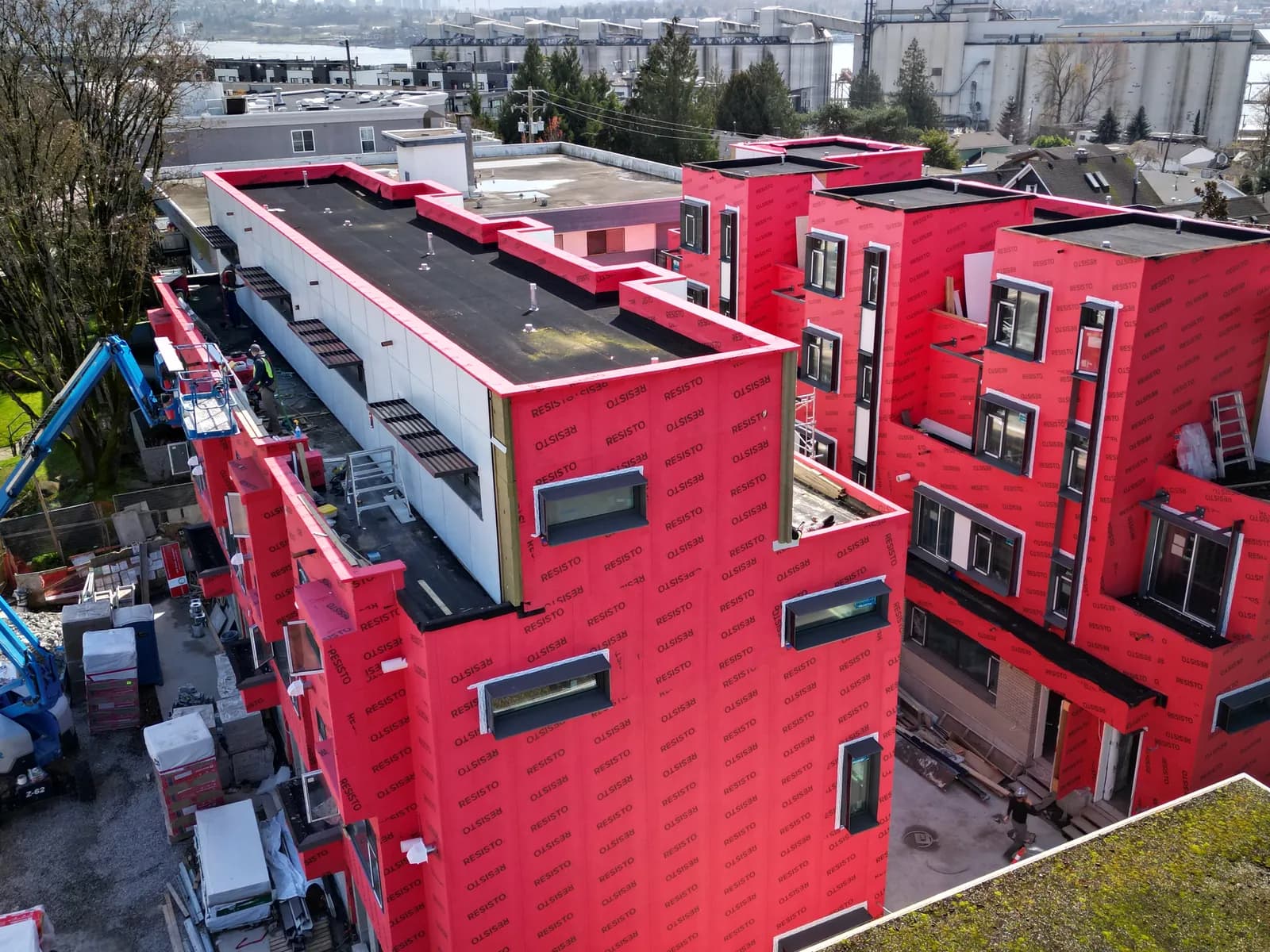
The rule that trips up owners in both municipalities is the same one. Swapping cladding for the same product on the same assembly is often a simple permit. Changing the assembly is not. Add a rainscreen cavity, add exterior insulation, alter the sheathing or the structure, and you are into a full building permit with drawings. That is not a reason to avoid the upgrade. It is a reason to know in week one rather than week six.
There is also a code point specific to this coast that is worth understanding. The BC Building Code ties its rainscreen requirement to local annual rainfall, and much of Greater Victoria sits below the threshold that makes a drained cavity mandatory. So an older Victoria wall can be code-compliant and still be an assembly nobody would build on purpose today. Compliance and performance are separate questions here in a way they are not in Vancouver.
Where Greater Victoria buildings actually fail
After enough tear-offs on the Island, the failures repeat.
Hard mortar on soft brick. This is the costliest mistake in Victoria restoration and it is almost always well-meant. Pre-1920 brick is soft and porous, and the lime mortar it was laid in was softer still, by design. The mortar is the sacrificial part of the wall. Repoint that brick with a modern high-portland mix and the mortar is now harder than the brick, so the wall's movement and freeze-thaw cycling go into the brick faces instead. You get spalling faces within a decade and a wall that cannot be repaired without replacing units. Any masonry and stone restoration on a heritage Victoria building starts with matching the original mortar, not with picking a product off a shelf.
Window heads. Pre-war openings frequently have no head flashing at all. The trim was the flashing. A hundred years of paint cycles later, it is not. Water gets in at the head and the upper corners and runs down inside the wall, which is why the stain usually shows up a floor below the leak.
Salt air. Dallas Road, Ross Bay, Cadboro Bay and Cordova Bay are a corrosion environment, not just a nice view. Fasteners, flashings, railings and hardware age at a rate that inland Saanich does not see. Specifying galvanized where stainless belongs is a twenty-year mistake made to save a few hundred dollars.
South and west elevations. Victoria summers are dry and bright. UV and heat cycling break down sealants and open stucco cracks on exposed walls years before the north side shows anything. Those cracks then take in the winter rain. Scope the sunny side harder than the shaded one, which is the reverse of what most owners expect.
Grade contact. Skirt boards, porch columns and stair stringers on older houses often sit at or below grade with a century of soil built up around them. It is a slow, contained rot, and it is cheap to fix early.
What restoration costs on the Island in 2026
Numbers first, conditions after.
A stucco re-clad with a proper drained cavity on a Greater Victoria house runs roughly $22 to $34 per square foot of wall area in 2026. Heritage brick repointing with matched mortar runs $28 to $50 per square foot depending on access and how much unit replacement the wall needs. A full building envelope restoration on a 1920s Fairfield or Oak Bay house, meaning cladding, sheathing repair, flashings, windows reset and trim rebuilt, lands between $95,000 and $190,000.
Three things move those numbers on the Island specifically. Access, because narrow lots and mature landscaping in the older neighbourhoods make scaffolding slower and sometimes rule out lifts. Heritage detailing, because matching a profile costs more than buying one. And mobilization, because any mainland contractor working Victoria is carrying ferry and accommodation costs, which is why Island work only makes sense at real project scale rather than for small repairs.
On the value side, Greater Victoria rewards exterior condition more than most BC markets. Buyers here are buying character and paying for it, and a restored, properly detailed exterior on a heritage-era house holds that premium. An unrestored one gets discounted twice: once for the visible condition, and again for the unknown behind it.
One Oak Bay example
A 1913 house near Willows Beach came to us after two rounds of spot stucco patching in six years. The owners had been told the cracking was cosmetic.
The tear-off found what we expected. The original assembly was sound where it had been left alone. Every location that had been repaired was worse than the areas nobody had touched, because the patches had sealed the face of a wall that needed to breathe outward, and a 1980s insulation retrofit had already closed off the inward path. Two window headers had gone soft. The masonry chimney had been repointed at some point with a mortar hard enough to be cracking the brick around it.
Total scope came in near the top of the range above. Had it been opened up at the first crack instead of the third patch, the window and chimney work would not have been in the budget at all.
Before you sign anything
Ask any contractor bidding your Island project for three things in writing: their WCB clearance letter, their liability coverage, and the warranty terms on both labour and materials. Then ask what happens to the price when the sheathing comes off and the scope changes, because on a hundred-year-old house it will. A contractor who cannot answer that question in writing is telling you something.
MV Construction has been doing exterior work across BC for more than ten years, fully licensed, WCB-insured and warranty-backed, on Vancouver Island as well as the Lower Mainland. We scope what we can see, we price the unknowns as named allowances instead of hiding them, and we put the whole thing in writing before anyone touches the building.
If you are planning restoration work in Victoria, Saanich or Oak Bay, call (778) 375-5672 or request a fixed-scope estimate. We will walk the building with you and tell you what we find, including the parts that can wait.