Nanaimo's harbour front takes a full winter of Strait of Georgia gales, and thirty kilometres south the same weather shows up half an hour later at Ladysmith. As a renovation contractor working Nanaimo and central Vancouver Island, we have quoted enough Departure Bay bungalows and North Nanaimo townhomes to know the failure pattern is almost never rain volume. Nanaimo averages 1,150 mm a year, less than Vancouver. The failures come from wind-driven rain that hits west and southwest walls sideways for weeks, salt aerosol that pits fasteners, and forty-year-old cedar shakes that never dried out between systems. When a Departure Bay owner calls saying the west wall smells musty every February, we are usually opening the same three details.
What makes Nanaimo exterior renovations different from mainland work?
Coastal exposure changes what fails first. Nanaimo homes take wind-driven rain from the Strait of Georgia at 40 to 60 km/h through winter storms, salt aerosol carries several hundred metres inland, and older subdivisions like Departure Bay and Old City Quarter still sit under cedar shakes or first-generation stucco with no drainage plane. Envelope repair on Vancouver Island is less about rainfall total and more about wind pressure, salt corrosion, and older wall assemblies that never had a capillary break behind the cladding.
The Nanaimo build eras we work on
Old City Quarter, Departure Bay, and Harewood host the 1950s to early 80s single-family stock. Cedar shake or T1-11 plywood on tarpaper. Some houses have been re-stuccoed once over the original assembly, which traps moisture worse than the shakes did alone. On a 1972 Harewood house last spring we pulled off newer stucco and found the original 1970s cedar still under it, blackened where the west-facing sill plate had wicked for forty years. The scope was a full re-clad, not a patch.
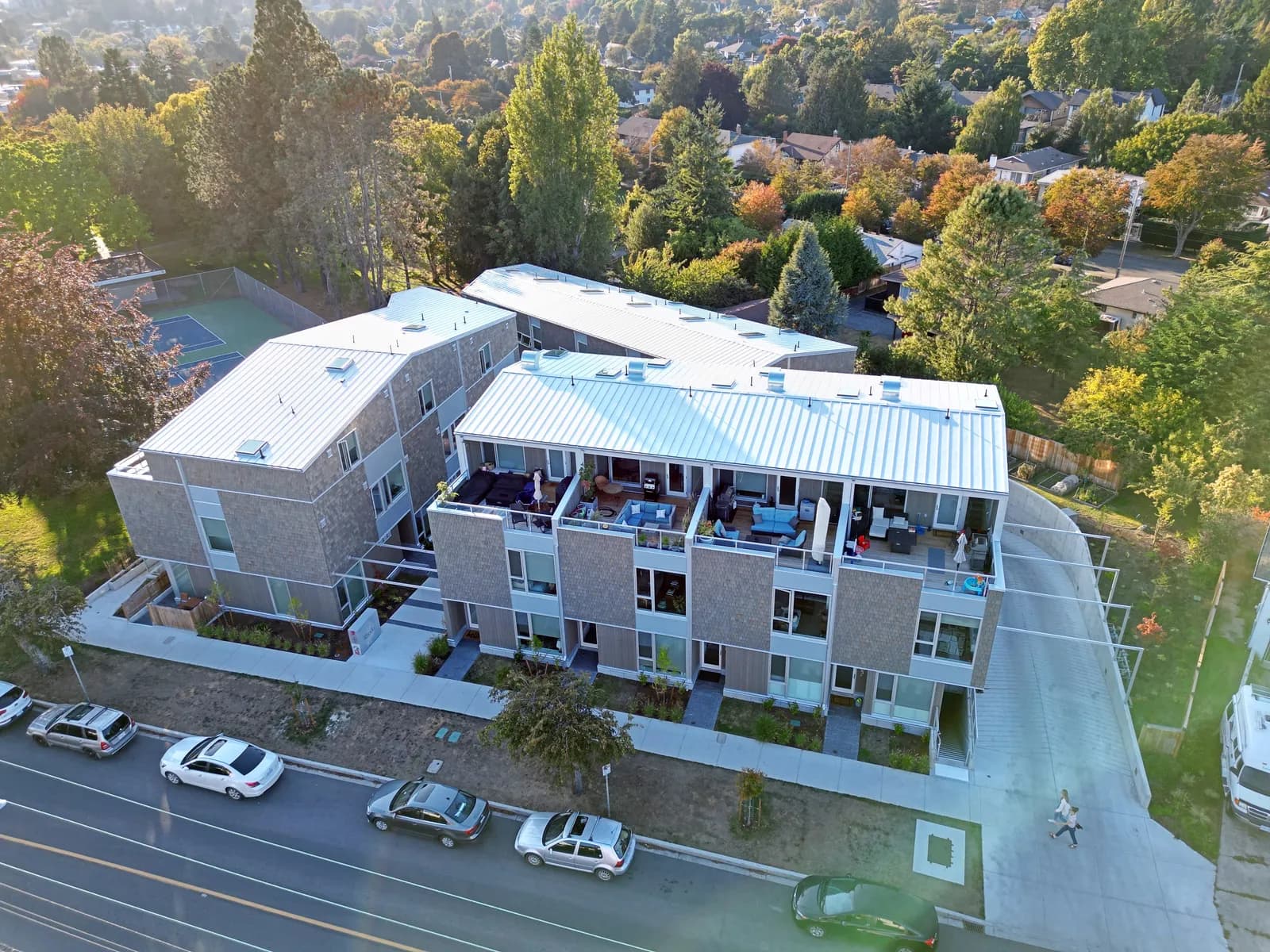
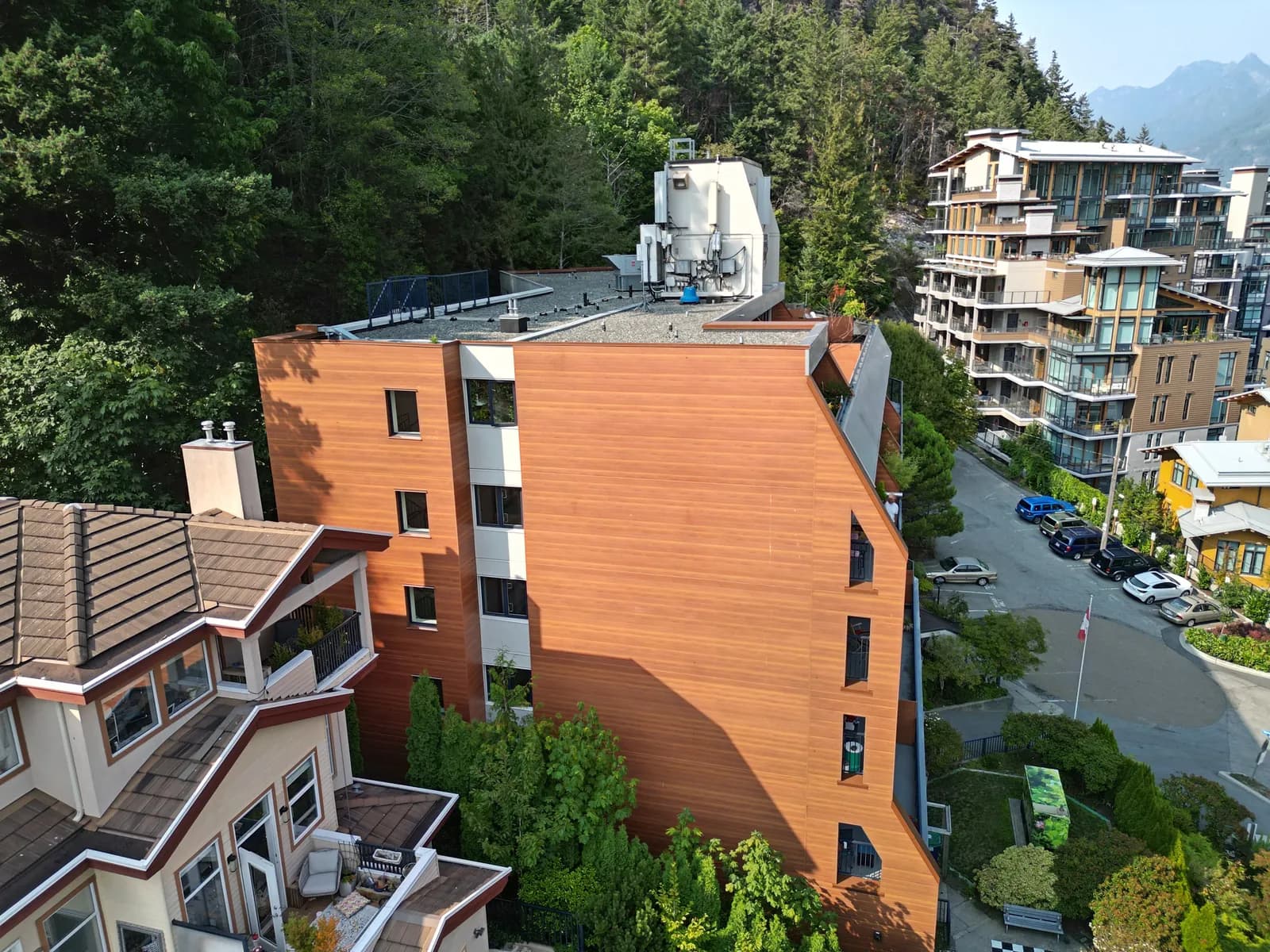
Downtown Nanaimo condos and mid-90s townhomes in Diver Lake and Hammond Bay sit in the same leaky-condo timeline as the mainland, and the same repair pattern applies: partial rainscreen retrofits on the exposed walls, full membrane and window flashing replacement, and cladding upgrade to fibre cement or engineered wood. Owners often want to keep the two protected walls original to control cost. That decision is defensible on Vancouver Island where wind direction is predictable.
North Nanaimo, University District, and Chase River went up from 2005 onward. Rainscreen is present. The failures are installation errors on the same details we see in Metro Vancouver's newer subdivisions: reverse-lapped step flashings at gable-to-wall junctions, sill pans skipped at french doors that open onto ocean-view decks, and ledger boards flashed short. The University District infill near Vancouver Island University has the tightest concentration of these calls because framing crews rotated fast during the 2015 to 2020 build wave.
What coastal exposure actually does to your exterior
Wind-driven rain is the difference. In Vancouver a 20 mm rain event drops water on wall surfaces roughly vertically, and a good drip cap sheds most of it. In Nanaimo the same 20 mm event with a 50 km/h southeast wind pushes water horizontally into every seam that faces the Strait. A stucco crack that would stay cosmetic on a Burnaby house becomes a moisture path on a Departure Bay wall within one winter. Wind pressure also drives water past caulking that is technically intact, because caulk seals gaps but does not resist positive pressure from behind the cladding.
Salt aerosol adds a second problem. Nanaimo homes within five hundred metres of Georgia Strait see fastener corrosion on standard galvanized nails at year twelve to fifteen, versus twenty-five to thirty on inland houses. Cedar shingle assemblies with copper or stainless fasteners hold up. Vinyl and aluminum trim with common galvanized screws start staining and backing out within a decade. On a Hammond Bay re-clad two years ago we pulled a 2011 house down to sheathing and every fastener in the exposed corners was rusted through the head, even though the siding still looked fine from the street.
The third factor is temperature. Nanaimo winters run milder than the mainland, so freeze-thaw cycles happen fewer times per year, and ice damage to stucco and mortar is less common than in Coquitlam or Maple Ridge. That is one item in the Vancouver Island renovation column that plays in the owner's favour.
Which repairs actually save money on Vancouver Island
Full rainscreen re-clad on the two exposed walls, patch and repaint on the sheltered walls. This is the pattern that works for pre-2000 Nanaimo houses. West and southwest walls take the weather. North and east walls on most Nanaimo lots are protected by neighbours, trees, or the house's own footprint. Doing the full envelope on all four sides makes sense on a heritage building or a strata that needs matched aesthetics. On a single-family Departure Bay home, a two-wall scope with matched cladding on the remaining walls saves twenty to thirty percent of the exterior renovation budget and puts the repair where the risk lives.
Window and door flashings at every opening, even if the surrounding cladding stays. Skipping windows to save on the estimate is the single most common mistake we see when quoting against cheaper bids. A new window that reuses old flashing pans is a five-year fix. The building envelope work has to include flashing replacement or the assembly will fail at the openings first.
Fastener upgrade to stainless on any wall within one kilometre of salt water. This costs a few hundred dollars extra per house and buys another twenty years of paint-only maintenance. When we scope a Nanaimo re-clad, stainless fasteners on the exposed walls are line one.
Permits, DPAs, and the Nanaimo timeline
The City of Nanaimo requires a building permit for envelope work that changes the wall assembly, and most re-clad and rainscreen retrofit projects qualify. Simple like-for-like siding replacement on a single-family home usually does not need a permit, but any change to the assembly (adding rainscreen, changing insulation depth, replacing sheathing) does. Nanaimo's Development Permit Areas cover the harbour frontage, several downtown blocks, and hillside slopes above Departure Bay. Homes inside those DPAs need a Development Permit before the building permit, which adds four to eight weeks on top of the standard three-week building permit review.
Strata renovations in North Nanaimo and the University District follow the same BC Strata Property Act rules as mainland strata. A depreciation report is required, three quotes are the norm, and a 3/4 vote at a special general meeting is required for a major expense over the contingency reserve. Our quotes for strata exterior renovation work on Vancouver Island run through the same fixed-scope written estimate process we use on the mainland.
Ladysmith, Parksville, and Qualicum Beach have their own municipal permit desks. Response times vary. Ladysmith is fast (two to three weeks on a straightforward envelope permit). Parksville and Qualicum both add oceanfront development permit requirements for anything on the water side of the Island Highway.
A Departure Bay case study
A 1978 rancher on the west side of Departure Bay Road called us for a re-stucco quote after two winters of interior mildew in the living room. The owner had a cheaper quote to spot-repair the cracks and repaint. On the site visit we found soft sheathing at the west-facing window, a chimney chase that had been flashed with roofing tar in the 90s, and the original tar paper under the stucco was in flakes.
The scope we quoted: strip stucco on the west and south walls to sheathing, replace 40 percent of the sheathing, install rainscreen with modern housewrap, new flashings at all openings and the chimney, stainless fasteners throughout, and re-stucco with a modern acrylic finish. North and east walls got crack repair, caulking, and repaint only. Total scope: 11 weeks, mid-six figures.
The owner reported dry interior walls through the following winter. The two protected walls needed nothing beyond paint. That two-wall discipline is what makes Vancouver Island envelope work affordable when the alternative is a full four-wall re-do on a 2,400 square foot house.
Working with an off-island contractor
MV Construction is based in the Lower Mainland and travels for Vancouver Island projects that meet a minimum scope. Ferry logistics and crew accommodations mean small repair jobs are not economical for us, and we recommend local Nanaimo contractors for anything under a certain project size. For envelope re-clads, full exterior renovations, and strata projects on Vancouver Island, our fixed-scope pricing typically comes in tighter than three-quote mainland comparisons because we schedule the crew in a single mobilization rather than spreading across multiple sites.
We are fully licensed, WCB-insured, and have been doing exterior renovation work in BC for over a decade. Every project comes with a written scope estimate and a workmanship warranty on the envelope assembly. The written estimate is the same document on Vancouver Island as on the mainland.
Getting a fixed-scope estimate
Send us photos of the exterior walls, the addresses of anywhere you have seen water damage inside, and any documentation from the previous owner or strata about past repairs. We can do a preliminary scope from photos and schedule the site visit around a mainland mobilization. Call 778-375-5672 or request a fixed-scope estimate with your Nanaimo, Ladysmith, Parksville, or Qualicum address, and we will get a written response back within a week.