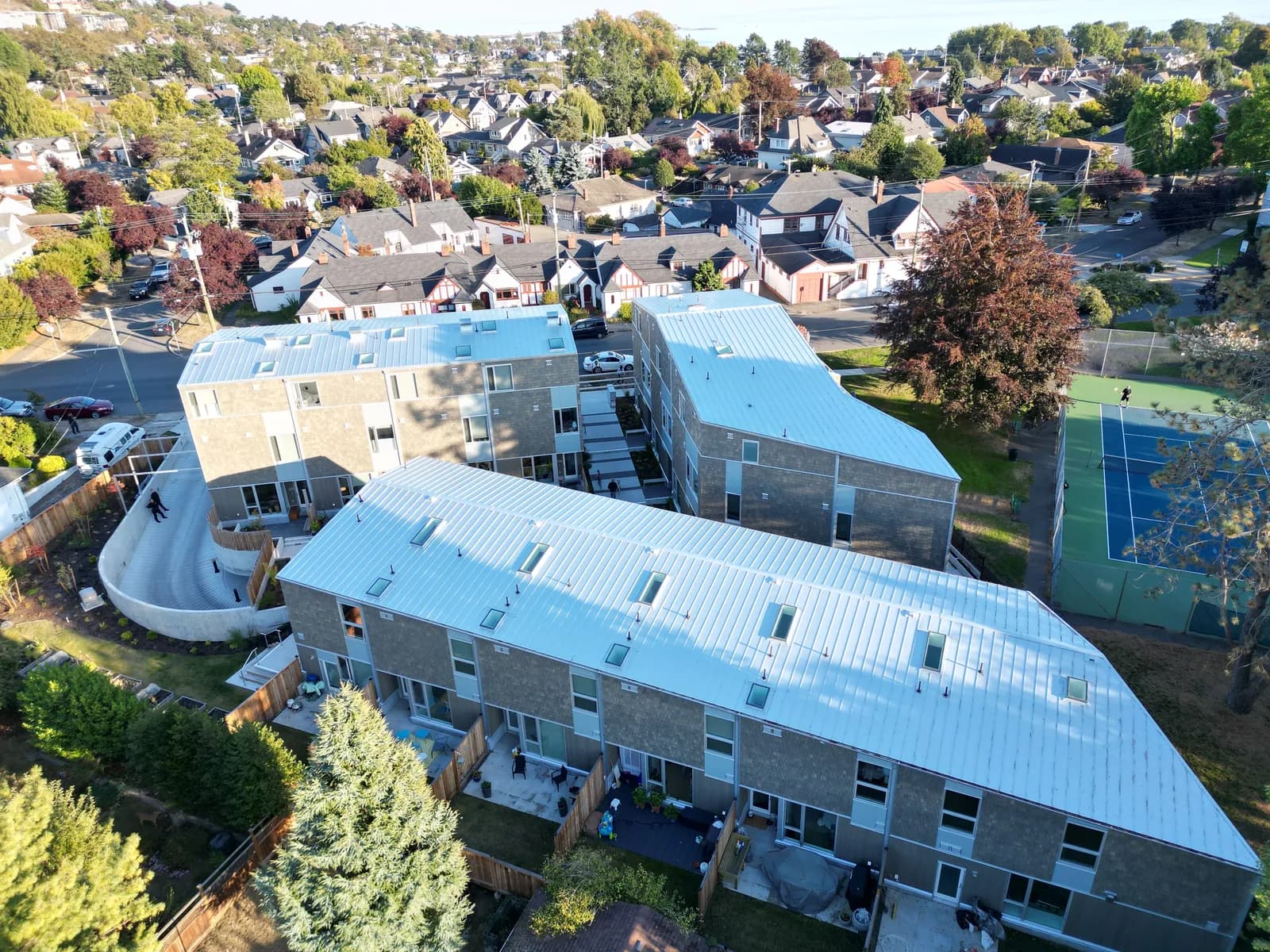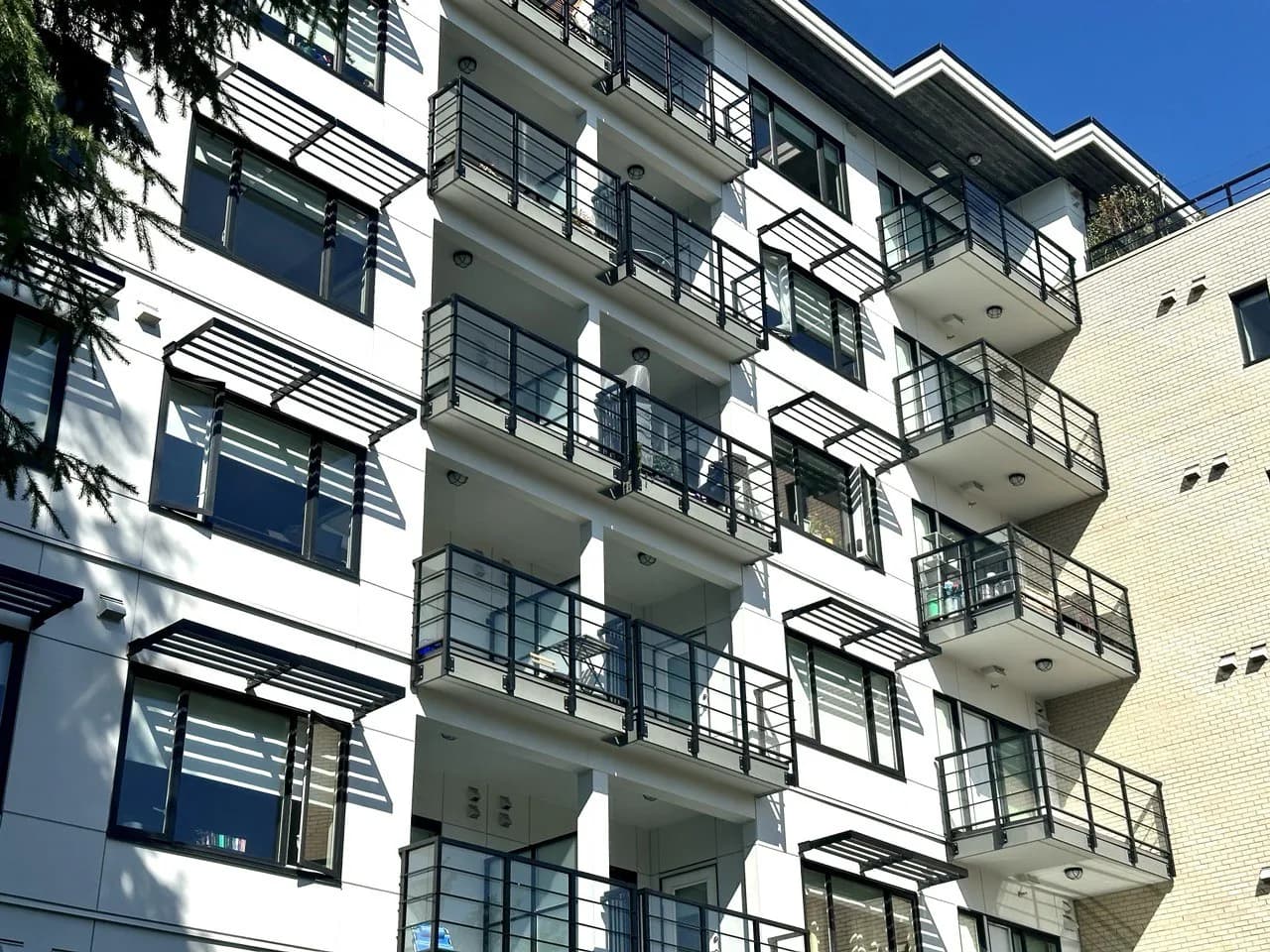
The call usually starts with a ceiling. An owner in unit 304 notices a brown ring above the bedroom window, photographs it, and emails the property manager. By the time we are on site three days later, the ring has doubled and the owner above has remembered that her balcony drain has been slow since spring. Nobody has done anything wrong yet. But four separate parties now have money at stake, and strata water damage in BC has a habit of getting expensive in the gap between them while everyone waits to find out who is responsible.
This is what actually happens, in what order, and who ends up paying for each piece.
Who pays for water damage in a BC strata?
The strata corporation's insurance covers damage to the building, including the inside of units, above the deductible. The strata corporation pays to repair the source if it sits in common property, which under the Standard Bylaws includes the exterior, roof, windows and balconies. The owner pays for damage inside their own strata lot below the deductible, for their own improvements, and for the source if it is theirs, such as a failed dishwasher hose.
That is the short version. The detail is where the arguments live.
The first 48 hours decide the size of the claim
Water does not wait for a council meeting. Gypsum board wicks moisture upward roughly 300 mm in the first day, insulation in a wall cavity holds it far longer, and mould growth on paper-faced drywall can start within 24 to 48 hours at normal indoor temperatures. A leak that would have been a $9,000 repair on day one is a $40,000 repair on day ten, and by then the claim has crossed most deductibles.
Three things need to happen immediately, and none of them require knowing who pays.
Stop or divert the water. Tarps, a temporary flashing, a plugged scupper cleared, a shut-off valve closed. Emergency mitigation is a common expense in almost every strata, and no insurer penalises a council for acting fast.
Get the drying started. Restoration crews set containment, remove saturated finishes and run air movers and dehumidifiers for three to five days with daily moisture logging. Those logs matter later, both for the insurer and for any dispute at the Civil Resolution Tribunal.
Document the entry point before it is repaired. Photographs, moisture readings, the date and the weather. Once a window is re-flashed and the wall closed, the evidence about where the water came from is gone, and with it the ability to assign cost with any confidence.
Where the water entered decides who pays
Under Section 149 of the Strata Property Act, the strata corporation must insure the common property, common assets, the buildings shown on the strata plan and fixtures built by the owner developer. That policy is what responds to a significant loss, whether the water came through the roof or through a unit's plumbing.
Repair responsibility is a different question from insurance, and it is set by the bylaws. Under Standard Bylaw 8, the strata corporation repairs and maintains common property, and in most strata plans that expressly includes the structure and exterior of the building, doors and windows on the exterior, and balconies. Standard Bylaw 2 puts repair and maintenance of everything inside the strata lot on the owner. Your building may have amended these, so read your registered bylaws rather than the standard ones.
In practice, the entry points we find in Metro Vancouver buildings fall into a fairly short list.
Balcony and deck membranes, usually at the door sill or where the membrane meets the guardrail post penetration. Common property, strata pays.
Window and door perimeters, where the original flashing was face-sealed with caulking rather than lapped into the water-resistive barrier. Common property in most bylaws, strata pays.
Roof and parapet details, including scuppers and drains blocked with needles from the Douglas firs the developer left in place. Common property, strata pays.
Cladding and the wall assembly behind it, which on a 1985 to 2005 building often has no drained cavity at all. Common property, strata pays, and this is the one that turns into a full envelope project.
In-suite plumbing, hoses, tanks and appliances. The owner's responsibility, and the owner is usually the one holding the deductible.
Mixed cases are common. A slow balcony drain that overflows into a wall is a strata issue. The same drain blocked by a planter box the owner installed against the bylaws is an argument, and those go to the Civil Resolution Tribunal more often than anyone would like.
The deductible is the number that actually matters
Since the 2019 to 2020 hard market, water damage deductibles on BC strata policies have not come back down much. Low-rise buildings with a clean claims history commonly carry $25,000 to $50,000 on water damage. Buildings with two or three claims in five years are seeing $100,000, and some Metro Vancouver high-rises sit at $250,000 or higher.
Two consequences follow from that.
Most water losses now fall entirely below the deductible. A single unit with a wet ceiling, wet drywall down one wall and damaged flooring is a $20,000 to $45,000 restoration. If the deductible is $50,000, no claim is made, and the cost is paid out of the strata's operating budget or contingency reserve fund, or charged back to an owner under the bylaws.
Section 158 of the Strata Property Act makes the deductible a common expense, but allows the strata corporation to sue an owner to recover it if the owner is responsible for the loss. Many strata corporations have also adopted chargeback bylaws that reach the same result faster. This is why an owner's personal condo policy matters: the loss assessment and deductible coverage in it is what stands between the owner and a five-figure invoice. Coverage of $50,000 was adequate five years ago and is not adequate now in many buildings.
None of this is legal advice. When real money is in dispute, a strata lawyer costs less than the argument.
The repair nobody budgets for is the cause
Insurance pays to put the building back the way it was. It does not pay to fix the reason the water got in, and it does not pay to correct an original construction detail that was never right.
That distinction produces the most common failure we see: the unit is restored beautifully, painted, re-floored, signed off, and the same wall is wet again the following November. The strata has spent $38,000 and still has the leak.
Finding the cause takes work. On a repeat leak we start with a review of the assembly drawings if they exist, then targeted water testing on the suspect openings, usually a hose test on the ASTM E1105 pattern, and inspection openings cut in the wall at high-risk locations. An investigation on a mid-size building runs $3,000 to $9,000. Compared to a second restoration, it is cheap. Our overview of building envelope repair and remediation covers what that investigation looks for.
The other thing councils underestimate is scope creep in the honest direction. Open a wall below a leaking window on a 1994 wood-frame building and there is a fair chance the sheathing is soft two metres either side of the opening. That is not the restoration contractor inflating the job. That is the actual condition of the wall, and it is better found now, while the scaffolding is already up, than in the next depreciation report cycle.
What a realistic timeline looks like
For a single-unit loss with a known source: emergency mitigation same day, drying three to five days, source repair one to two weeks depending on weather and access, interior rebuild two to four weeks. Six weeks from stain to finished, if the council can approve work without waiting for a general meeting.
For a loss that turns out to be an envelope problem: investigation two to four weeks, engineer's report and scope another three to six weeks, tendering and council or general meeting approval four to twelve weeks, then the work itself. Buildings routinely take six to nine months from the first ceiling stain to a signed contract. Delegating emergency and investigative spending authority to the council in advance is the single change that compresses this most.
MV Construction has worked on multi-family and strata buildings across Greater Vancouver and Vancouver Island for more than 17 years, from Coquitlam townhome complexes to concrete towers in Burnaby. We are fully licensed and WCB-insured, we carry the documentation property managers need before a crew sets foot on site, and our workmanship is warranty-backed. On water ingress we price the investigation and the repair as separate, written, fixed-scope items, so a council can approve finding the cause without committing to a number nobody can yet defend.
If your building has a stain that has come back more than once, or a restoration and remediation project stalled between the insurer and the council, call (778) 375-5672 or request a fixed-scope estimate. Bring the photos and the dates. They tell us more than the drawings do.