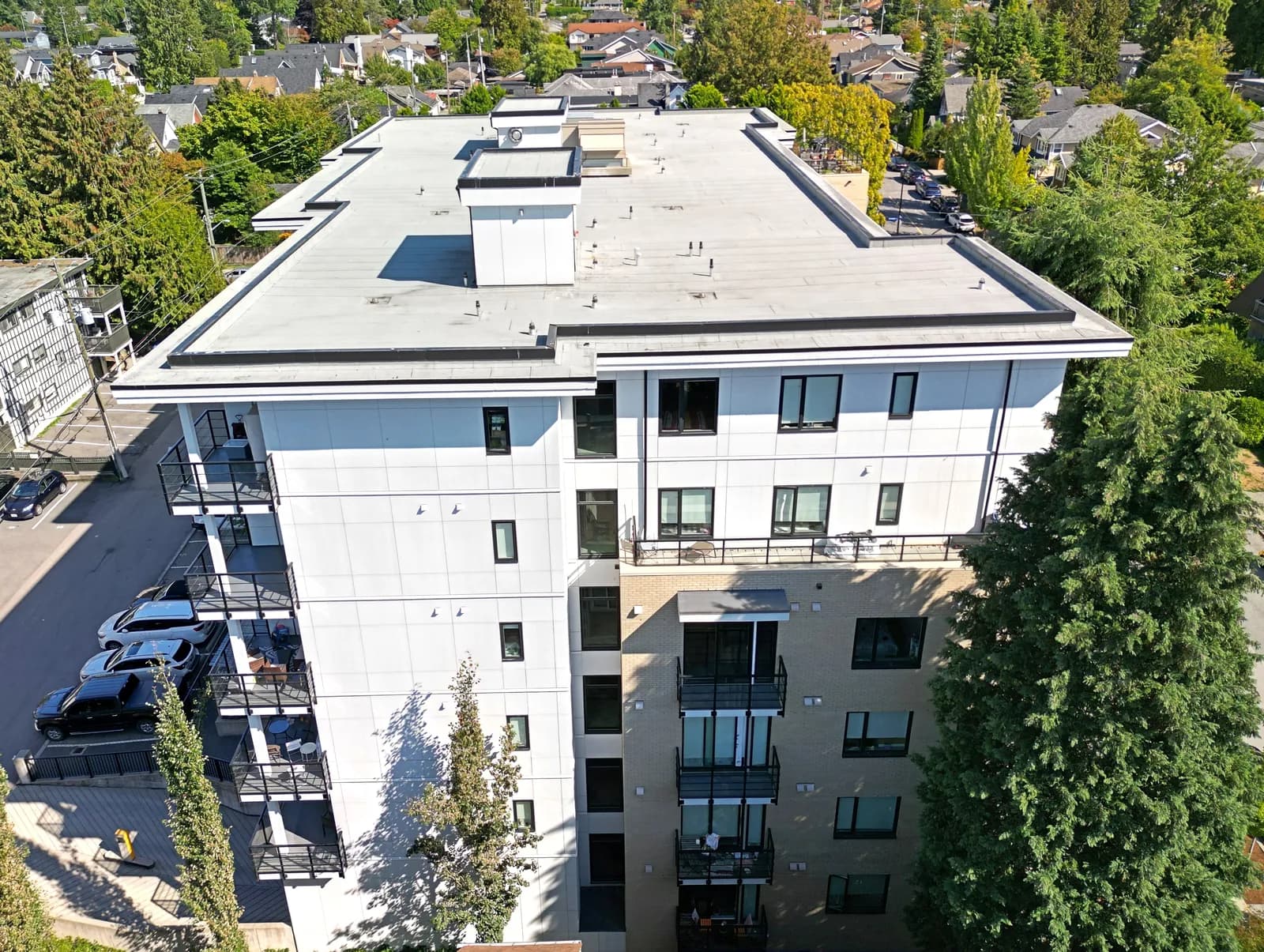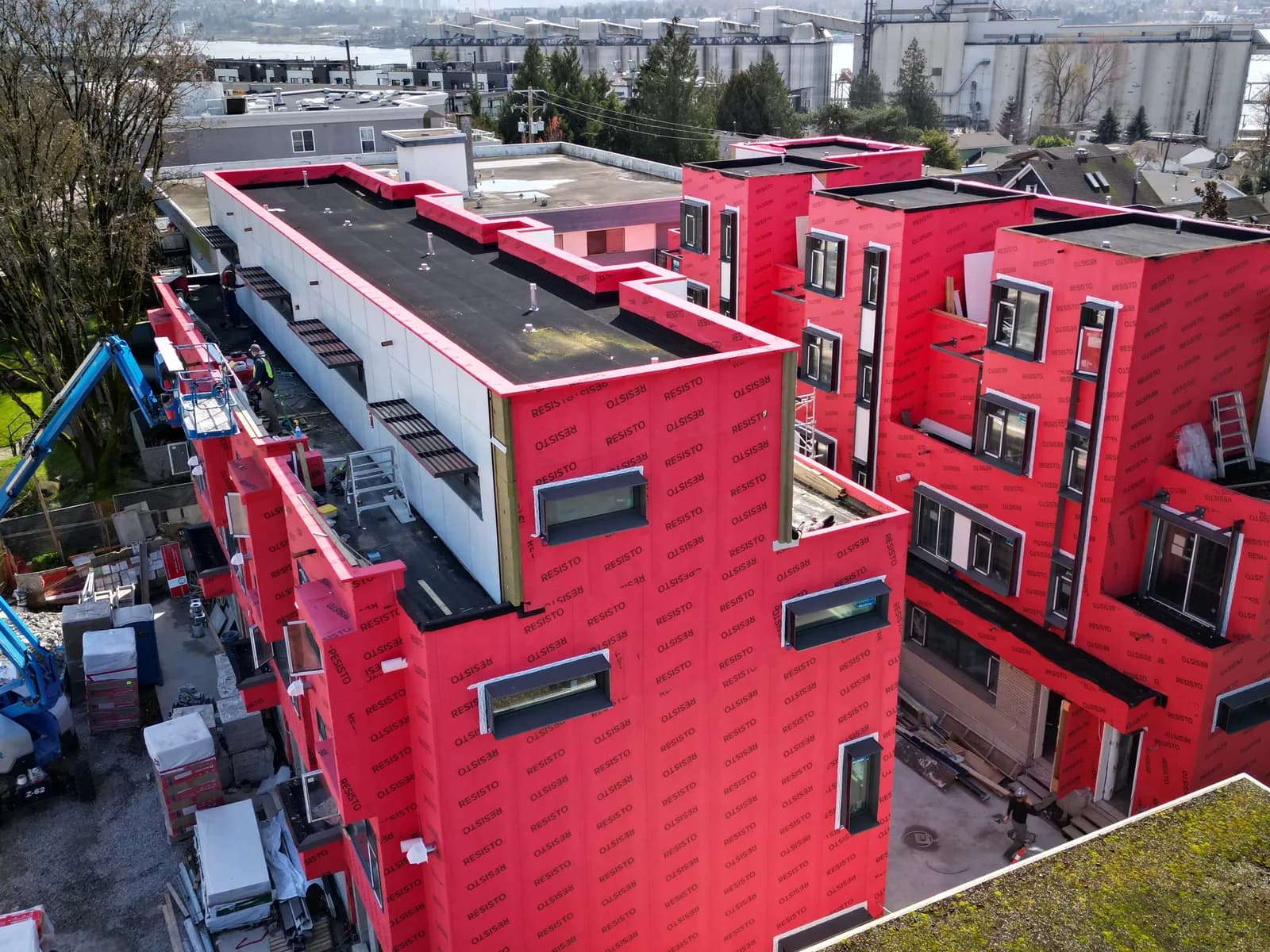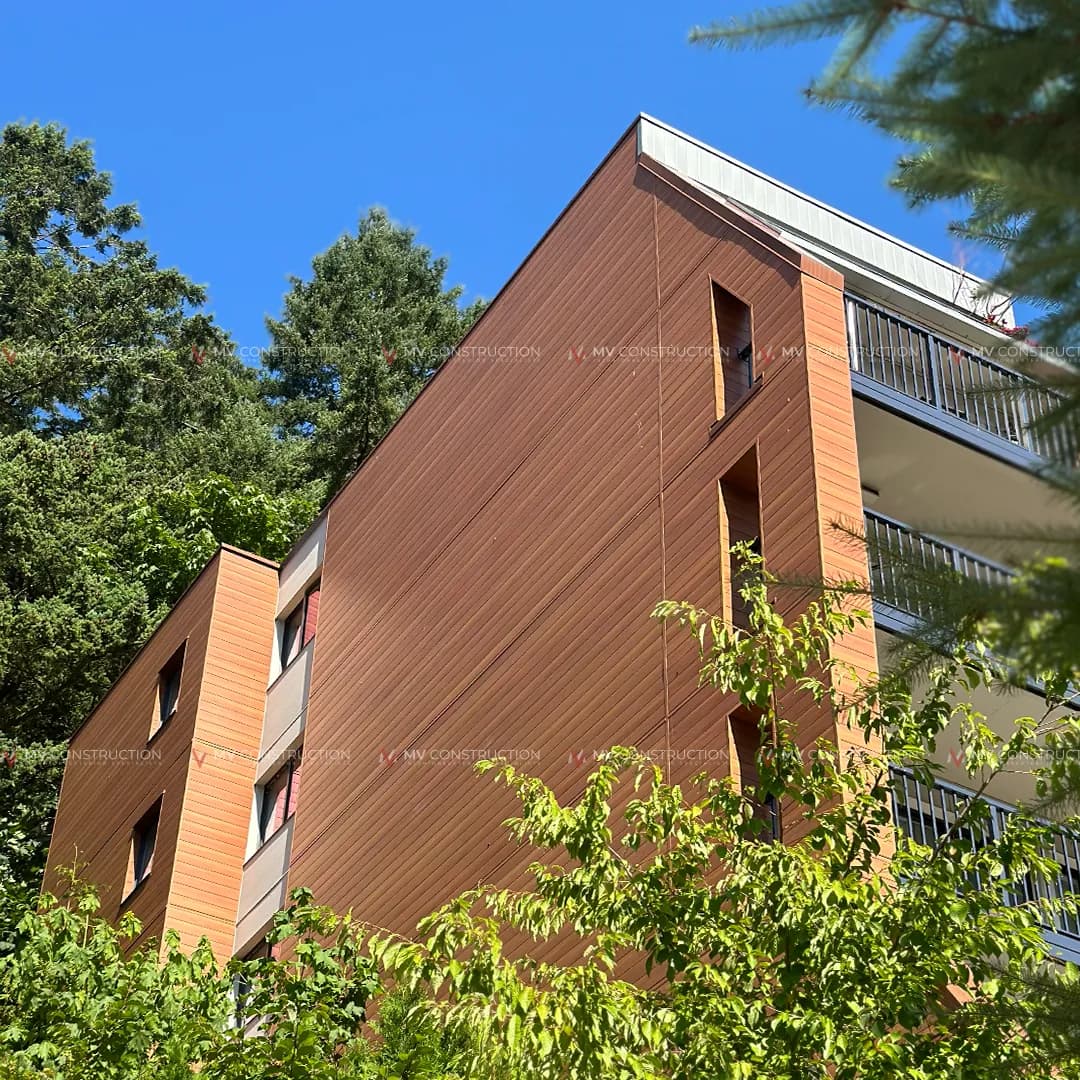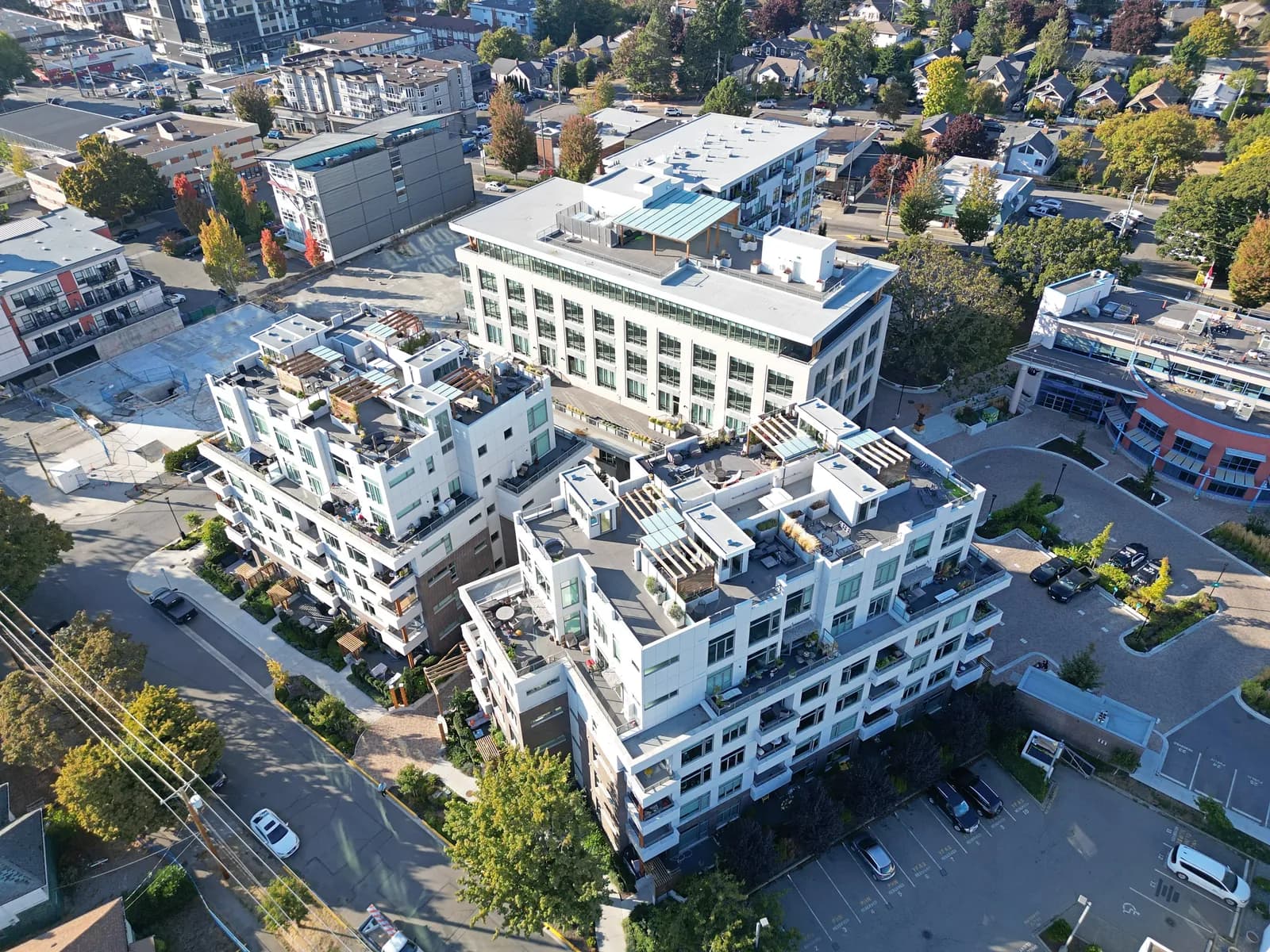
On a Vancouver strata inspection last October, the west elevation had been re-coated twice in eight years. The east elevation had never been touched. Same building, same age, same paint spec, same council losing money.
The strata assumed the previous contractor had rolled on a bad batch. What actually happened is simpler. The west wall took every atmospheric river coming off Georgia Strait, and the crew had spec'd a general-purpose acrylic finish rated for drier climates. The east elevation faced a treed hillside, saw a third of the wind-driven rain, and held its color for a decade.
Stucco painting in BC is not one product across one climate. The choice between elastomeric and acrylic depends on exposure, substrate condition, and what was on the wall before. Pick right and the finish holds ten to fifteen years. Pick wrong and you're back on scaffolding in three.
How often should stucco be painted in BC?
On coastal BC exteriors, a quality elastomeric stucco re-coat holds for 10 to 15 years before it needs another cycle. Acrylic finishes usually last 7 to 10 years in the same climate. If your stucco shows hairline crazing, chalking, or dull uneven color but the substrate is sound, re-coating is the fix, not replacement. Full re-clads only pencil out when moisture has reached the sheathing behind the wall.
What "stucco painting" actually means
Painting stucco is not the same as painting siding or trim. A traditional exterior latex has 3-mil dry film thickness and no elongation to speak of. Roll it onto BC stucco and it will bond, sit on the surface for two winters, and start chalking off the west elevation by year three.
Purpose-formulated stucco coatings are engineered differently. Elastomeric products build to 15-25 mils dry film thickness, roughly 5-10 times the film of standard paint. They stretch 90 to 400 percent before failing, which lets them bridge the hairline cracks that older stucco develops as it cures and cycles through temperature changes.
Acrylic stucco finishes sit in between. They're thicker and more flexible than trim paint but nowhere near elastomeric. Their advantage is color range, cleaner sight lines on flat facades, and lower installed cost per square foot.
Both are formulated to be vapor-permeable in one direction. Water beads off the outside. Moisture that's already inside the wall assembly can still migrate outward through the coating. That one-way behavior matters on the BC coast, where any wall system that traps moisture will rot from behind.
Elastomeric stucco coatings: what they actually do
Elastomeric is the default recommendation for exposed BC exteriors, and here's why.
Elongation. A quality elastomeric coating stretches 90 to 400 percent before rupture. Hairline cracks up to about 1/16 inch flex under the coating without telegraphing back through. This is critical on cementitious stucco, which develops fine cracking as it cures and continues to move with daily temperature swings.
Film thickness. Applied at spec (15-25 mils dry), elastomeric builds a continuous membrane over the substrate. Standard trim paint at 3 mils leaves every substrate imperfection visible and offers no mechanical resistance to wind-driven rain.
Water repellency with breathability. Elastomeric films shed liquid water off the face but allow water vapor to escape from the substrate outward at rates of 8 to 15 perms. On coastal walls where the exterior takes 1,100+ mm of rain annually, that combination is what protects the wall assembly.
BC installed cost, 2026. Between $5.50 and $8.50 per square foot for elastomeric re-coat work in Metro Vancouver, depending on prep condition, access difficulty (scaffolding vs ladders vs swing stage), and color complexity. A 5,000-sq-ft single-family exterior lands between $27,500 and $42,500.
Best fit. Coastal exposures, strata multi-family, any wall with existing hairline crack patterns, rainscreen stucco assemblies showing face-side crazing, and depreciation-report timelines that call for a 10-15 year re-coat interval.
Acrylic stucco coatings: what they actually do
Acrylic finishes have their place, and it's not a fallback place. On the right wall, an acrylic re-coat outperforms elastomeric.
Elongation. Typically 5-15 percent, which sounds thin next to elastomeric but is plenty for a wall that isn't already cracking. Freshly repaired stucco, new construction, and sheltered elevations don't need 400 percent elongation.
Film thickness. Applied at 3-6 mils dry film. That's roughly the film build of a high-end exterior latex, which means shorter application time, faster dry-through, and lower material cost per square foot.
Color range. Wider palette than elastomeric because acrylic products accept more colorant loading without losing bond strength. If a strata council wants a heritage green that pantone-matches a downtown mural, acrylic is the answer.
Breathability. Acrylic finishes are more vapor-open than elastomeric — 15 to 25 perms is common. On heritage stucco over lime-based render, that vapor permeability protects the historic substrate from freeze-thaw damage.
BC installed cost, 2026. Between $3.50 and $5.50 per square foot for acrylic re-coat work in Metro Vancouver. The same 5,000-sq-ft exterior runs $17,500 to $27,500.
Best fit. Sheltered inland elevations, freshly repaired or new stucco, heritage substrates where breathability matters most, and projects where a shorter 7-year re-coat cycle is acceptable.
When elastomeric wins
The decision usually comes down to five conditions:
- Coastal exposure. If the wall faces Georgia Strait, English Bay, Boundary Bay, or the open Fraser, elastomeric earns its cost premium in year one. Vancouver, North Vancouver, West Vancouver, Delta, Richmond, and White Rock all fall here.
- Existing hairline crack pattern. Once cementitious stucco is 8-12 years old, hairline crazing is normal. Acrylic will telegraph those cracks back through the finish within 2 years. Elastomeric bridges them for the life of the coating.
- Strata depreciation report calling for 10+ year cycle. Councils that plan on 15-year re-coat intervals cannot use acrylic without eating the difference through in-cycle touch-ups.
- Rainscreen stucco with face-side crazing. These assemblies work when the coating stays continuous. A cracked face lets water in, and the drainage cavity behind can't dry it out in time. Elastomeric maintains the shed layer.
- South and west elevations on any building over 10 years old. UV degradation is not a minor issue in BC. South elevations receive roughly 1,400 kWh/m² of solar radiation annually. That's chalking-off territory for anything under 15 mils of film.
When acrylic is the smarter call
Just as often, the right answer is acrylic, and paying for elastomeric is money left on the wall.
- Sheltered inland elevations. Langley, Abbotsford, and Fraser Valley slopes see roughly 600-800 mm annual rainfall and much less wind-driven exposure. Acrylic performance is close to elastomeric there for two-thirds the material cost.
- New or freshly repaired stucco. If the substrate was replaced or fully patched within the last 6 months and has no crack pattern, elastomeric's crack-bridging capacity is unused capacity you paid for.
- Heritage cementitious or lime-based render. Vapor permeability protects historic substrates from freeze-thaw damage. An elastomeric coating can trap moisture that a lime substrate normally releases outward.
- Cost-sensitive projects on interior elevations. North-facing walls under significant roof overhang, courtyard-side elevations, and any facade shielded by adjacent buildings often perform acceptably with a 7-year acrylic cycle at roughly 60 percent of the elastomeric cost.
- Complex custom color programs. If the design brief calls for six accent tones and a heritage palette, acrylic gives you the tinting range without compromising bond.
The prep work nobody talks about
Coating performance in BC is 60 percent prep, 30 percent product, 10 percent application weather. Every failed stucco and EIFS re-coat I've inspected traces back to a prep shortcut, not a bad product.
Pressure wash. 2,500 to 3,000 PSI with a 25-degree tip on modern acrylic-modified stucco. Lower on lime-based or heritage substrates (1,200 PSI, 40-degree tip). The wash removes chalk, mildew, efflorescence, and loose material. On stucco that hasn't been cleaned in a decade, this alone changes color perception by two shades.
Crack diagnosis and repair. Hairline cracks under 1/32 inch will be bridged by elastomeric alone. Cracks between 1/32 and 1/8 inch need routing, backer rod where appropriate, and a fiber-mesh embedded patch coat. Cracks wider than 1/8 inch or accompanied by hollow-sounding wall areas are substrate failure, not surface failure — coating won't fix them.
Efflorescence and salt removal. White crystalline deposits are salts leaching out of the cementitious substrate. They must be neutralized (dilute acid wash on modern stucco, chemical scavenger on heritage) before priming. Coat over active efflorescence and it will push through as blistering in the first winter.
Primer selection. Alkali-resistant primer is mandatory on stucco less than 28 days cured and recommended on any re-coat over previously painted work where the old finish is unknown. Skipping primer on fresh stucco leads to saponification within one wet season.
Application weather. 10-32°C ambient, no rain forecast for 24 hours after final coat, no direct sun on the working elevation during application on hot days. In Metro Vancouver, that limits application to roughly April through mid-October for exterior work.
Coat count. Two coats minimum for both elastomeric and acrylic. Cutting to one coat drops warranty coverage from most manufacturers and cuts service life roughly in half.
What BC weather actually does to stucco coatings
The failure modes are climate-specific, and the fix depends on which one you're looking at.
Wind-driven rain. Metro Vancouver averages 1,150 mm of rain per year, and roughly 30-40 percent of that arrives driven at 40+ km/h wind speeds. Elastomeric coatings shed this; acrylic finishes at 3-6 mils allow gradual moisture penetration on the most exposed elevations. Result on the wrong product: chalking, color loss, and moisture staining bleeding through the coating.
Freeze-thaw. Not a lower-mainland issue at sea level, but real above 400 m elevation (Squamish, Whistler, higher parts of North Van and Coquitlam). Freeze-thaw expands moisture trapped in the substrate. A vapor-open acrylic gives that moisture a way out. Elastomeric can trap it and cause spalling.
UV degradation. South and west elevations at BC's latitude take significant UV load. Both product families degrade under UV, but elastomeric's thicker film has more material to lose before failure. On south walls, acrylic often shows visible chalking by year 5; elastomeric holds visually clean through year 10-12.
Salt spray. Waterfront exposures within 2 km of open water (parts of Horseshoe Bay, White Rock, Steveston, Deep Cove) take airborne salt loads. Salt drives chloride corrosion of any embedded lath, and both coatings degrade faster there. Waterfront installations should always spec elastomeric plus stainless-steel corner beads and lath fasteners.
Coastal biofilm. Algae and mildew colonize any north-facing coating in the coastal shade. Both product families accept mildewcide additives; ask for them explicitly on shaded elevations.
Cost comparison for typical BC re-coat projects
Real 2026 pricing for stucco painting in BC, Metro Vancouver market, based on installed cost including prep, primer, two coats, and standard warranty:
Single-family home, 2,500 sq ft of stucco surface
- Acrylic re-coat: $8,750 to $13,750
- Elastomeric re-coat: $13,750 to $21,250
Two-story custom home, 5,000 sq ft of stucco surface
- Acrylic re-coat: $17,500 to $27,500
- Elastomeric re-coat: $27,500 to $42,500
Strata townhouse block, 15,000 sq ft of stucco surface
- Acrylic re-coat: $52,500 to $82,500
- Elastomeric re-coat: $82,500 to $127,500
5-story strata multi-family, 40,000 sq ft of stucco surface
- Acrylic re-coat: $140,000 to $220,000
- Elastomeric re-coat: $220,000 to $340,000
Range within each cell tracks access difficulty (ladder vs scaffolding vs swing stage) and prep condition. Add 15-25 percent for buildings above four stories that need engineered swing stages instead of standard scaffolding.
Colored elastomeric adds roughly $0.30-$0.60 per sq ft over base white. Custom acrylic colors add $0.15-$0.35.
When re-coating is the wrong answer
Not every failing stucco wall wants a re-coat. Some walls want a full re-clad, and the visible symptoms overlap enough that homeowners regularly spend $18,000 on a re-coat that lasts eight months before the underlying problem punches through.
The tells that re-coating won't work:
- Cracks wider than 1/8 inch, especially horizontal cracks at floor lines
- Bulges or wavy areas visible when raking light hits the wall
- Hollow-sounding areas when you tap the surface (delaminated substrate)
- Rust bleed at corner beads or fastener locations
- Moisture stains that reappear each winter regardless of coating condition
- Efflorescence that returns within 6 months of a chemical clean
- Windows or doors that stick where they didn't a year ago (frame movement from wall failure)
Any two of the above means the wall assembly is failing, not the finish. Re-coating over that condition traps water and accelerates the underlying rot. The correct scope is exploratory opening (typically two 400x400 mm cutouts per elevation to inspect sheathing and weather-resistive barrier), followed by targeted exterior envelope repair or, in the worst cases, full stucco removal down to the sheathing with new WRB, lath, and system.
MV Construction handles stucco painting in BC across residential, strata, and commercial properties. Every project runs under WCB coverage, full liability insurance, and BC contractor licensing, backed by 17+ years of exterior finish work across Greater Vancouver and Vancouver Island. Our stucco and EIFS re-coats carry a written warranty covering both prep and coating, with scope documented before any product goes on the wall.
FAQ
How long does elastomeric stucco coating last in Vancouver?
On properly prepped west-facing exposures in Vancouver, quality elastomeric coating lasts 10 to 15 years before recoat. On east or north elevations with lower UV load, 15+ years is realistic. Application quality (clean substrate, correct film thickness, proper cure time) matters more than product brand within the top three or four manufacturers.
Can I paint stucco myself?
Small patches on a single-story home, yes. Full building re-coats need pressure washing at controlled PSI, crack diagnosis, alkali-resistant priming, and elastomeric application at 15-25 mils wet film thickness. Roller application typically fails to achieve spec thickness; rented sprayers rarely produce the atomization needed for elastomeric. A DIY re-coat that costs $2,500 in materials but delivers 4 mils of film is worse than not painting at all, because it seals in future moisture without providing the mechanical protection you paid for.
Does re-coating fix moisture problems?
No. Coatings shed water but cannot repair a failed weather-resistive barrier, missing kickout flashings, or compromised window flashings. If moisture is reaching the sheathing, a re-coat can trap it inside the wall. Diagnose and repair the water entry point first, then coat.
How much does stucco painting cost per square foot in BC?
Acrylic finishes run $3.50 to $5.50 per sq ft installed as of 2026. Elastomeric runs $5.50 to $8.50 per sq ft. Multi-story access (swing stages, scaffolding), heavy prep, and premium color additives push both figures higher. A one-time site inspection tightens the range considerably.
Should I re-coat before selling my home?
If the coating is actively failing (chalking, crazing, moisture staining, uneven color), yes. A $12,000-$18,000 re-coat on a $2M home typically returns full cost at resale because it removes an obvious inspection concern. If the coating is sound but dated, a color refresh alone rarely pays back at listing.
Elastomeric or acrylic for a strata depreciation-report project?
Elastomeric, in almost every case. Depreciation reports typically assume 12-15 year finish cycles, and acrylic won't hold that on multi-story exposed walls. The material premium on a large strata (roughly 40 percent) is more than recovered by not having to re-coat at year 8.
If your stucco is showing crazing, chalking, or uneven color and you're weighing a re-coat against replacement, MV Construction runs written estimates that break out prep, product, coats, and warranty separately. Book a site visit through the request a fixed-scope estimate form or call 778-375-5672. Every stucco painting project we quote in BC comes with a written scope before scaffolding goes up.