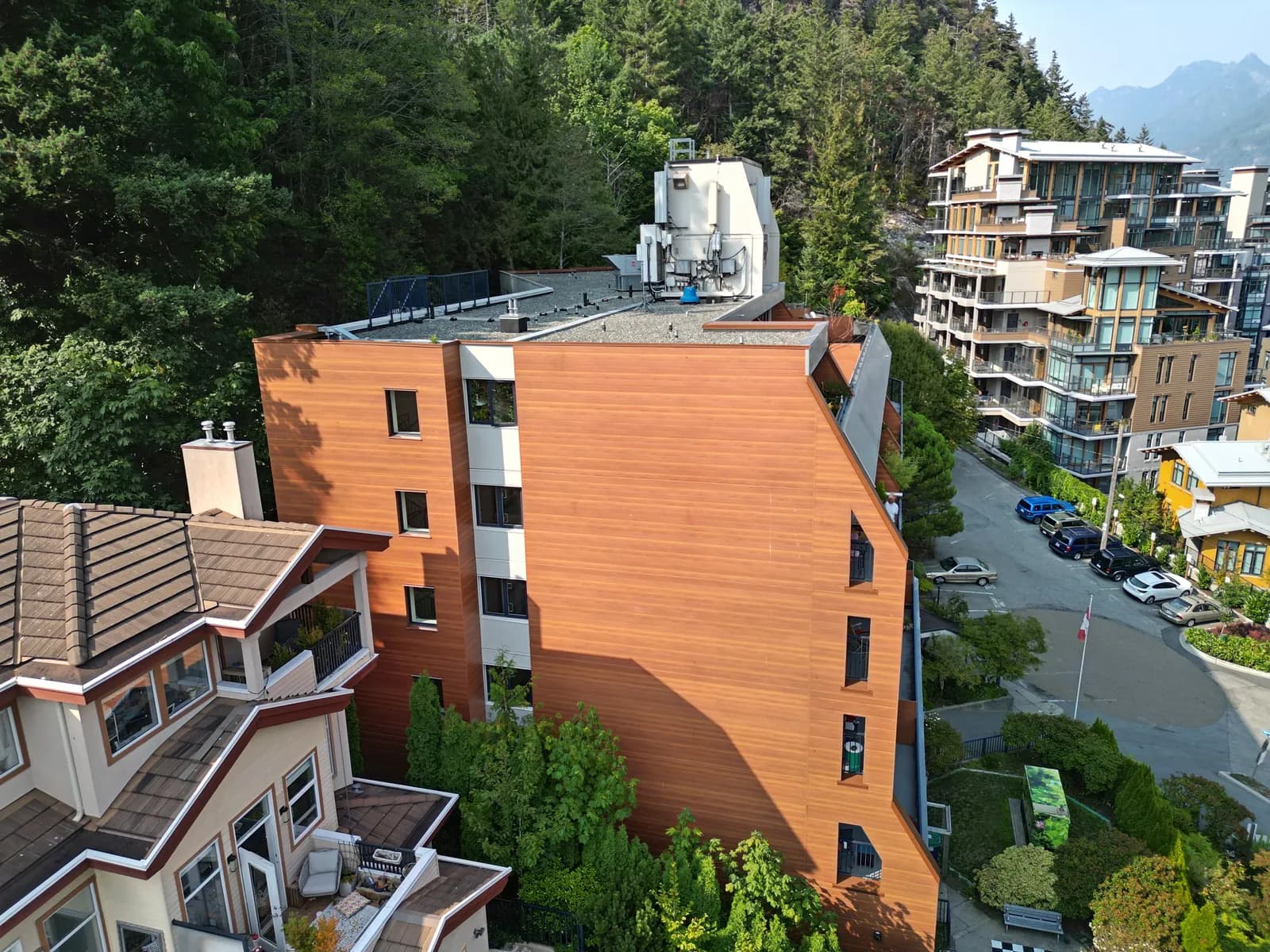
A wall can stay dry for fifteen years and leak on the third day of one storm. That is the pattern we see every fall on the coast. Building envelope leaks in BC rain rarely start during an ordinary shower. They start when an atmospheric river parks over the Lower Mainland, the wind holds from one direction for 48 hours, and water gets pushed into joints that were never tested that hard.
In November 2021, parts of southern BC took more than a month of normal rainfall in about two days. Smaller atmospheric rivers reach the coast several times every fall and winter, mostly between October and January. If your building has a weak detail, this is when it shows.
Where do building envelopes leak during an atmospheric river in BC?
Most leaks come through eight places: window and door corners, balcony door sills and deck membranes, roof-to-wall junctions, wall penetrations such as dryer vents and light fixtures, stucco cracks and failed sealant joints, parapet caps, overflowing gutters, and below-grade walls. Wind-driven rain over two or three days forces water into gaps that ordinary rain never reaches.
The rest of this guide explains why long storms behave differently, what each leak point looks like from inside, and what to do in the first day, the first week, and through the full repair.
Why a multi-day storm finds leaks a normal rain misses
Three things change when an atmospheric river arrives.
The first is wind. Rain falling straight down mostly runs off a wall. Rain driven at 50 or 60 km/h hits the wall sideways, and the pressure difference between outside and inside pulls water through any gap, sometimes upward against gravity. A window corner that sheds normal rain can take in a steady trickle under that pressure.
The second is duration. Stucco, wood siding and brick all absorb water. In a typical rain they soak up a little and dry out the next day. After two or three days of constant wetting, the cladding is saturated and the drainage cavity behind it, if there is one, carries far more water than it was sized for.
The third is direction. South- and west-facing walls usually take the most water in these storms. A building that has never leaked may simply never have seen the wind from the right angle for long enough. That is not proof the envelope is sound.
Age matters here too. Many wood-frame buildings in the Lower Mainland built before the mid-2000s were face-sealed: cladding attached directly to the sheathing, with sealant as the main line of defence. Newer walls generally have a drained rainscreen cavity that lets water escape. If your building predates that change, our guide to a rainscreen retrofit in BC covers what the upgrade involves.
The eight places water gets in
1. Window and door corners
The lower corners of windows are the most common leak source we open up. Missing sill pans, sealant that has pulled away from the frame, and corner joints in the window itself all let water into the wall below. From inside, look for staining or bubbling paint under the window corners and swollen drywall at the baseboard. Our article on window and door flashing details shows what correct flashing looks like.
2. Balcony door sills and deck membranes
On strata buildings, the sliding door threshold fails first. If the membrane stops at the sill and relies on a bead of sealant, a long storm will find the crack in that bead. Ponding water on a deck with a blocked drain makes every small flaw worse.
3. Roof-to-wall junctions
Where a lower roof meets a taller wall, water running down the roof edge needs a kick-out flashing to throw it clear of the wall. Without one, a full storm's worth of roof water empties into the cladding at a single point. The damage usually shows as rot or staining just below the roof line.
4. Penetrations through the wall
Dryer vents, exhaust hoods, hose bibs, light fixtures, electrical boxes, gas lines and heat pump line sets. Each one is a hole in the envelope, and many were sealed with a bead of caulking and nothing behind it. Heat pump retrofits added a lot of new holes to older BC homes in the last five years, and not every installer flashed them.
5. Stucco cracks, control joints and the base of the wall
Hairline cracks in stucco take in water by capillary action, and saturated stucco holds it against the sheathing. Check the weep screed at the bottom of the wall as well. When soil, bark mulch or a new patio has been raised up against it, water that runs down the wall has nowhere to drain.
6. Parapets and cap flashings
Flat-roofed buildings collect leaks at the top of the wall. A parapet cap without slope, open joints between cap sections, or fasteners driven through the top surface will send water straight down into the wall assembly. These leaks often appear several floors below the source.
7. Gutters and downspouts that overflow
A gutter clogged with fir needles overflows in an hour of heavy rain. Over three days, that overflow soaks the same strip of wall continuously. Downspouts that discharge at the foundation add groundwater exactly where you want less of it.
8. Below-grade walls and window wells
Long storms raise the water table and overload perimeter drains, especially older drain tile that is half full of silt or roots. Basement suites show it first: wet carpet along an exterior wall, efflorescence on concrete, or water in a window well that has no drain.
What to do in the first 24 hours
When building envelope leaks in BC rain reach the inside of your home, the order of the first steps matters.
- Make it safe. If water is near light fixtures, outlets or the electrical panel, switch off that circuit at the breaker. Do not stand in water to do it.
- Photograph everything. Take wide shots and close-ups of the water, the stain, the exterior wall outside that spot, and the date and time. Note the wind direction if you can. Insurers and contractors both need this record.
- Control the water inside. Move furniture, pull back carpet, set buckets and towels, and start fans if the power is safe.
- Report it. Homeowners call their insurer. Strata owners report to the property manager in writing the same day, since the leak almost always involves common property.
- Do not caulk in the rain. Sealant will not bond to a wet surface, and it can trap water inside the wall. A temporary tarp or a cleared drainage path does more good until the weather breaks.
If drywall is wet over a large area or the water keeps coming, emergency drying should start within 24 to 48 hours. Mould can begin to grow on wet drywall and framing in that window. Our flood and water damage restoration crews handle extraction, drying and moisture monitoring while the envelope repair is being scoped.
The first week and the full repair
Days 1 to 3: water extraction, drying equipment, and moisture readings in the wall and floor. Drywall usually dries in three to five days with equipment. Framing can take longer.
Days 3 to 7: tracing the water path. The stain inside is often not where the water got in. A contractor may need to open the cladding outside, or cut an inspection hole inside, to find the source. The insurance adjuster typically visits in this period.
Weeks 2 to 8: permanent repair. A single failed window or penetration on a house is often a one- to two-week exterior job. A strata building with leaks across several elevations can take months, and part of that work may need to wait for drier weather or be done under tarps and temporary hoarding. Membranes and sealants need dry surfaces, and reliable repair days in the Lower Mainland are scarce between November and March.
How insurance usually treats rain leaks
How insurers treat building envelope leaks in BC rain catches many owners off guard. Most BC home and strata policies cover sudden and accidental water damage. Many exclude gradual seepage, wear and tear, and rain entering through an opening that the storm itself did not create. If wind tears a flashing off the wall and rain comes in, that is often covered. If rain finds an old failed sealant joint, the interior damage may be covered while the envelope repair is not. Overland flooding and groundwater are usually separate endorsements.
Read your policy wording and ask your broker before assuming either way. On strata buildings, the bylaws and the deductible decide who pays, and water-damage deductibles in Metro Vancouver now often run into the tens of thousands of dollars. Our guide on strata water ingress and who pays walks through how that split usually works.
Whatever the policy says, a repair history helps. Dated photos, inspection notes and invoices for completed work show that the owner or strata maintained the building.
After the storm: find the leaks before the next one
The best time to fix building envelope leaks in BC rain is during the dry spell after the storm, while the stains are fresh and the water path is still traceable. Write down every leak location, the wall it was on, and the wind direction. A contractor can then test those spots with a controlled water test and repair the source instead of the symptom.
If several units or elevations leaked in the same storm, that is a pattern, not bad luck. It usually points to a detail repeated across the building, and it belongs in a building envelope condition assessment and the next depreciation report update.
A contractor who works through the wet season
MV Construction has more than 10 years of exterior and envelope work across Greater Vancouver and Vancouver Island. Our crews are fully licensed, WCB-insured and bonded, our repairs are warranty-backed, and we work with insurance adjusters on restoration claims every season. We take emergency leak calls 24/7 within Greater Vancouver and arrange temporary protection while the permanent repair is scoped.
If a storm has found a weak point in your walls, call us at (778) 375-5672 or request a written leak assessment. Our building envelope contractor team will trace the water path, tell you in writing what needs a permanent repair and what needs temporary protection until the weather clears, and give you a fixed scope before any work starts.