A common scene on a BC envelope repair: the stucco comes off below a bathroom window on a 1990s house, and the sheathing underneath is speckled black from the sill to the floor line. The owner sees the spots and assumes the worst. The crew lead is looking lower, at the bottom plate, where a screwdriver goes in a full inch with almost no push.
Those are two different problems with two different repairs. Mould vs rot in an exterior wall in BC is the question that sets the scope once a wall is open. Mould on wood is usually a cleaning job. Rot means the wood has lost strength, and that wood gets cut out and replaced. The black spots get the attention, but the soft plate is what changes the bill.
What is the difference between mould and rot in a wall?
Mould is fungal growth on the surface of damp materials. It can start on drywall paper or sheathing within 24 to 48 hours and does little harm to the strength of the wood. Rot is decay fungi breaking down the wood itself, and it needs framing or sheathing held wet, typically above 25 to 30% moisture content, for weeks or months. Mouldy wood is usually cleaned and dried. Rotted wood is removed and replaced.
Why BC walls grow both
Both start with water that gets into an exterior wall and cannot get out. Coastal BC supplies plenty of it. From November to March, Metro Vancouver and most of Vancouver Island see rain on more days than not, and the air between storms stays humid enough that a wet wall barely dries.
Much of the housing stock here was built with no way to drain. Face-sealed stucco from the 1980s and 1990s, the wall type behind BC's leaky-condo crisis, sits tight against the sheathing with only building paper in between. When a window sill or a deck connection leaks into that assembly, the water stays there. Walls with a rainscreen gap behind the cladding can dry toward the outside, which is why they tolerate small leaks far better. Our article on rainscreen gap inspection covers how that gap gets checked.
Time decides which problem you find. A wall that got wet once, from a single storm or a burst pipe, and dried within a few weeks will often show mould and nothing else. A wall that has been wet every winter for five or ten years is where rot lives.
How a crew tells them apart once the wall is open
Colour is the least reliable clue. Mould comes in black, green, white and grey, and it can sit on wood that is perfectly sound. Rotted wood, from a few feet away, can look like plain darkened lumber.
The first test is a pick or an awl. Pushed into sound framing, it meets resistance, and prying it out lifts a long splinter. In decayed wood it sinks in with little force, and the fibres break off in short, crumbly pieces across the grain. Every exposed stud, plate and panel gets probed, with extra attention at the base of the wall and under windows.
The second is a pin moisture meter. The BC Building Code limits framing lumber to 19% moisture content when it is installed. Readings in the high 20s and above, mapped across the opening, show where conditions for decay have existed. One dry reading in October does not clear a stud that sat wet every winter, so the readings are judged together with the probe results.
Then there is the wood itself. Brown rot, the type most often found in the softwood framing used in BC, turns lumber brown and splits it into small cube-shaped pieces. It can look dry and crumbly, which is why homeowners often call it "dry rot." In most cases it is brown rot in wood that has since dried out, and the leak that fed it may still be active.
Sheathing tells its own story. OSB that has stayed wet swells at the edges, loses its surface layer and lets go of its nails. Plywood holds together longer, though its outer veneer can be soft well before the panel looks damaged.
The two problems often turn up together. Mould grows happily on wood that is rotting underneath, so a mouldy stud still gets probed. The reverse case matters more for your budget: a stud with no visible mould can be soft for the bottom 15 cm where it sat on a wet plate. A wall covered in black spots with hard, dry framing is often the cheaper repair of the two.
When mould is the whole problem
If the framing and sheathing probe sound and the readings drop as the open wall dries, the repair is cleaning. Wet drywall and insulation come out and are discarded, because porous materials that have grown mould are not worth saving. Wood with surface growth is HEPA-vacuumed, wire-brushed or sanded where the growth is heavy, wiped down, and dried to target before anything is closed. Some crews apply an encapsulating coating after the wood is clean and dry. Bleach does very little on wood: it cannot reach into the grain, and it adds water to a wall you are trying to dry.
Larger areas need containment so spores do not spread through the house. That means poly barriers, negative air pressure with HEPA filtration, and workers in respirators. Health Canada recommends professional help once mould covers more than about 3 square metres, and the inside of an exterior wall reaches that size quickly. Our guide to mould remediation in BC explains the process in more detail.
When the wood has rotted
Rot changes the job from cleaning to carpentry, and sometimes to structural work. Decayed wood is cut back past the visibly damaged section, because decay runs ahead of what shows on the surface. What gets replaced depends on where the water sat: sheathing panels below windows and along the base of the wall, bottom plates and rim joists where water drains down and pools, stud ends that are cut and sistered or replaced, and headers or posts under leaking windows and deck connections.
Those last items carry load. Once a structural member is involved, the repair needs an engineer's direction and, in most Metro Vancouver municipalities, a building permit. Temporary shoring goes in before anything load-bearing comes out. On a strata building, a building envelope consultant usually designs the repair and reviews each opening as the work proceeds. Our piece on what a building envelope consultant report tells you shows what that document will look like.
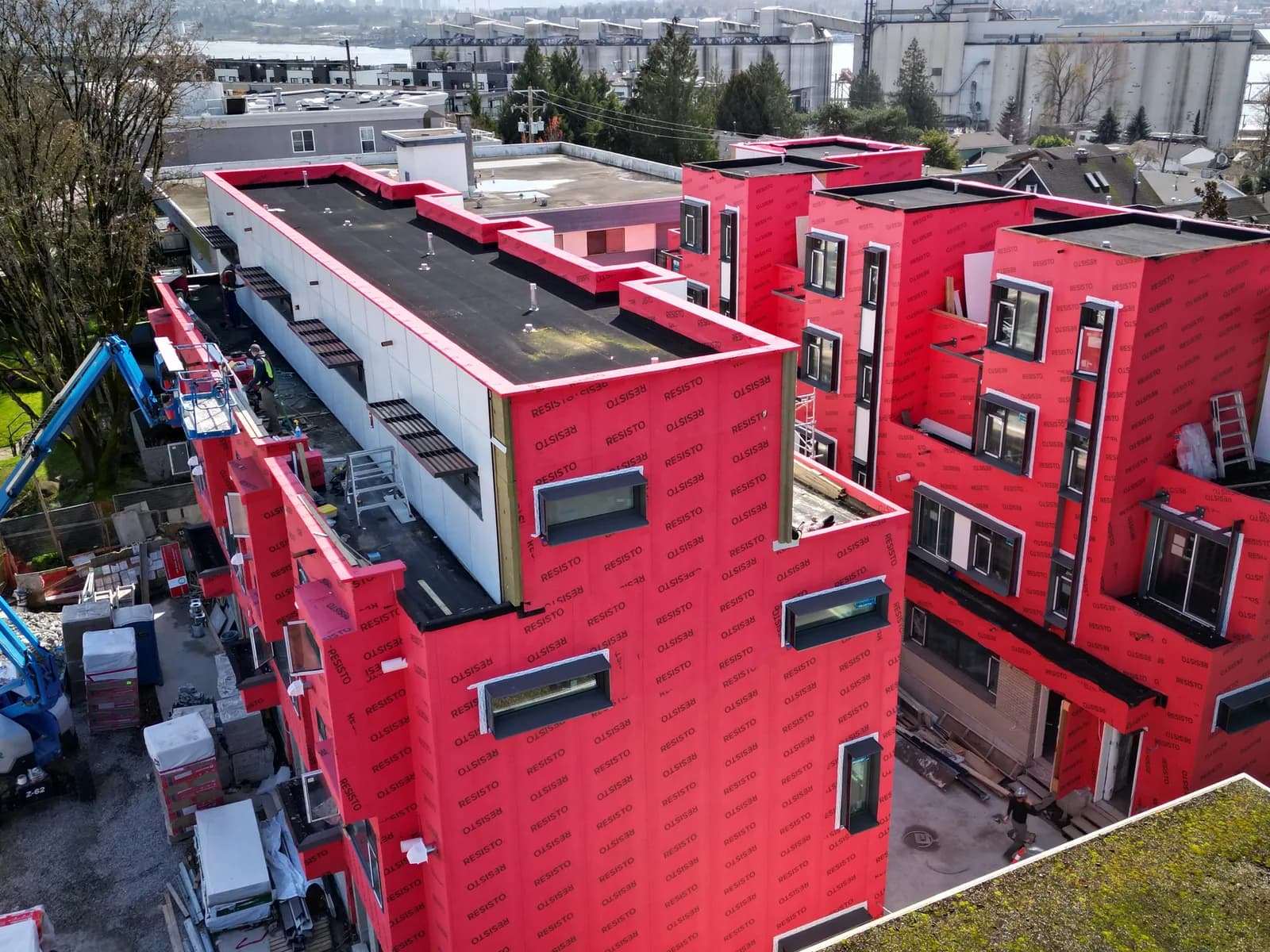
Replacing wood without fixing the source buys a few years at most. Rot repair is the point where the flashing, sill pan or membrane that let the water in gets corrected, and where the wall goes back together with a drainage gap if it never had one. That work is building envelope repair, and it is the part that stops the same wall rotting again.
The estimate line that protects you from surprises
Nobody can see inside a closed wall, so any honest estimate for envelope repair has a known part and an unknown part. A single lump sum for "repair rot as found" hides the unknown part, and it tends to come back later as a change order.
Ask for a written estimate that prices the known scope and lists unit rates for hidden damage: a price per sheet of sheathing replaced, per linear foot of plate, per stud sistered, per square metre of mould cleaning. When the wall opens, everyone measures the same thing and the cost changes with the measurement. Ask the crew to photograph and mark each damaged piece before it is removed, so the count can be checked. A bid with unit rates can look less tidy than a single number, but it is the one you can verify.
What insurance does with mould and rot
Most Canadian home and strata policies exclude rot and mould that come from long-term seepage, condensation or deferred maintenance. Where mould follows a sudden insured event, such as a burst supply line or storm damage that opened the cladding, many policies cover the cleanup up to a set limit. Rot found deep in a wall almost always points to water over months or years, and insurers tend to treat it as gradual deterioration.
That is why documentation from the first day matters. Dated photos, moisture maps and probe results help the adjuster see whether the damage is fresh or old. On a strata property, the master policy and the bylaws decide who pays for what inside the wall. Read your own policy wording, because exclusions differ between insurers.
How long mould and rot repairs take
In the first 24 hours, the goal is stopping more water from getting in, even with a temporary cover. Photograph everything before it is moved. If you can see or smell mould, leave it alone: tearing out mouldy drywall without containment spreads spores through the house. Call your insurer the same day if the water came from a sudden event.
Over the first week, the wall is opened far enough to find the edges of the damage. Probe tests and moisture readings on every exposed member decide what is cleaned and what is replaced, and drying equipment runs on anything that stays.
For the full repair, a wall with mould only is usually cleaned, dried and closed within one to three weeks on a house. Rot is slower. Replacing sheathing and framing, then new membrane, flashing and re-cladding, typically takes four to ten weeks per affected exterior elevation. Structural members, permits and winter weather can all push that further, since stucco and many sealants need temperatures above about 5°C to cure. A strata building follows the consultant's phasing and can run for several months.
Who opens the wall matters
The mould or rot call is made in the first hour after the cladding comes off, and the person making it should be the one who will rebuild the wall. MV Construction has handled fire and flood restoration and envelope repair across Greater Vancouver and Vancouver Island for more than 10 years. Our crews are fully licensed, WCB-insured and bonded, we take emergency calls 24/7 within Greater Vancouver, and our workmanship carries a written warranty. Every project starts with a free written estimate.
If a wall on your house or strata building has been opened and you are not sure what you are looking at, call us at (778) 375-5672 or request a written estimate. We will probe it, map the moisture and tell you which parts can be cleaned and which have to be replaced.