Every October we get the same call. A homeowner in Burnaby or a strata council in Coquitlam has finally approved the scope, the money is in place, and someone asks whether the crew should just start in the spring instead. The assumption behind the question is that a winter exterior renovation in BC means five months of crews standing around watching rain.
That is not what the season does. Coastal BC winters are wet, not deeply frozen, and wet and frozen stop completely different trades. Some work is genuinely off the table between November and March. A surprising amount is not, and waiting for May often costs more than working through the wet months with the right protection in place.
Can exterior renovation work be done in a BC winter?
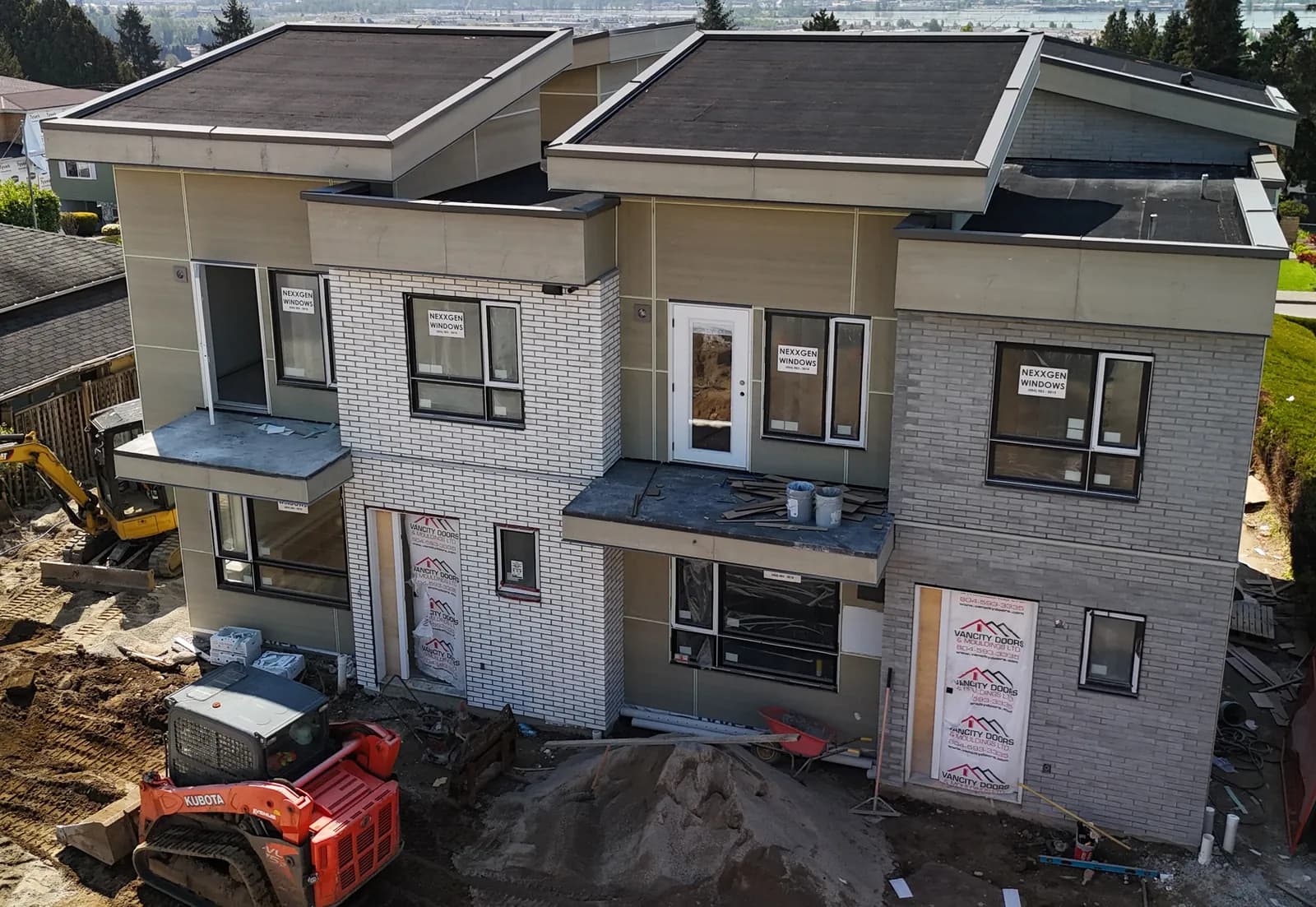
Yes, with limits. Tear-off, framing repair, sheathing, building wrap, windows, flashing, fiber cement and metal cladding all continue through a Lower Mainland winter under tarps and scaffold wrap. What stops is anything cement-based or coating-based below roughly 5°C: traditional stucco, mortar, parging, acrylic finish coats, membranes and paint. Those wait for stable temperatures, usually mid-March onward.
The dividing line is not the calendar. It is whether the material needs a chemical cure that depends on temperature and moisture, or whether it is a mechanical assembly that goes together dry and gets covered.
What keeps working through November to March
Tear-off and investigation. Removing failed cladding is weather-neutral work. It is also the phase where the real scope is discovered. Opening a wall in December means the rot, the missing flashing and the undersized headers get priced in winter, not found in June after a spring contract has already been signed at a lower number.
Framing and sheathing repair. Wet lumber is not a problem in itself. Plywood and OSB in a Vancouver winter will pick up moisture, and a crew that knows the coast leaves the assembly open long enough to dry back before it is closed in, or uses a moisture meter rather than a guess. Below roughly 19 percent moisture content, the wall can be wrapped.
Building wrap and air barrier. Self-adhered membranes have a temperature floor, usually around 4°C for standard products, but low-temperature versions are made for exactly this and mechanically fastened housewrap has no meaningful limit. This is the phase where a building actually gets drier than it was before the work started.
Windows and doors. Replacement units go in year-round. Sealants are the constraint, not the frames. Most quality exterior sealants are rated to 4°C and some to -18°C, so the product spec matters more than the month.
Flashing and sheet metal. Bending and installing metal is unaffected by cold. If a building is leaking at window heads or transitions, waiting until spring to install the flashing is the expensive option.
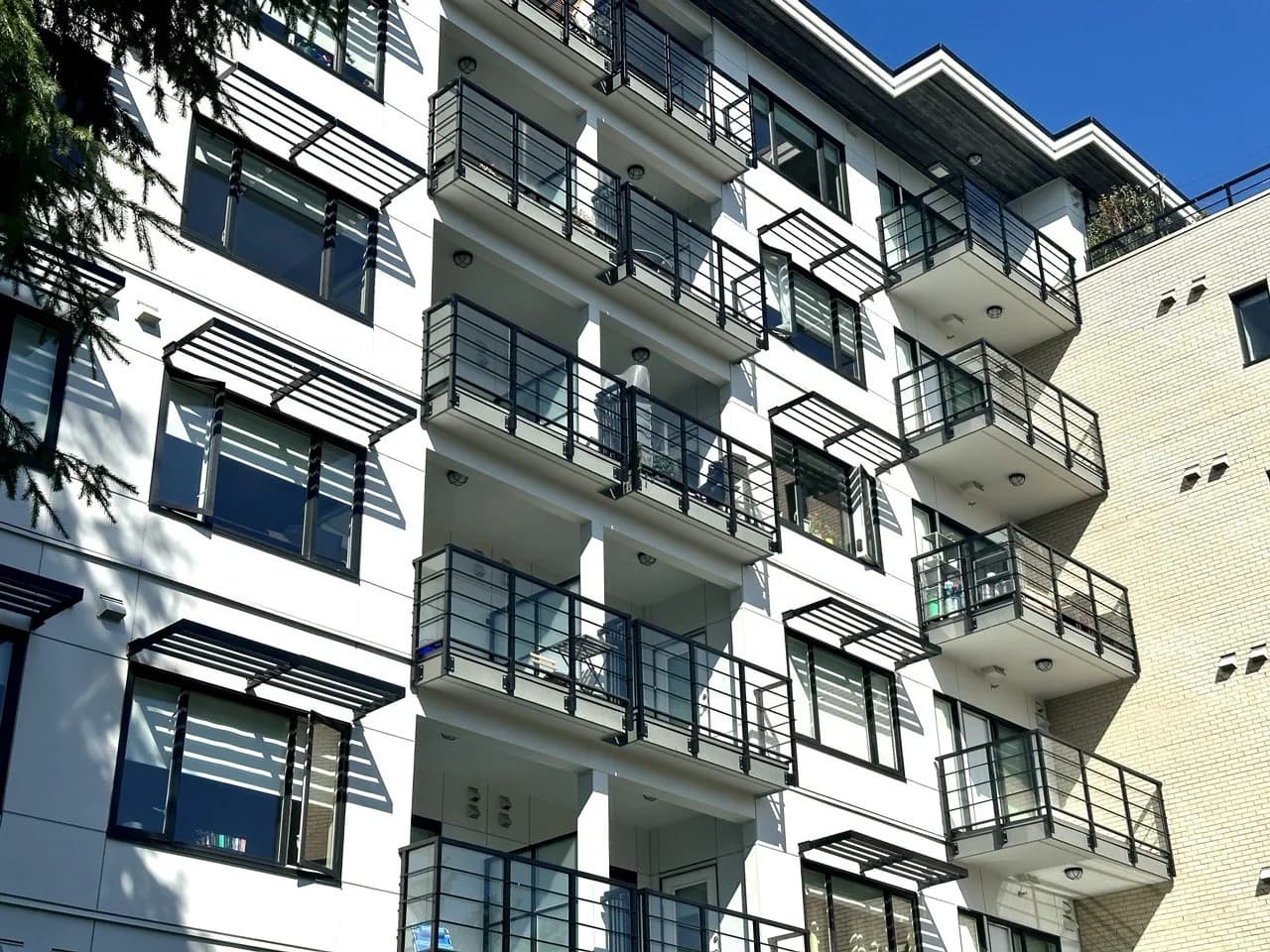
Fiber cement and metal cladding. Both are mechanically fastened, dry systems. Fiber cement cutting is actually easier in damp conditions because the dust drops instead of hanging. Caulking and touch-up paint are the only pieces that need a warmer window.
What genuinely has to wait
Cement-based and coating-based work is the real winter casualty, and no amount of scheduling pressure changes the chemistry.
Traditional stucco. Portland cement stucco needs ambient and surface temperatures above 5°C and rising for the duration of the cure, typically 48 hours minimum per coat with 7 days between the base coats on a three-coat system. Applied cold, it cures weak and cracks within the first year. Applied to a frozen substrate, it never bonds at all.
Mortar and repointing. Same constraint. Mortar below 5°C loses compressive strength permanently, and freeze-thaw on green mortar destroys the joint. Heated enclosures make winter masonry possible on commercial work, but on a residential repoint the enclosure usually costs more than the mortar.
Acrylic and elastomeric finish coats. Most manufacturers specify 10°C and rising, with no rain in the following 24 to 48 hours. In a Lower Mainland winter that combination is rare enough that scheduling around it is not realistic.
Exterior paint. Same story. Low-temperature formulations exist and work down to about 2°C, but film formation on a damp substrate is a gamble, and the failure shows up as peeling two winters later.
Deck and balcony membranes. Torch-applied and liquid membranes both need dry, warm substrates. A balcony membrane installed in February on a damp deck is a warranty claim waiting to happen.
How the wall gets protected in between
This is the part that separates a crew that works winters from a crew that simply says yes to a winter start.
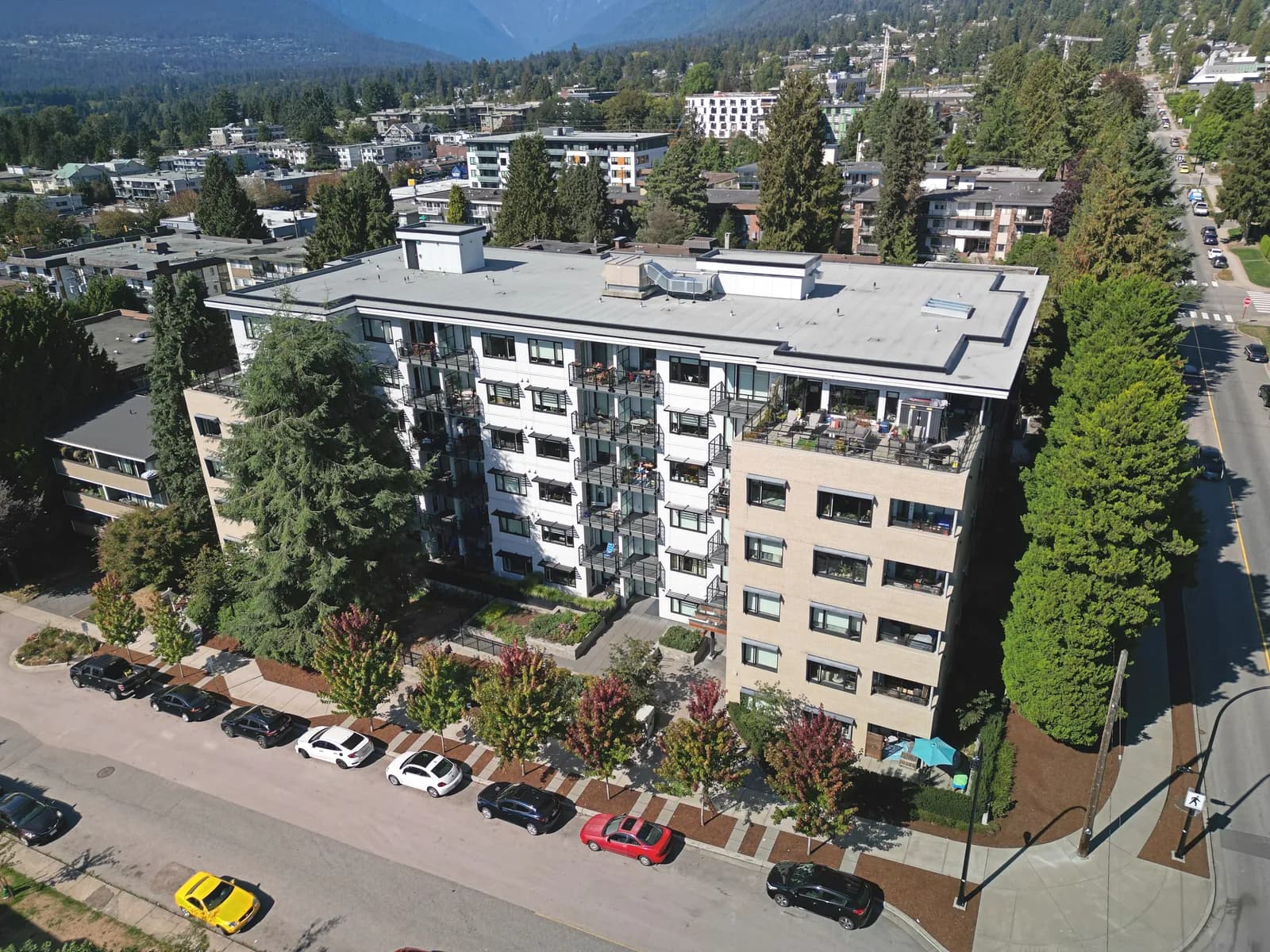
Scaffold wrap and shrink wrap turn an open wall into a controlled space. Done properly, the wrap is fastened to the scaffold rather than the building, vented at top and bottom so moisture does not condense inside, and inspected after every wind event. On a four-storey strata in Port Coquitlam, that wrap is not a courtesy. It is what lets the tear-off, sheathing and wrap sequence run through January without the interior drywall ever getting wet.
Temporary weatherproofing is the second piece. When a wall is opened and cannot be closed the same week, it gets a temporary water-resistive barrier with lapped and taped seams, not a tarp with a nail through it. Anyone who has opened a wall in February and found last winter's temporary tarp still doing structural duty knows the difference.
The third piece is sequencing, and it is where experience shows. A crew that plans a winter job runs all the dry trades first, holds the cement-based scope for spring, and closes each elevation before moving to the next rather than opening the whole building at once. Two elevations open in December is manageable. Four is how a project ends up with interior damage.

The mistake most owners make
The common error is not starting in winter. It is booking a spring start in February and assuming the price holds.
Every exterior contractor in Metro Vancouver has the same May-to-September window, and demand compresses into it. Scaffolding rental rates climb, subtrade availability tightens, and the estimate you were given in February gets revisited. Crews that stay busy through the winter are generally the ones with capacity and stable pricing in spring, because their schedule was never a scramble.
There is a second version of the same mistake. A building with active water ingress gets told to wait for spring, and spends four more months of the wettest season taking water into a wall assembly that is already compromised. The tear-off, the drying and the framing repair can all happen in December. Only the finish has to wait. Deferring the whole project to protect the finish schedule usually adds rot repair that was avoidable.
Ask a contractor what specifically has to wait and why. The answer should be about cure temperature and substrate moisture, not about crew preference.
What winter changes for a strata building
Multi-family work has a wrinkle single-family work does not. Residents live there through the whole thing, and winter concentrates the friction.
Enclosure wrap cuts daylight into suites on the elevation being worked. On a 60-unit building with two elevations wrapped at a time, that is a real complaint stream, and the council should hear about it before the notices go out rather than after. The practical answer is to sequence the darkest elevations first, in December and January, so the wrap comes off as the days get longer.
Heat loss is the other one. An open wall with a temporary barrier is not an insulated wall. Suites on that elevation run colder and hydro bills go up for the four to eight weeks the assembly is open. Some councils absorb that; some budget a small credit. Either way it belongs in the project communication plan, not in a surprise email in February.
Balconies are where winter schedules usually break. If the scope includes balcony membranes, that work is spring, full stop, and the balconies on the affected elevation stay out of service until it happens. A council that expects balcony access back in March on a project that started in November has been told the wrong thing.
What a winter estimate should say in writing
A written estimate for winter work should name three things the summer version does not need.
The first is the weather protection scope and who pays for it: wrap material, installation, maintenance through wind events and removal. On a multi-family envelope job this is a real line, often 3 to 6 percent of contract value, and it belongs in the estimate rather than in a change order in January.
The second is a defined hold point. Something like: cladding, flashing and windows complete by March, stucco base and finish coats scheduled for the first stable window above 5°C, with the wall protected in the interim. A schedule that pretends stucco will be applied in January is not a schedule.
The third is what happens to the price if the spring window slips. Weather delay language should be specific about which conditions pause work and whether standby costs apply.
Working with a BC winter rather than against it
MV Construction has run exterior projects through ten-plus Lower Mainland winters, on single-family homes and on multi-family buildings where residents stayed in place the whole time. Fully licensed, WCB-insured, and every scope delivered as a written estimate before anyone touches the wall. Our winter sequencing is warranty-backed the same as our summer work, because the point of protecting an open wall properly is that the assembly performs identically either way.
Winter is also when scheduling is realistic. A building envelope assessment in November leads to a January tear-off and a March finish. The same call made in April lands in a queue behind everyone who waited.
If you are weighing a winter start on an exterior renovation, the useful next step is a scope conversation about what can run now and what should hold. We do the same walkthrough for building envelope and restoration work as for a single elevation of failing cladding. You can request a fixed-scope estimate or call (778) 375-5672 and we will tell you honestly which half of your project belongs to this season.