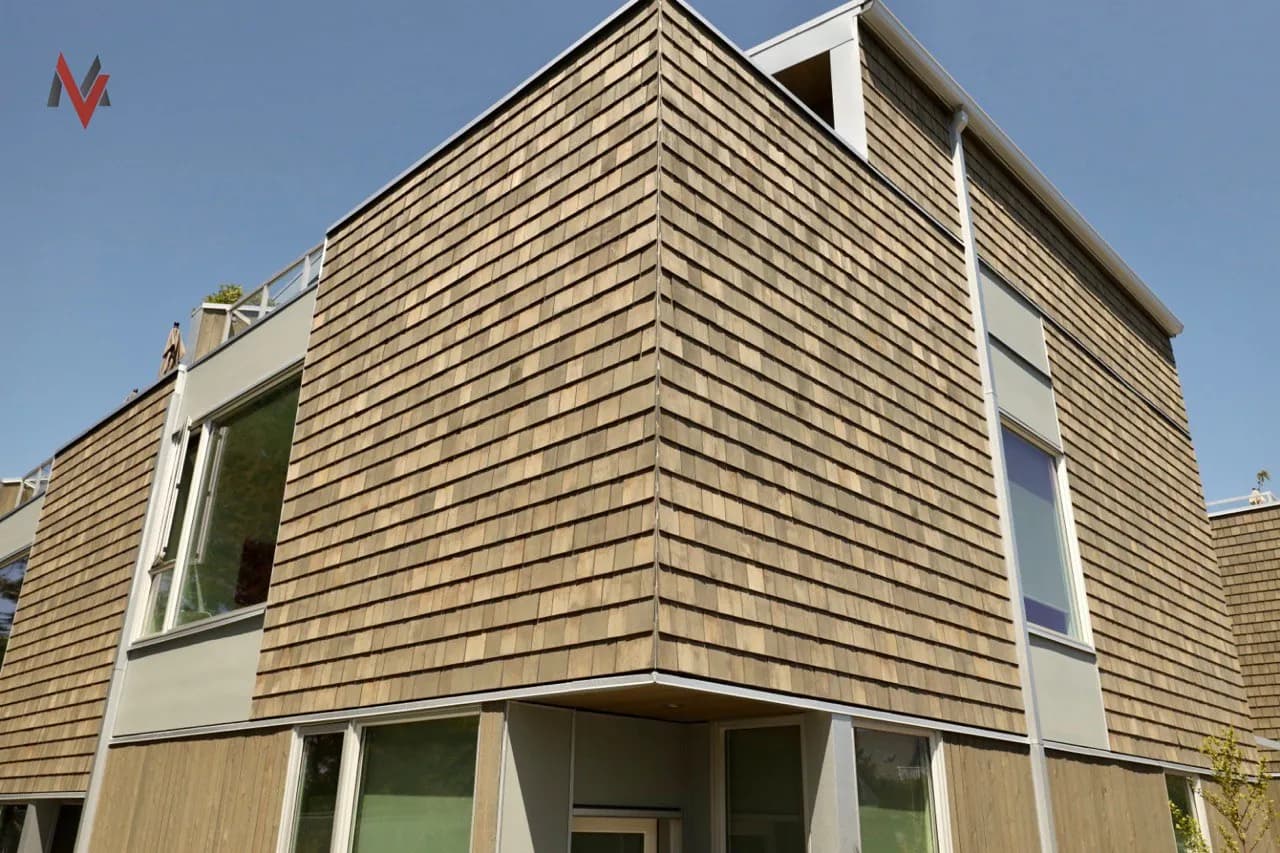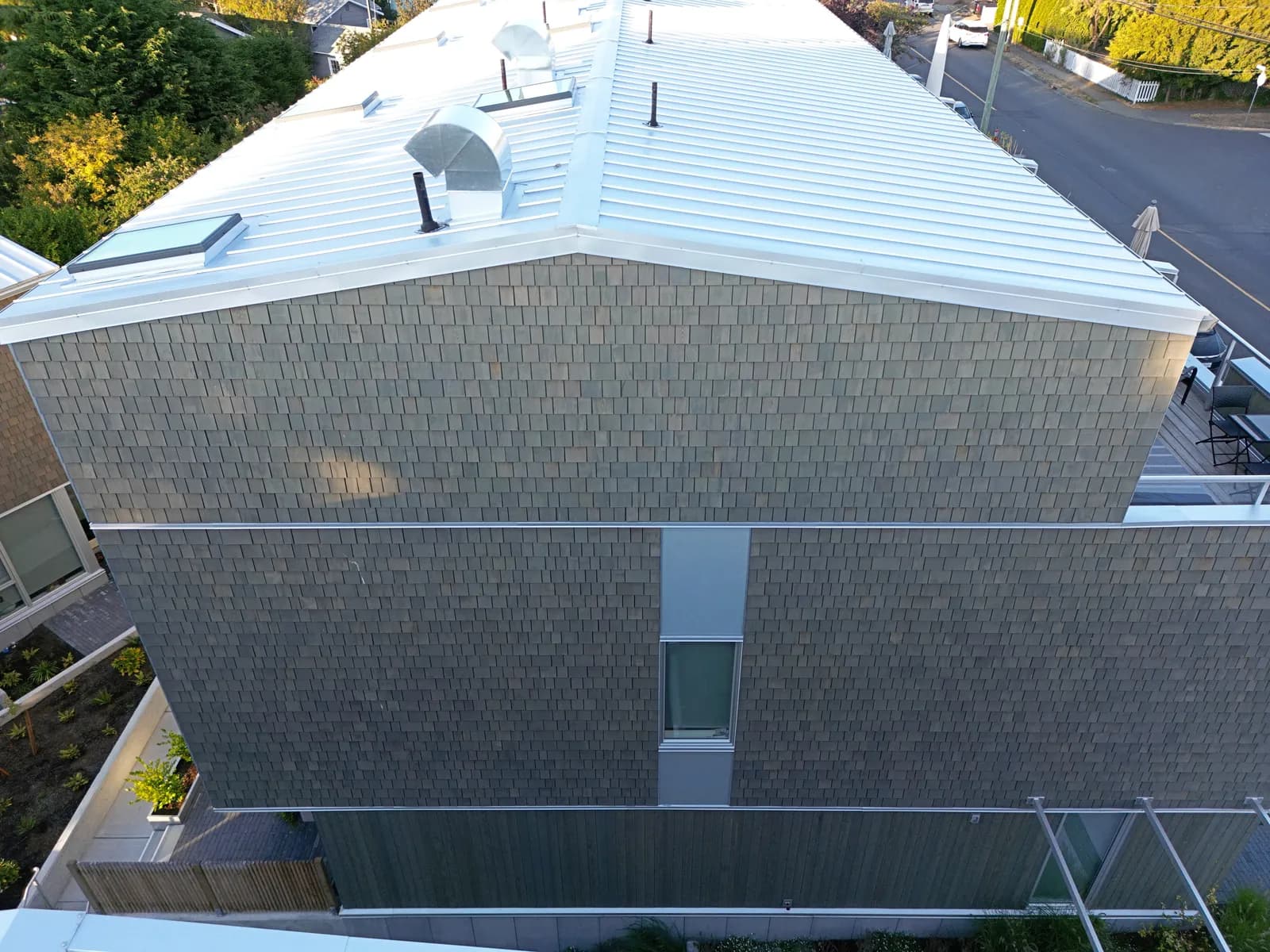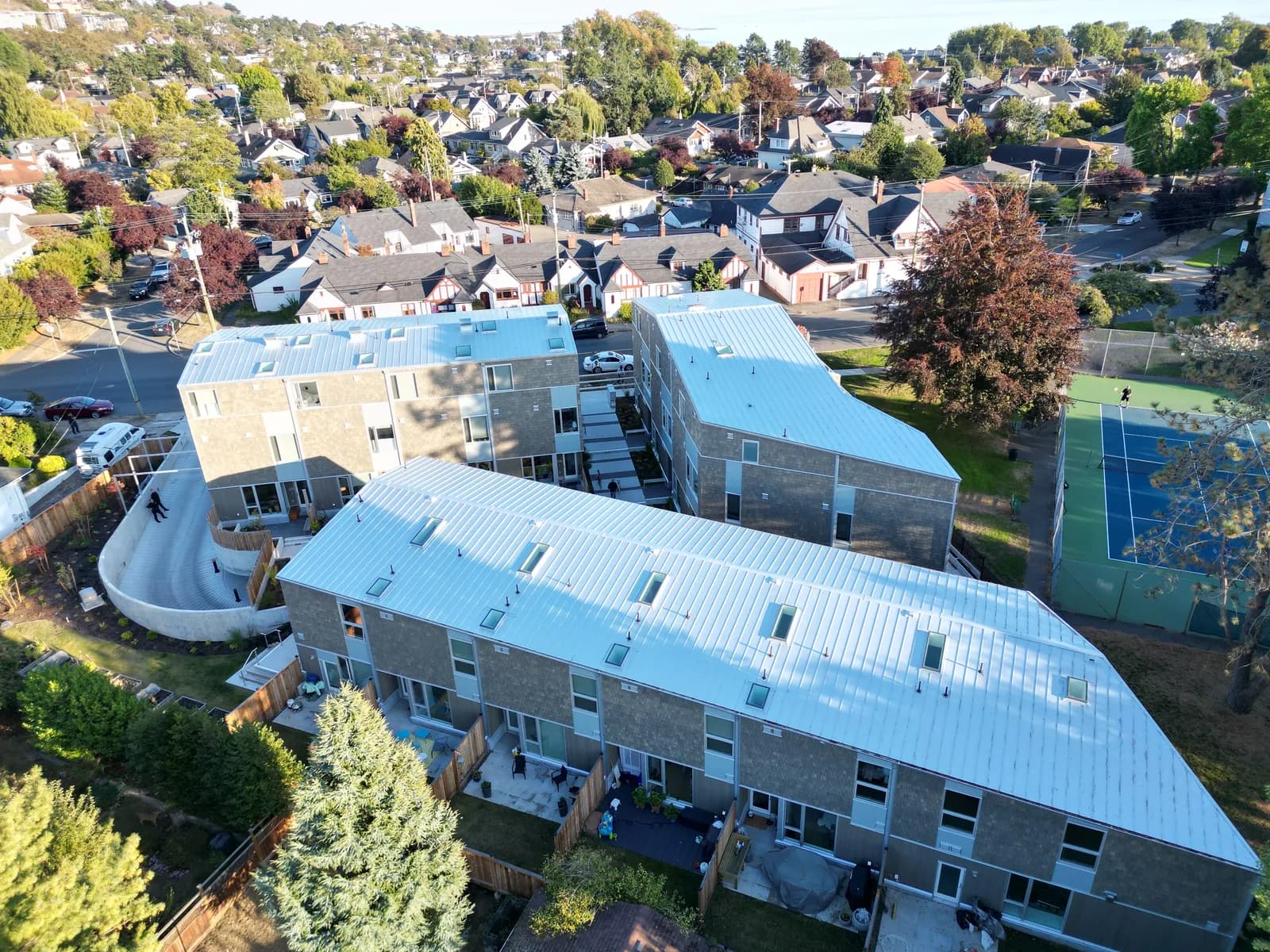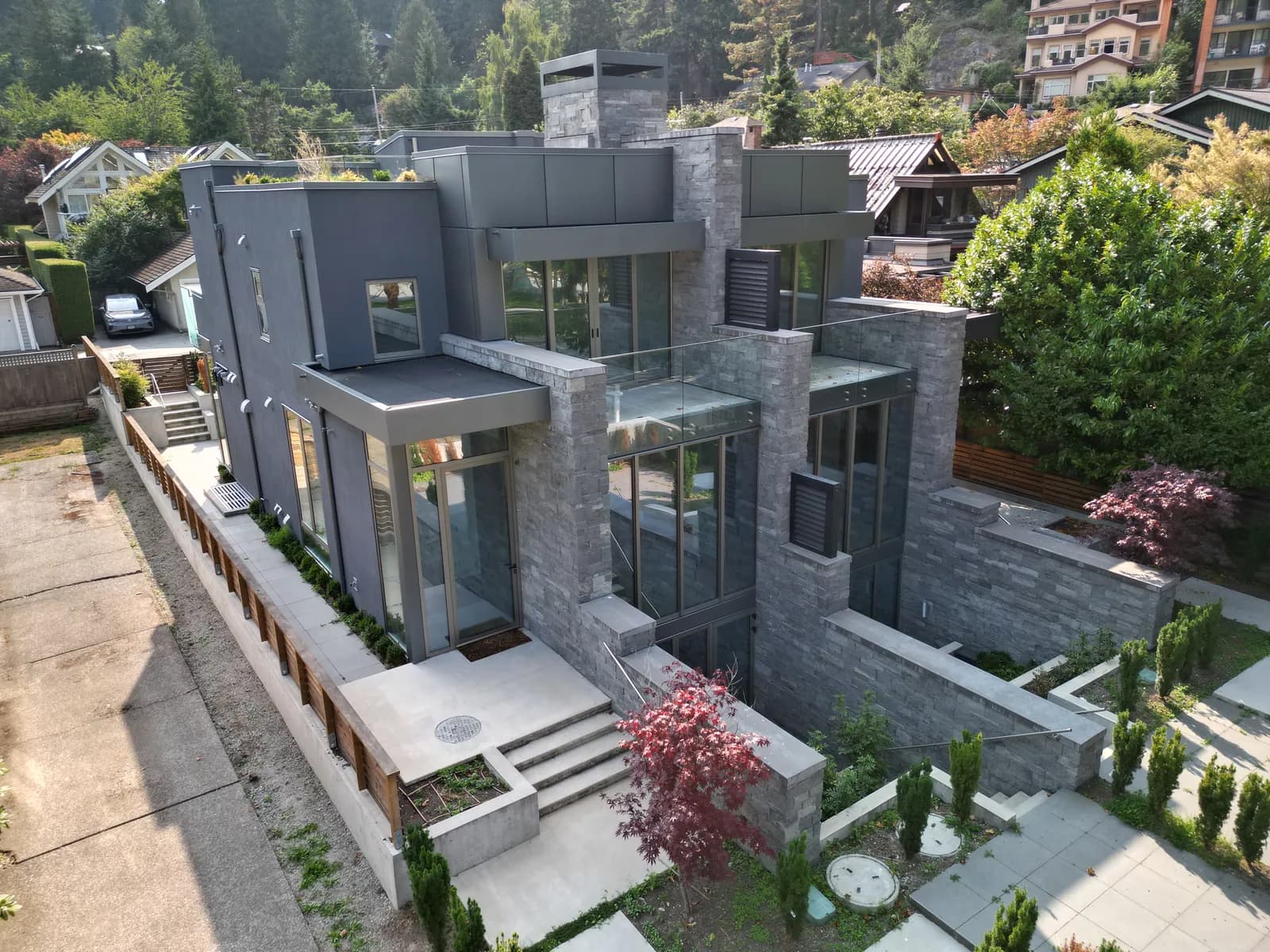
The first thing that fails on a White Rock house is almost never the cladding. It is the fastener holding the cladding on. Any exterior renovation in White Rock or South Surrey starts from that: within about a kilometre of Semiahmoo Bay, salt-laden air gets into every lap, every nail head and every flashing joint, and it works on metal continuously whether it rains or not. The siding on a Marine Drive bungalow can still look acceptable from the sidewalk while the nails behind it have lost half their section. Inland Surrey does not do this. Two kilometres uphill from the pier is a different corrosion environment than the beach, and the same cladding spec performs differently in each.
What does salt air actually do to a house in White Rock?
Airborne chloride settles on the wall and pulls moisture from the air, so metal stays wet even on dry days. Fasteners, flashings, drip edges and railing hardware corrode first, typically 2 to 3 times faster than the same parts 5 km inland. Cladding itself lasts longer than the metal holding it. On the White Rock waterfront we expect fastener-driven failures at 15 to 20 years rather than 30.
The four kinds of houses on this hill
The area reads as one neighbourhood from the highway. On site it is four.
The White Rock waterfront and lower hillside, below Buena Vista. 1950s to 1970s bungalows and view boxes, many rebuilt twice, on steep lots with full exposure to the bay. Original cedar or stucco, no rainscreen, and often a deck or railing assembly added later by someone who used whatever fasteners were in the truck. This is the harshest exposure in Metro Vancouver outside of Point Roberts and the Island coast.
Upper White Rock and East Beach, above 16 Avenue. Same era, less direct spray, more wind. Houses here get the salt in weather events rather than continuously, so metal lasts longer but the wind-driven rain load on the south and west elevations is heavy.
Ocean Park, Crescent Beach and the Elgin and Chantrell corridors. A mix of 1970s ranchers under mature trees and 1990s to 2000s two-storeys. Crescent Beach adds a flood-construction dimension the rest of the area does not have. Under the tree canopy in Ocean Park the north elevations stay damp from October through April, and moss and organic growth do more damage than salt.
Morgan Creek, Rosemary Heights, Grandview Heights and the newer South Surrey subdivisions. 1995 to present, mostly acrylic stucco with stone veneer accents, some fiber cement. Far enough from the water that chloride is a minor factor. The failures here are the standard Lower Mainland ones: window head flashing, deck ledgers, and stucco applied without a drainage gap in the pre-2000 builds.
Where the salt attacks first, in order
Fasteners. Hot-dip galvanized nails are the standard inland spec and they are not enough within a few blocks of the beach. The zinc coating consumes itself, then the steel goes. On a re-clad we pulled on a lower-hillside house last year, roughly a third of the original siding nails snapped when the panels came off rather than pulling through. Marine exposure calls for 304 stainless as a floor and 316 stainless where the wall faces the water directly.
Flashings and drip edges. Painted or mill-finish aluminum pits, then perforates at the fold, usually at the head flashing above windows where nobody looks. A pinhole in a head flashing puts water directly onto the sheathing above the window, and the stain shows up on the interior two winters later.
Railing and deck hardware. Powder-coated aluminum railings on the ocean side chalk and pit within a decade. The bigger problem is galvanic: an aluminum post base bolted down with a plain steel anchor becomes a battery in salt air, and the aluminum sacrifices itself around the bolt. Every waterfront deck we open has at least one post base doing this.
Cladding, last. Cedar in salt air goes grey and then black, streaked from stainless-deficient fasteners bleeding down the face. Fiber cement holds up well but swells at unprimed field cuts. Acrylic stucco does fine against chloride and poorly against the wind-driven rain that comes with it.
Wind, rain and the exposure factor
A wall on the White Rock hillface takes rain roughly horizontally during a southeast blow. The BC Building Code treats moisture exposure through an exposure calculation that accounts for overhang width relative to wall height, and the tall, narrow, minimal-overhang view houses on this slope score at the bad end of it. That is the technical reason a two-storey on Marine Drive with a 300 mm eave needs a drained and vented rainscreen while a 1970s Ocean Park rancher with a 900 mm overhang under trees has survived 50 years without one.
It also means window and door detailing does more work here than the cladding choice does. Sloped sill pans, back dams, and membrane returned into the rough opening are the difference between a wall that lasts 40 years and one that gets reopened at 15. On an exposed elevation we install pans at every opening whether the window is being replaced or not.
What an exterior renovation in White Rock costs
Numbers from our 2026 estimates, for a 2,400 sq ft two-storey.
Full re-clad to fiber cement over a drained rainscreen, including strip, sheathing repair allowance, self-adhered membrane at all openings, stainless fastening throughout, new flashings and paint: $95K to $135K on the hillside, $80K to $110K on a flatter Morgan Creek or Grandview lot. The gap is access, not material. Scaffolding a steep White Rock lot with a 30-foot drop on the view side costs what it costs.
Aluminum plank siding, which we recommend often on direct-exposure walls because there is no organic material to feed and the finish holds against salt: $115K to $155K.
Stucco tear-off and rebuild with a drained acrylic system: $100K to $140K.
Flashing and fastener remediation without a full re-clad, on a house whose cladding is still sound: $18K to $35K. This is the job most waterfront owners should be doing and almost nobody asks about. Replacing corroded head flashings, drip edges, railing anchors and exposed fasteners buys another 10 to 15 years out of cladding that would otherwise be torn off early.
Carry a sheathing allowance. We use $6K to $10K on a South Surrey house and $12K to $20K within two blocks of the beach, because the fastener corrosion and the wind-driven rain arrive together and the sheathing behind a failed head flashing is rarely dry.
The mistake that costs the most here
Owners spec the cladding and let the contractor spec the fasteners. The cladding is the visible decision, the one with samples and colours, and it gets all the attention. The fastening and flashing schedule is a line item nobody reads.
On a waterfront wall the fastener schedule is the decision. A $110K fiber cement re-clad installed with hot-dip galvanized nails on Marine Drive will show rust streaks down the face inside eight years and will need to come off again inside twenty. The same job with 316 stainless costs $2,500 to $4,000 more in material and is a different asset. Ask any contractor bidding your house to write the fastener grade into the estimate. If they will not put it in writing, that tells you what you needed to know.
Two municipalities, two sets of rules
White Rock and South Surrey look continuous and are not. The City of White Rock has its own building department, its own tree bylaw and its own hillside and view considerations, and the lots are small with tight setbacks that affect where scaffolding can legally stand. Neighbour access agreements are routine on the hill and worth arranging before the crew mobilizes, not during.
South Surrey falls under the City of Surrey, and much of the newer area sits inside development permit areas with form and character guidelines that can apply when cladding materials or colours change. Same-for-same replacement generally does not trigger this. A material change on a Grandview Heights house sometimes does.
Crescent Beach carries flood construction level requirements that affect work touching the foundation or lower wall. Confirm the current requirement before design rather than after.
On value: South Surrey and White Rock detached prices are among the highest in Metro Vancouver outside the City of Vancouver and West Vancouver, and buyers here are represented by inspectors who know what salt air does. A written envelope warranty and a documented stainless fastener schedule are worth real money at resale in this specific market, more than the same paperwork would be in Langley.
A Marine Drive case, briefly
A 1968 view bungalow four lots up from the promenade, cedar bevel siding replaced by a previous owner around 2006 with galvanized ring-shank nails. The call was about rust streaking on the south face. Behind the siding we found sheathing at 26 percent moisture below both bedroom windows, corroded head flashings perforated at the fold on three of five openings, and two deck post anchors that had eaten through the aluminum base plate.
Scope became a full strip on the south and west elevations, sheathing replacement across roughly 18 square metres, new sill pans and head flashings at every opening, aluminum plank cladding on the exposed walls with 316 stainless fastening, and cedar retained on the sheltered north side. Nine weeks on site including the neighbour access agreement, $128K, of which $21K was framing, sheathing and flashing work that would not have existed if the 2006 job had used the right fasteners.
Who does this work
MV Construction has run exterior renovation and building envelope projects across Metro Vancouver for more than 17 years, including waterfront and marine-exposure work from White Rock to the North Shore. We are licensed, WCB-covered and insured for residential, strata and commercial scope, which is the documentation a White Rock strata council or a City of Surrey permit file will ask for before anyone sets a scaffold. Every estimate is written and fixed-scope, with the sheathing allowance and the fastener grade broken out as separate lines so you can see exactly what you are buying. Workmanship carries a written warranty.
Our exterior renovation crews handle the full assembly, and our siding and building envelope teams do the flashing and rainscreen detailing that marine exposure demands.
If you own a house on the White Rock hillside, in Ocean Park or in Crescent Beach and want to know what the metal behind your cladding looks like before it becomes a sheathing project, request a fixed-scope estimate or call (778) 375-5672. We can usually walk the house within a week and deliver written numbers within ten days.