Courtenay sits about 110 km up Highway 19 from Nanaimo, and on Comox Valley homes the difference from the south Island shows at the bottom of the wall. The siding and stucco here take the same winter rain as the rest of the east coast, roughly 1,200 mm a year at Comox, and then spend part of most winters under snow plowed off the driveway or slid off the roof. When we scope an exterior renovation in Courtenay, BC, the first thing we check is the bottom 30 cm: swollen hardboard trim, T1-11 edges gone soft, stucco that has spalled where it meets the ground.
We take exterior renovation work in the Comox Valley from our Lower Mainland base when the scope justifies a full crew mobilization: a re-clad, a stucco remediation, a strata envelope project in Comox or Courtenay. A two-day patch is a better fit for a local trade, and we say so on the first call.
How much does an exterior renovation in Courtenay, BC cost?
For a typical Comox Valley house with 2,000 to 2,400 square feet of wall, a full re-clad in fibre cement or acrylic stucco over a new rainscreen cavity runs about $38 to $62 per square foot in 2026, or roughly $76,000 to $149,000. Stripping only the two worst walls cuts that by 25 to 35 percent. Rotted sheathing and framing add $12 to $20 per square foot where the crew finds them.
Those numbers include mobilization, and the Comox Valley carries a bigger travel line than Nanaimo or Duncan. Every truck, crew change and freight load rides the Horseshoe Bay to Departure Bay ferry and then drives another 110 km north. Spread across a nine-week re-clad, that is a small share of the total. On a $12,000 repair it could be a third of the bill. Any off-island bidder should show travel, freight and accommodation on their own line, and our page on the Vancouver Island service area explains how we price it.
Snow at the base, rain on the southeast
Courtenay and Comox see more snow and more nights below freezing than Victoria or Nanaimo in most winters. Cumberland, higher up at the foot of the Beaufort Range, usually gets more again.
Snow piled against a wall does its damage slowly. It melts from the bottom during the day, the water wicks into the lowest siding course and the sill plate behind it, and it refreezes overnight. Hardboard and T1-11 swell and delaminate at the bottom edge. Stucco taken down to grade, or buried by years of new topsoil and bark mulch, soaks up meltwater and spalls through freeze-thaw. Manufactured stone wainscots on 2000s homes fail the same way when the installer left no weep at the base.
The southeast walls take the other half of the weather. Winter storms come up the Strait of Georgia and hit the exposed side of the Comox Peninsula, from Point Holmes around to Kye Bay, with wind-driven rain and salt. Waterfront lots along Baynes Sound at Royston and Union Bay are more sheltered from the wind but still see the salt. It shortens the life of nails, flashings and window fasteners, and we price stainless or hot-dipped fasteners for any house within sight of the water.
The counterintuitive part for the valley is the north wall. In Duncan or Victoria the sheltered north side is usually the healthy one. In the Comox Valley the north and shaded walls hold snow and frost longest and dry slowest, so the base of the north wall is often as wet as the face of the southeast wall. A two-wall repair here picks its walls by moisture readings, never by compass alone.
The mistake we see most often is a bead of caulking along the bottom of the siding, or across the stucco weep screed, put there to keep snowmelt out. It closes the exit the wall used to drain through, and by spring the trapped water shows up as soft sheathing behind it.
What the housing stock looks like in Courtenay, Comox and Cumberland
Courtenay's oldest homes sit around the downtown core off Fifth Street and on the west side near the Puntledge River: 1920s to 1950s wood frame, bevel or drop siding, sometimes stucco on wood lath. Those walls have lasted because they dry. Keep them that way, and be wary of anyone who wants to seal them under an elastomeric coating.
East Courtenay and the hill subdivisions filled in through the 1970s and 1980s with split-levels and ranchers. The typical cladding is T1-11 or hardboard on the upper floor and painted stucco or brick on the lower, often original and often 40 years old. These are the Courtenay homes where the bottom-course damage concentrates.
Crown Isle and the newer subdivisions around it went up from the late 1990s onward, with stucco, cultured stone accents, vinyl and later fibre cement. Homes from the first decade there sit in the transition between face-sealed stucco and rainscreen, so find out what is behind the stucco before anyone prices the wall. A probe reading and one test opening will tell you.
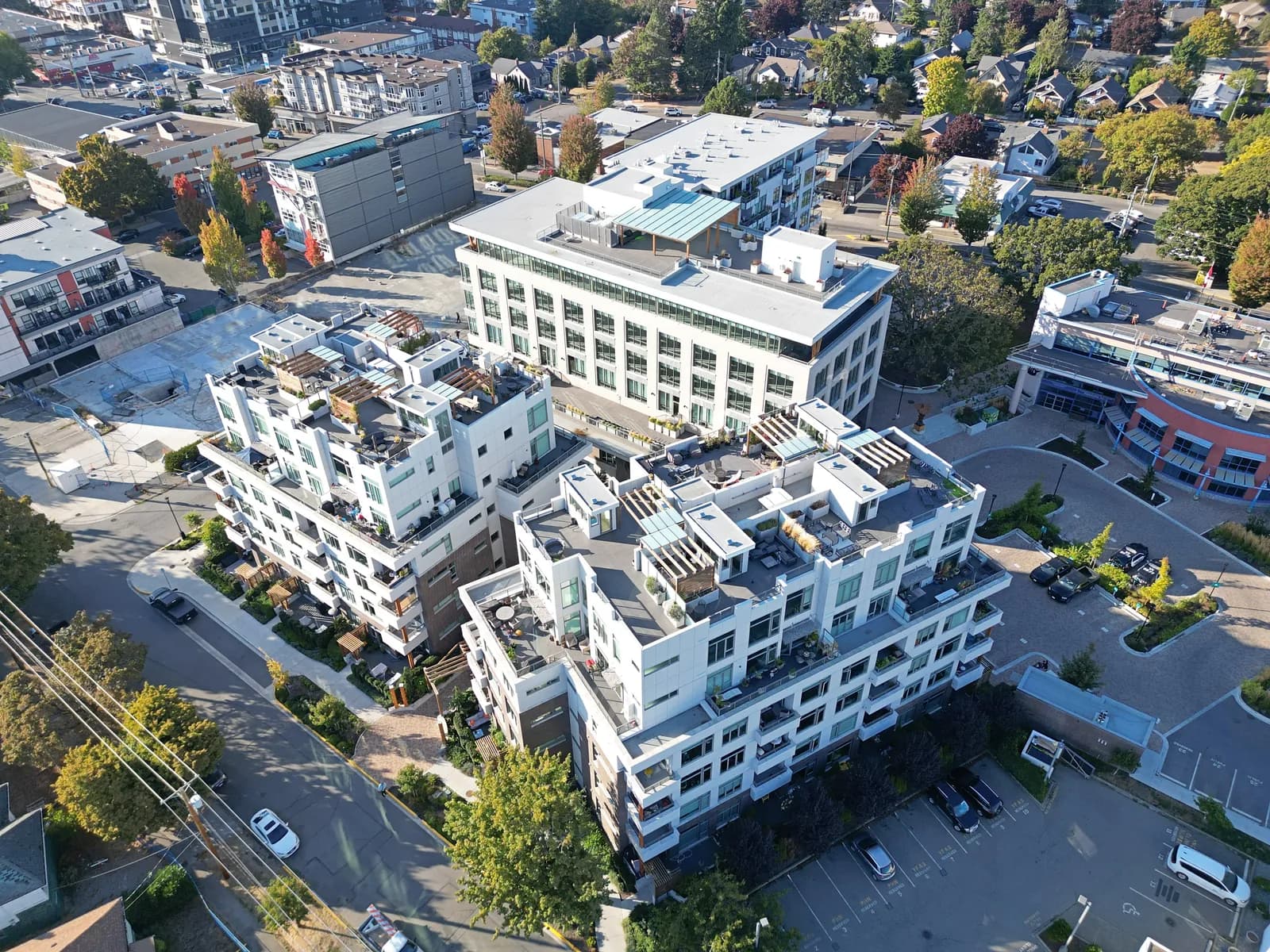
Comox has its share of 1960s to 1980s ranchers on the peninsula, but envelope work there leans toward strata. Many of the townhome and condo buildings around downtown Comox date from the 1990s and were built to the same face-sealed details as the Lower Mainland leaky-condo stock, and their depreciation reports now call for building envelope repair. Comox has a large retired population, and on a strata job most residents are home through the day. That shapes how we schedule noisy work and balcony access.
Cumberland is the old coal-mining village. Its early-1900s cottages near Dunsmuir Avenue have usually been re-sided at least once, and the layer added between the 1950s and 1970s is often asbestos-cement shingle. WorkSafeBC requires a hazardous materials survey before renovation or demolition work like this, so on a Cumberland house the lab results come before the demolition schedule. The newer subdivisions at the edges of the village are mostly 2010s construction with rainscreen walls, and some are still inside the 10-year structural term of BC's new home warranty.
A typical East Courtenay scope
This is a composite of the houses we get asked to price for an exterior renovation in Courtenay, BC, with no single address behind it.
A 1984 split-level: T1-11 upstairs, painted stucco downstairs, and a rear deck with the ledger bolted through the siding. The owners call about paint that will not hold on the north side and a soft spot beside the patio door. Probe readings come back high on the southeast wall and along the bottom of the north wall, and normal on the other two.
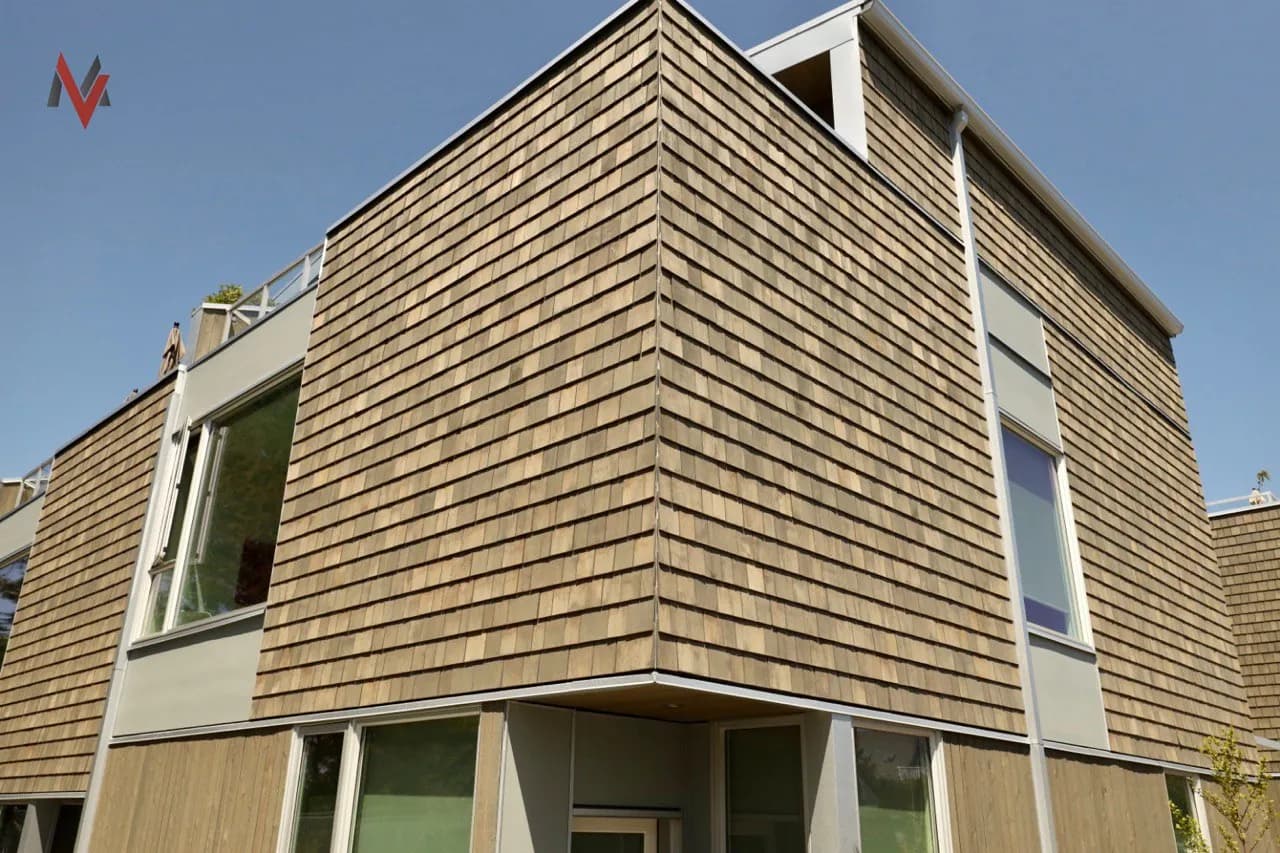
The scope we would write strips the southeast and north walls to sheathing, replaces the soft plywood and the rim joist behind the deck ledger, and adds self-adhered membrane at every opening, new housewrap, 19 mm rainscreen strapping and fibre cement lap siding on those two walls. The ledger is rebuilt with spacers and a metal flashing above it. On the lower-floor stucco: crack repair, a new weep screed with proper clearance to grade, and regrading where the lawn has crept up the wall. The west and east walls get repair, flashing and paint matched to the new siding.
Expect 8 to 10 weeks on site including inspections, with one mobilization. A job like this usually lands in the $60,000 to $90,000 range, and the rim joist is where the contingency line gets used. The cladding work is the same scope we run on siding replacement jobs in the Lower Mainland. The differences are the travel line and the snow at the base.
Who issues the permit in the Comox Valley
Four offices cover the valley. The City of Courtenay, the Town of Comox and the Village of Cumberland each issue building permits inside their own boundaries. Outside them, in Royston, Union Bay, Fanny Bay, Merville, Black Creek and the rural areas, the Comox Valley Regional District handles building inspection.
All four apply the BC Building Code. In our experience like-for-like siding repair does not need a permit, while a re-clad that adds a rainscreen cavity, replaces structural sheathing or rebuilds a deck does. Confirm with the desk for your address before the scope is final.
Two local notes. Low-lying lots along the Courtenay River and its estuary carry flood construction levels and development permit requirements, which matter for any work at foundation or deck level. And Cumberland's downtown along Dunsmuir Avenue has design guidelines for building exteriors, so check a cladding change there with the village first.
The BC Energy Step Code applies to new construction. On a re-clad of an existing house, adding exterior insulation is your choice, and the cheapest time to make it is while the wall is open.
What envelope work does for a Comox Valley sale
The Comox Valley market turns over on a rhythm set partly by 19 Wing Comox. Postings move military families in and out every summer, and buyers from Alberta and the Lower Mainland make up much of the rest. Both groups tend to buy on a tight timeline, so the inspection report carries a lot of weight. A 1980s split-level with original T1-11 and a soft bottom course draws a repair credit or a conditional offer that drags on. The same house with new rainscreen cladding, a closed permit and a transferable warranty gives the inspector nothing to write up on the walls.
If you plan to sell within two or three years, get the walls assessed first, so you set the repair price instead of leaving it to the negotiation.
Hiring a mainland crew for a Courtenay job
Any contractor you consider for an exterior renovation in Courtenay, BC, local or from the mainland, should show four documents before you sign: a current WorkSafeBC clearance letter, liability insurance naming your property, a business licence valid where the house sits, and a written warranty covering workmanship and materials. MV Construction is licensed, WCB-insured and warranty-backed, with 17+ years on exterior and envelope work, and the warranty terms go into the written estimate.
Our crew stays in the valley for the length of the job, and the scaffolding stays with it. Siding and flashing work continues under tarped scaffold through most of the winter, though a heavy snowfall stops it for a day or two. Stucco, acrylic finishes and sealants need 5°C and rising for several days, which in the Comox Valley usually means May. If you are reading this in November, the realistic sequence is an assessment and test openings over the winter, a written scope and permit by early spring, and a spring start. Our guide to planning a spring exterior renovation in BC lays out that calendar.
To start, send photos of each wall, the year the house was built, and where you have seen water staining inside. From photos we can usually tell whether the scope suits a Comox Valley mobilization before we book the site visit. Call (778) 375-5672 or request a fixed-scope written estimate for your Courtenay, Comox or Cumberland home.