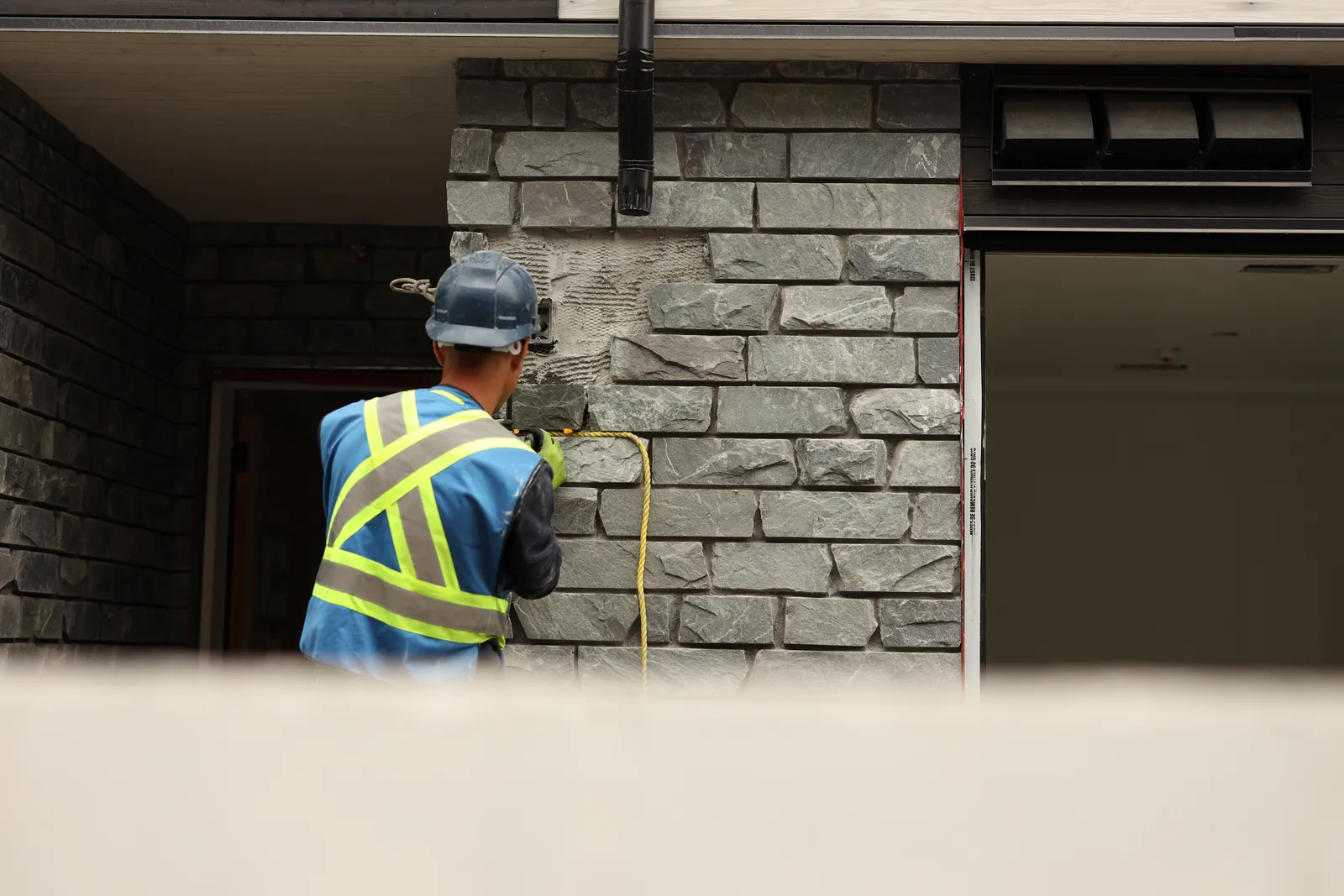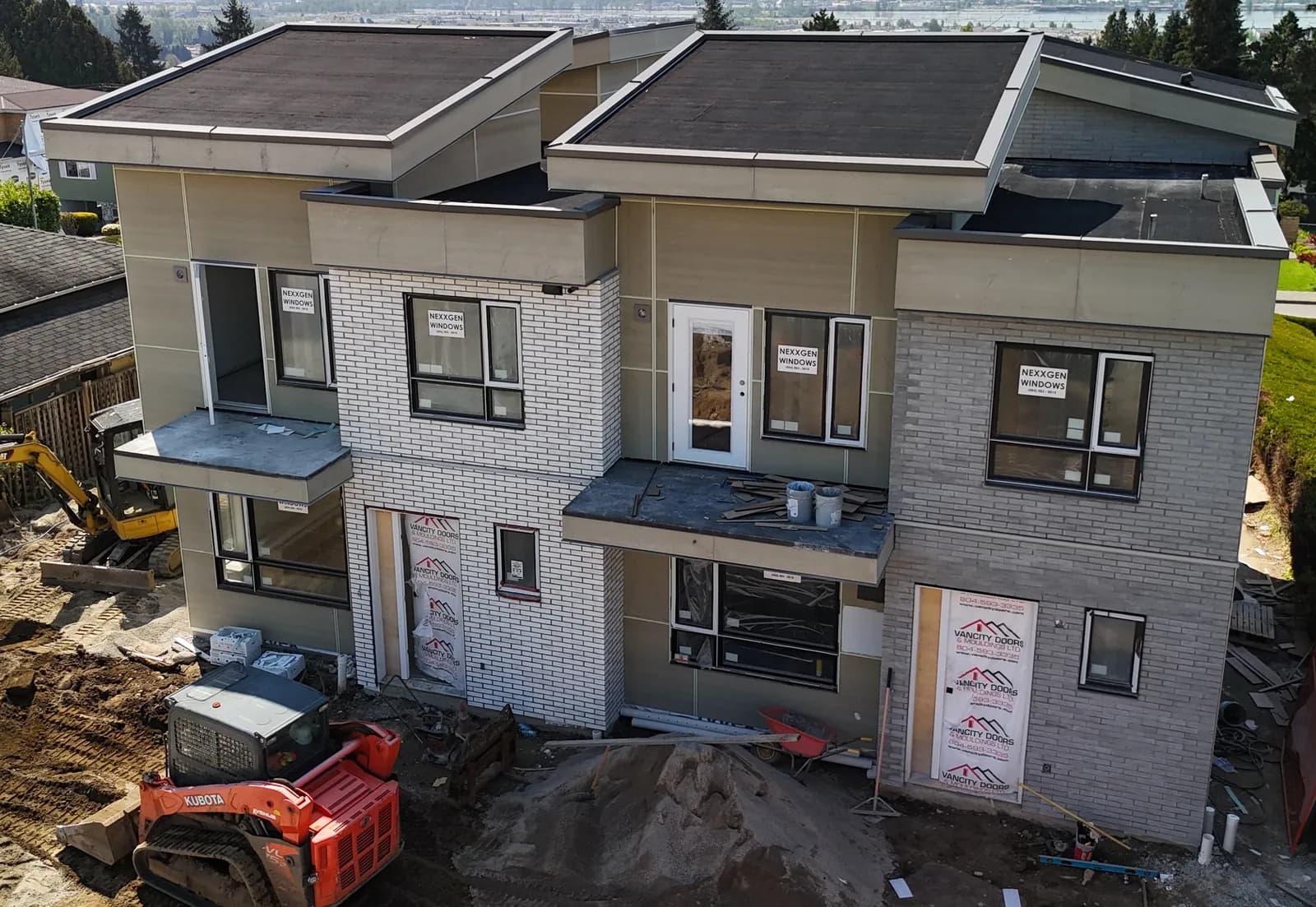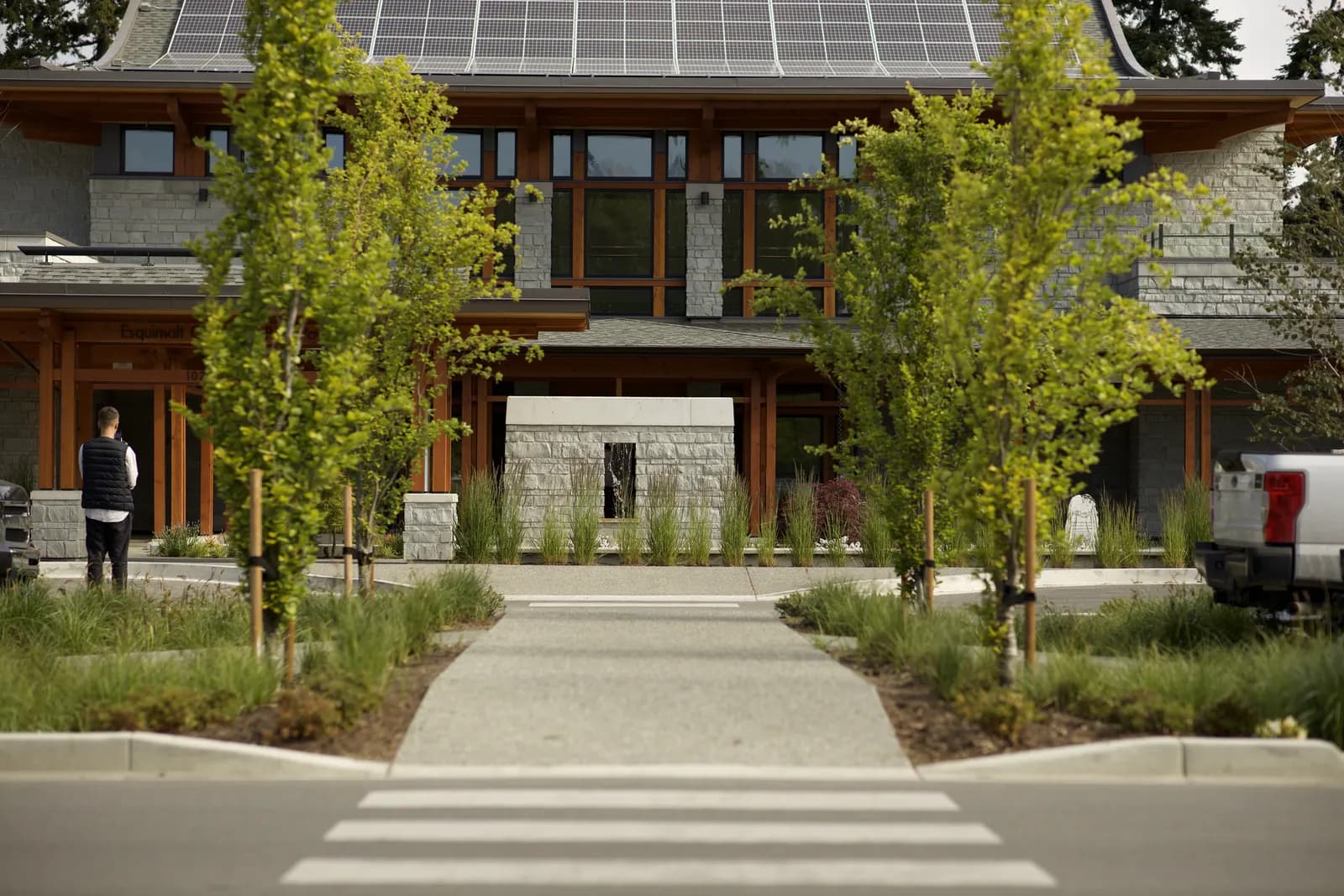
Most calls about manufactured stone start the same way. Three or four stones have dropped off beside the garage door, they are lying in the flower bed in one piece, and the owner wants to know if someone can stick them back on before the rain gets worse. Sometimes the answer is yes, and the job takes a mason half a day. Sometimes those stones are the first sign of a panel that has been wet for years. Good stone veneer repair in BC starts by finding out which of the two you have, before anyone mixes mortar.
This guide covers the repair side: what damage can be fixed stone by stone, when a full panel needs replacing, what both cost in 2026, and how colour matching changes the decision. The background on why water gets behind adhered stone in the first place is in our article on why stone veneer fails in BC.
When does manufactured stone veneer need replacing instead of repair?
Replace the panel when the sheathing behind it reads wet or soft, the lath is rusted, more than about 15 percent of the stones in that section sound hollow, or the product is discontinued and a patch would show from the street. Re-set individual stones when the damage comes from an impact or isolated debonding on a dry, sound wall. In 2026, spot repair in Metro Vancouver typically runs $450 to $1,500, and panel replacement $55 to $85 per square foot.
What "panel" means on a stone wall
It depends on the product on your house.
Most homes and townhouses in the Lower Mainland built since about 2000 have adhered manufactured stone: individual cast concrete units, 40 to 60 mm thick, set one at a time in mortar on a scratch coat over metal lath. These walls have no panels in the factory sense. When we write a repair estimate, a panel is a section of wall between two natural breaks: an outside corner, a window or door trim, a control joint, or the line where stone meets stucco or siding. The eye reads the stone and grout inside that section as one surface, which is why we price manufactured stone repairs by panel once a patch grows past a few stones.
The second kind is panelized manufactured stone. These are interlocking units, often around 8 by 36 inches, fastened with screws through a flange or onto a metal channel, with no scratch coat behind them. They showed up on BC houses later, mostly on accent walls and columns. A damaged unit can be unscrewed and replaced, but because each course locks into the one below, the courses above it usually come off too.
Then there are the foam and polyurethane faux stone panels sold at building supply stores. They are not masonry and they do not take mortar. The only real repair for a cracked one is a new panel from the same product line, if it is still made.
Everything below is about adhered manufactured stone, because that is where nearly all the repair calls in BC come from.
Five kinds of damage, five different repairs
Impact damage
A car bumper at the garage, a lawn mower, a ladder that slid. The stone cracks or a corner breaks off, and the wall behind it is fine. This is the cleanest stone veneer repair there is. The mason cuts out the broken unit with a grinder and chisel, cleans the setting bed back to the scratch coat, back-butters the new stone and presses it in, then grouts and tools the joint to match the joints around it.
If the product is still sold, most of the cost is the visit itself.
Loose stones on a dry wall
Stones pop off when the setting bed never bonded properly. The usual causes are stone set without back-buttering, a scratch coat left dusty or dried out too long before setting, and work done in summer heat or near-freezing weather. You can recognize this kind of debonding because the back of the fallen stone is clean or carries only a thin skin of mortar, and the scratch coat behind it is grey, hard and dry.
To check the rest of the wall, a mason taps every stone in the panel with a rubber mallet or a screwdriver handle. A bonded stone sounds solid. A debonded one gives a dull, hollow clack. Under about 15 percent hollow, we remove and re-set the loose stones. Past that, the rest of the panel tends to follow within a few winters, and replacing it once costs less over ten years than coming back to re-set stones three more times.
Spalling and face loss
Manufactured stone is concrete. Most products get their colour from iron oxide pigment concentrated near the face, so when the face spalls, the grey body shows through and the stone looks bald. In BC we see this in splash zones: the bottom 300 mm of a wall near downspouts and irrigation heads, and along walkways where de-icing salt goes down during the two or three icy weeks of the year. A film-forming sealer rolled on to "protect" the stone makes it worse, because it holds moisture in the face where freeze-thaw can work on it.
Spalled units get replaced. Paint will not make them look right, and the spalling keeps going underneath it.
Efflorescence and staining
White powder, rust-brown streaks under flashings, dark patches that stay wet a day after the rain stops. These are symptoms. Efflorescence means water is moving through the stone and mortar and leaving salts behind as it evaporates. It cleans off, but if the source stays, it is back by spring. The dark patches deserve more attention than the white ones, because they tend to sit right over the spots where moisture probe readings run high.
Water behind the stone
This is where panels get replaced. Soft sheathing at the base of the wall, rotted posts inside stone columns, rust bleeding from the bottom edge of the stone where a weep screed should be. The cause is almost always a missing drainage gap, a buried or missing weep screed, or missing cap and head flashings. The repair is to remove the panel down to the sheathing, fix the wood, and rebuild the wall assembly with a drainage layer and proper flashings before any stone goes back on.
How we decide between re-setting stones and replacing a panel
We make the call on site, usually in one visit, with three checks.
The first is the tap test, done on every stone in every panel that shows a symptom, plus the panels on either side. The second is a moisture probe pushed through grout joints at the base of the wall, beside windows and at the bottom of columns. Wood sheathing below about 19 percent moisture content is dry. Between 19 and 28 percent it is wet enough to worry about. Above 28 percent, decay fungi are active and the wood is probably soft. The third is a test opening: we remove three or four stones in the worst spot and look at the lath, the scratch coat and the sheathing directly.
After that, the rules are short. Any soft sheathing means the panel gets replaced, and we keep opening until we reach dry wood. Rusted lath means replacement, because the scratch coat is only as strong as the steel holding it. Hollow stones over 15 percent of a panel means replacement. A discontinued product with damage more than a few stones wide means replacing to the nearest natural break, so the colour change lands on a corner or a trim line. Everything else is a repair.
Replacing a whole panel often costs less than chasing stones, on paper as well as over time. Spot work pays for a crew to set up, protect the landscaping, mix small batches and fuss over a dozen joints, and per stone it runs three to four times what the same stone costs inside a full panel. Once a patch covers about a third of a panel, the numbers usually favour doing the whole section.
Matching new stone to old
Colour matching decides more stone veneer repairs than the damage does.
Manufacturers retire colours and profiles every five to seven years. A house finished in 2012 may have a ledgestone that has not been sold in BC for a decade. Even when the product is current, installed stone fades under UV and weathers in the rain, so new stone with the same name looks darker and more saturated for its first two or three years on the wall.
We work through the options in a set order. First comes salvage: stones from a low-visibility area such as a side yard, behind a gate or the back face of a column are removed carefully and reused in the visible patch, and the new stock goes where nobody looks. Manufactured stone often breaks on removal, so salvage is a bonus and never the whole plan. Second is blending two or three current products to get close, which works well on rubble and fieldstone patterns and poorly on tight ledgestone. Third is a mineral masonry stain on the new stones to bring them toward the weathered colour, which suits patches of a few square feet. When none of those gets close enough, we replace the elevation to a corner.
Grout gets less attention than it deserves. A perfect stone match with grout two shades lighter, or tooled flush where the original was raked, reads as a repair from across the street. We mix test batches and let them cure before the final stones go in.
What stone veneer repair costs in BC in 2026
Typical 2026 ranges for adhered manufactured stone in the Lower Mainland and on Vancouver Island are below. They exclude landscaping, scaffolding above one storey and framing repair, which is priced by the hour once the wall is open.
| Repair | Typical 2026 cost |
|---|---|
| Diagnostic visit: tap test, moisture probe, 3 to 4 test openings | $600 to $1,200, credited against the repair |
| Spot repair, impact damage or loose stones (up to about 8 stones) | $450 to $900 |
| Each additional stone, same visit | $40 to $90 |
| Panel replacement with a new drainage assembly | $55 to $85 per sq ft |
| Sheathing replacement where needed | $9 to $15 per sq ft |
| Base-course remediation, bottom 400 to 600 mm of wall | $190 to $340 per linear ft |
| Stone column or pilaster rebuild | $2,400 to $4,800 each |
| Full elevation re-clad, adhered manufactured stone | $48 to $75 per sq ft |
Panel replacement costs more per square foot than a full re-clad because a small area carries the same setup, flashing work and tie-in to existing stone as a large one. A typical garage-front panel, about 10 feet wide and 4 feet high, is 40 square feet. Replaced with a new drainage assembly, that comes to $2,200 to $3,400, plus $360 to $600 if the sheathing behind it has to go.
Compare that with the pattern we see on houses where the stones were re-glued: three repair visits over six years at around $700 each, and the sheathing behind the stone a little softer every time.
Panelized systems are the least expensive to repair when the product is still made. A few damaged units and the courses above them typically run $600 to $1,500.
A written estimate for stone work should separate the diagnostic, the stone and the allowance for sheathing at a stated price per square foot. That way, if the wall is worse than expected once it is open, you already know what the extra costs, and nobody has to negotiate it with the wall half removed.
Why BC weather changes the repair plan
Vancouver International Airport records about 1,200 mm of rain a year, and homes on the upper North Shore get close to twice that. Most of it falls between October and March, often as atmospheric rivers that drive rain sideways into south and west elevations for two or three days at a time. Manufactured stone absorbs water like any concrete. The wall depends on the drainage gap behind it to get that water back out.
Freeze-thaw on the coast is mild compared with the Interior, but the Fraser Valley from Abbotsford to Chilliwack sees more cycles, and so do North Shore houses at higher elevations. That is where we find spalling first.
The season matters for the work as well. Mortar for setting stone needs temperatures above about 5°C while it sets and for at least 48 hours after, and CSA A371 calls for cold-weather protection below 4°C. From late October through March, we do spot repairs in dry, mild windows. Panel replacements that expose sheathing get tented and heated, or we install temporary protection (membrane lapped under the stone above and a temporary flashing at the base) and rebuild in spring. If stones are falling now, the right move in November is to make the wall safe and keep water out of the opening, then do the permanent repair once the wall has had a chance to dry.
Strata buildings: one unit's stones, everybody's wall
Townhouse complexes built between about 2004 and 2014 in Surrey, Langley, Coquitlam and Maple Ridge often have adhered manufactured stone at every garage front and entry, installed by the same crew to the same detail. When one owner reports loose stones, the safe assumption is that the other units have the same wall.
In most BC strata plans the exterior walls are common property, so the strata corporation decides on and pays for the repair, not the owner whose garage it is. Bare land stratas and some bylaws split it differently, so check the plan before anyone books a contractor.
The approach that works for councils is to survey every unit's stone in one visit with tap tests and probe readings, then price the repair unit by unit. Council gets a per-unit number it can take to owners, and the work can be phased by building across two seasons. Our building envelope crews run strata stone veneer repair this way, so residents are not living behind scaffolding for months.
Repairs we end up undoing
Each of these shows up on BC jobs every year.
- Stones glued back with construction adhesive or caulking. It holds for a year or two. It also seals the joint so water behind the stone has no way out, and when the stone lets go again it takes the face of the scratch coat with it.
- A clear film-forming sealer rolled on to stop efflorescence. The stains disappear for a season, the moisture stays in the stone, and spalling starts within a few winters. If a sealer goes on at all, it should be a breathable penetrating silane or siloxane, applied after the water source is fixed.
- New stone set over a wet wall without opening it, because the estimate never included test openings. The patch looks good for one winter.
- Landscaping raised against the wall after the repair. The weep screed at the base needs at least 100 mm of clearance to soil and 50 mm to paving, and new mulch beds and pavers bury it more often than anything else.
- Pressure washing to clean off stains, which drives water into the joints and strips the face colour from older manufactured stone.
What we recommend
Book a spot repair if a few stones came off after an impact, the wall is under about 15 years old, the stones around them sound solid on a tap test, and the product is still sold. It is a half-day job.
For anything else, pay for a diagnostic visit first. That includes loose stones with no clear cause, dark patches that stay wet, rust at the base of the wall, efflorescence that keeps coming back, and a product you can no longer buy. Then replace by panel to the nearest natural break, with a full drainage assembly behind the new stone. It costs more than re-setting stones, and it is the repair that stops the same call from coming in next winter.
A replaced panel gets the same layers as a new wall, which we walk through in installing cultured stone in Vancouver. If you are weighing a move to natural stone on that elevation instead, our comparison of cultured stone and real stone covers cost, weight and lifespan.
FAQ
Can you glue manufactured stone back on? Not with construction adhesive or caulking if you want it to last. A loose stone should be removed, the old setting bed cleaned off its back and off the scratch coat, and the stone back-buttered and re-set in fresh mortar. Adhesive seals the joint, traps water behind the stone and usually fails within one or two BC winters.
How do I know if my stone veneer is coming loose? Tap each stone with the handle of a screwdriver. A bonded stone sounds solid, and a debonded one sounds hollow. Other signs are hairline cracks in the grout around a single stone, stones that shift under hand pressure, and a gap opening along the top edge of the stone. If more than a few stones in one section sound hollow, have the wall probed for moisture.
Can manufactured stone be painted or stained to hide a repair? Paint is a poor fix. It traps moisture, peels within a few years and ends up being redone across the whole wall. A mineral masonry stain on new stones can bring them close to the weathered colour on patches of a few square feet. For larger areas, salvaged stone and blended products give a more reliable match.
When is the best time of year for stone veneer repair in BC? April to early October, when temperatures stay above 5°C and the wall can dry out before work starts. Spot repairs can go ahead in mild, dry windows through the winter. Panel replacements that expose sheathing are best done in spring and summer, or tented and heated if they cannot wait.
Planning a stone veneer repair with MV Construction
MV Construction has repaired and installed manufactured stone, natural stone and brick across Greater Vancouver and Vancouver Island for more than 10 years. Our crews are fully licensed and WCB-insured, we carry liability coverage on every project, and our workmanship comes with a written warranty. Before we price a stone veneer repair, we open the wall where the symptoms are, so the written estimate covers what is behind the stone as well as the stone itself, and the number holds once work starts.
If stones are loose or stained on your house or strata complex, our masonry and stone contractor team can book a site visit. You can request a fixed-scope estimate online or call (778) 375-5672.