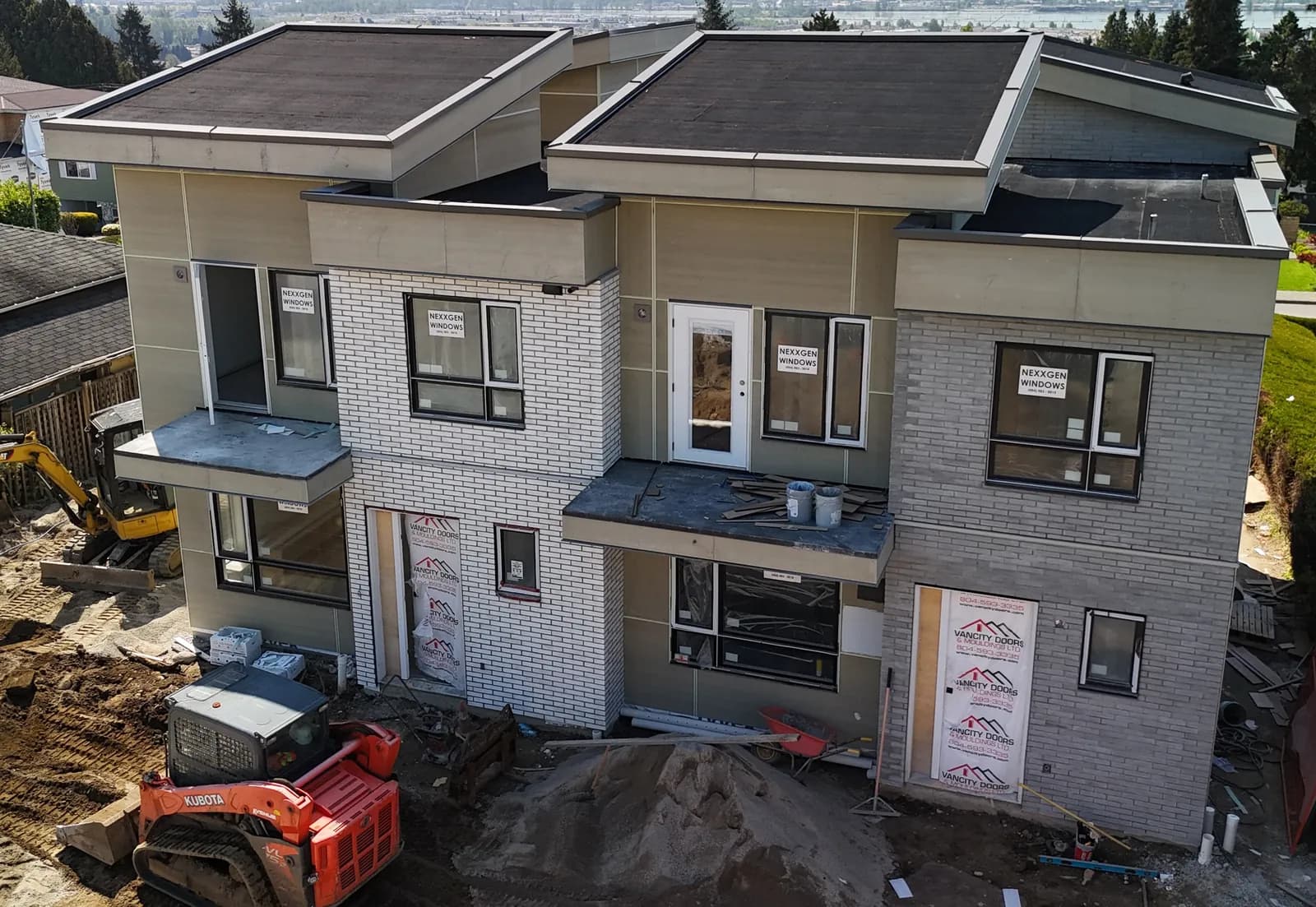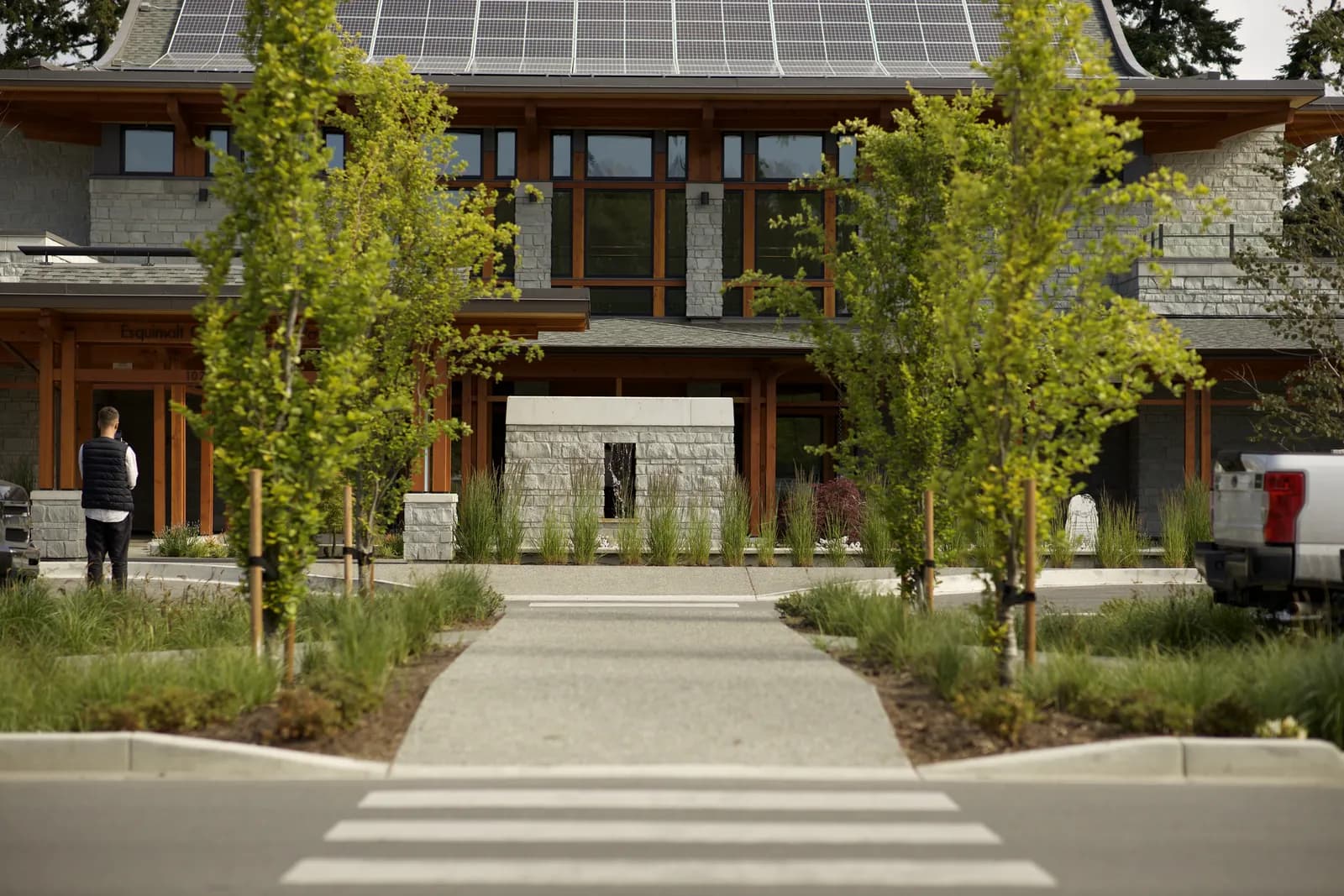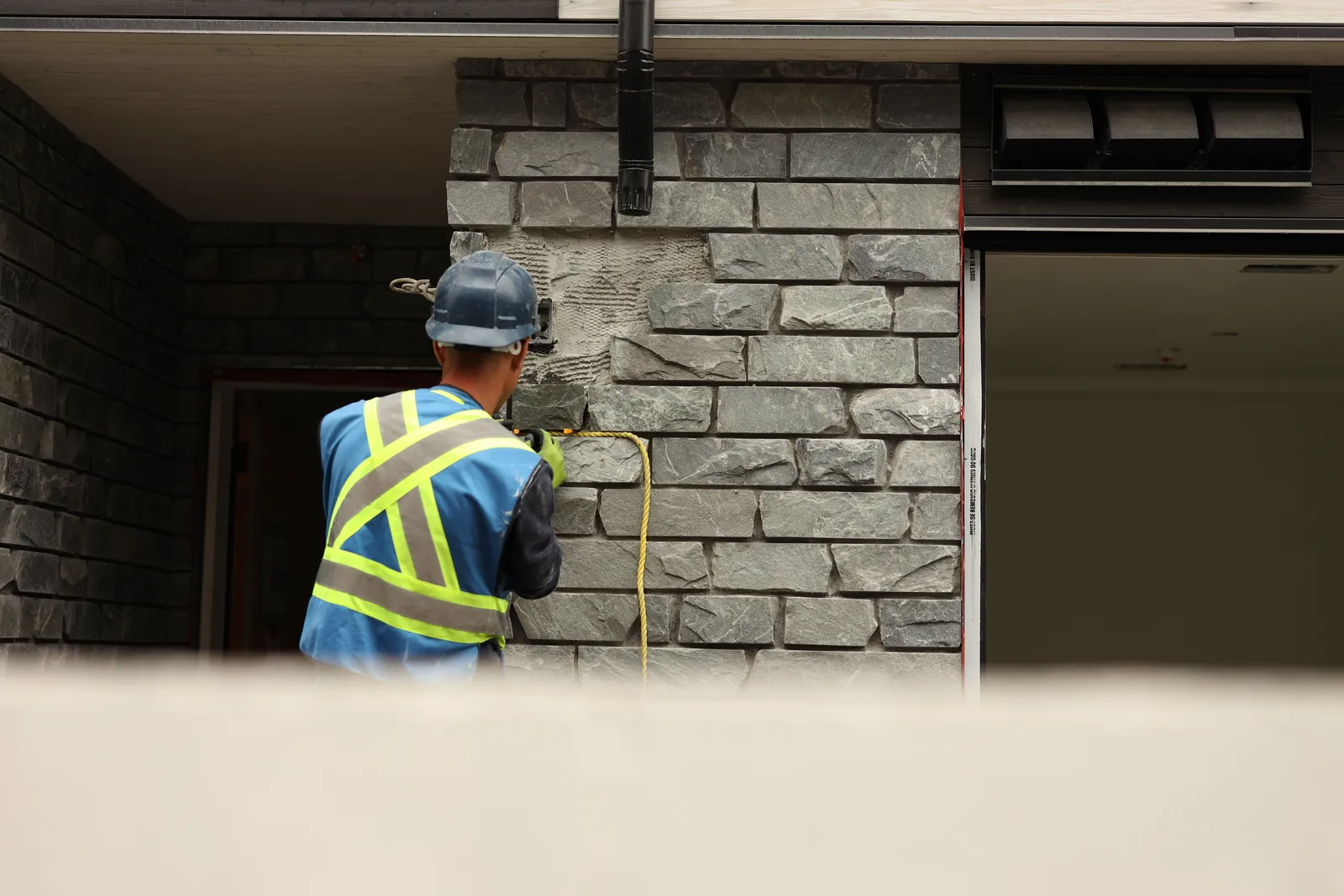
At seven in the morning on a Coquitlam site in late November the brick pallets have a skin of frost, the sand pile is stiff on top, and the thermometer on the scaffold reads 2°C. The mason wants to lay. The schedule wants him to lay. Whether that course of brick is sound in ten years depends on what happens in the next 24 hours, and most of it has nothing to do with how well he trowels the joint.
Masonry in cold weather in BC is a question of mortar, not of skill. Mortar cures by a chemical reaction that needs liquid water and warmth. Take away either one and the reaction slows, then stops. Freeze the joint before it has set and the water inside expands and breaks the paste from the inside. The brick looks fine. The joint is already weaker than it will ever need to be.
Can you lay brick and stone in cold weather in BC?
Yes, down to about 4°C with no extra measures, and below that only with heated mortar, dry unfrozen units and protection that keeps the new work above freezing for 24 hours (48 hours for grouted or reinforced masonry). Below minus 7°C the wall needs a heated enclosure. Adhered stone veneer and lime mortar stop earlier, at about 5°C and rising. In Metro Vancouver, unprotected masonry usually ends in mid November and resumes in March.
Those numbers come from the mortar's chemistry and the industry temperature tiers, and each type of masonry sits a little differently against them. The protection has a price on a BC job in 2026, and so does waiting.
What cold does to fresh mortar
Portland cement hardens by hydration. Water reacts with the cement grains and grows crystals that lock sand and units together. The reaction runs at a useful pace between roughly 5°C and 30°C. Each 10°C drop cuts the rate by about half, so a joint laid at 2°C gains strength at a quarter of the pace of the same joint laid at 22°C. Near 0°C the reaction has slowed so far that the mortar is, for practical purposes, waiting.
Waiting would be fine if the mortar stayed liquid. It does not. Fresh mortar is 15 to 20 percent water by weight, and water expands about 9 percent when it freezes. Ice forming inside a joint that has not yet set pushes the paste apart, opens micro-cracks and breaks the bond between mortar and brick. When the joint thaws, the hydration restarts in a structure that is already damaged. Compressive strength ends up 30 to 50 percent below the design value, and bond strength, the one that keeps rain out of the wall, suffers more.
There is a threshold that matters here. Once mortar has lost enough water through hydration and evaporation, roughly below 6 percent, freezing no longer has enough water to do damage. Reaching that point takes about 24 hours at temperatures above freezing in a dry wall, longer when the units are wet or the air is cold. That is why every cold-weather standard talks about protecting the work for a set number of hours after it is laid, and why the protection period runs longer in deeper cold.
Freeze-thaw on green mortar is a one-time event. Freeze-thaw on cured mortar with open joints is a slow one, and we covered that side in our guide to masonry repointing before winter. This article is about the first kind: new brick, new block, new stone, going up when the air is cold.
The temperature tiers masons work to
Canadian masonry work falls under CSA A371 (construction) and CSA A179 (mortar and grout). Their cold-weather clauses line up closely with the US masonry code tiers that most BC specifications reference, and in practice the industry works to four bands of ambient air temperature.
| Air temperature | Laying requirements | Protection after laying |
|---|---|---|
| 4°C to 0°C | No frozen or ice-glazed units. Heat water or sand so mortar goes on between 5°C and 50°C. | Cover the wall with a weather-resistant sheet for 24 hours. |
| 0°C to minus 4°C | Heat sand and water. Keep mortar above freezing on the board. | Cover completely for 24 hours; 48 hours if grouted. |
| Minus 4°C to minus 7°C | Heat the units and the wall surface above 0°C. Wind breaks when wind exceeds 25 km/h. | Insulating blankets for 24 hours; 48 hours if grouted. |
| Below minus 7°C | Enclosure with heat that keeps the air around the work above 0°C. | Keep the masonry above 0°C for 24 hours; 48 hours if grouted. |
Two things about the table catch people out.
The first is that the forecast sets the tier. A wall laid at 6°C at noon with a clear night and minus 3°C forecast falls into the second band for protection, because the mortar will still be green when the temperature drops. At the end of each day the foreman checks the overnight low and covers for that, whatever the afternoon reading was.
The second is that the mortar temperature limits run both ways. Mortar above 50°C flash-sets on the board and loses workability within minutes, so heating the water to boiling and hoping is a mistake. We aim for mortar at 10°C to 25°C coming off the mixer, which means warm water at around 40°C and sand that has been covered and, in the colder tiers, heated.
Brick, block, and stone each behave differently
The tiers cover the mortar. The units add their own limits.
Clay brick absorbs water, and in a BC fall the pallets arrive wet. Wet brick laid in cold weather does two things: it pulls heat out of the mortar faster than dry brick would, and it holds enough water that the unit itself can freeze and spall at the face in its first winter. Brick must be covered on site, kept off the ground, and checked for ice before laying. Ice on the bed face stops the mortar bonding at all, and we have seen a whole course lift off with a flat bar because it was laid on glazed units.
Concrete block has the same ice rule but a different problem: cold block has a lot of thermal mass, and in the minus 4°C band it has to be heated so it does not freeze the mortar from the inside of the joint. Block walls are also where grout comes in. Grouted cells hold far more water than a mortar joint, which is why grouted masonry carries the 48-hour protection period and why cold-weather grouting below 0°C is normally done inside an enclosure.
Natural stone laid in full mortar beds follows the brick rules, with one addition. Dense stone such as granite holds the cold for hours, so a stone pulled from an uncovered pile at minus 2°C will chill a 20 mm mortar bed below freezing even on a 4°C afternoon. Stone should sit under cover, and in the colder bands inside the enclosure, for a day before it is laid.
Adhered stone veneer is the strictest of the four. Manufactured and thin natural stone go onto a cement scratch coat over lath, and each stone is bedded in a polymer-modified mortar. The scratch coat is thin, exposed on one face and sitting against cold sheathing on the other, so it loses heat in both directions. Manufacturers generally set the floor at 4°C to 5°C and rising, for the scratch coat, the setting bed and the grout, with that temperature held for 24 to 48 hours. We stop exterior adhered veneer earlier than full-bed masonry for that reason, and we wrote up the full sequence in our article on installing cultured stone in BC.
Mortar choices for winter work
The mortar type that goes into a cold-weather job is the same one the wall needed in July. Type S for below grade, retaining walls, chimneys and anything with heavy freeze-thaw exposure; Type N for most above-grade veneer, where its softer, more flexible joint suits the brick. Cold does not change the specification. It changes the handling.
Accelerators are the first thing a supplier offers when the temperature drops, and they are useful within limits. A non-chloride accelerator speeds up hydration so the mortar reaches the safe water content sooner, which can cut the protection period in the milder bands. What it does not do is stop mortar freezing. There is no such thing as antifreeze mortar. Products sold that way lower the freezing point by a degree or two at doses that cost strength and increase efflorescence, and the trade-off is rarely worth it.
Calcium chloride, the old-school accelerator, is off the table on any masonry with steel in it. Chlorides corrode ties, shelf angles and reinforcing, and CSA A179 limits chloride content in mortar for exactly that reason. On a veneer wall the ties are the only thing holding the brick to the building, and a 1990s wall with rusted ties is already a common repair in Metro Vancouver. Nobody should be adding chloride to a new one.
Lime mortar, the right choice for pre-1940 brick in Kitsilano, Strathcona or James Bay, has no winter option at all. Natural hydraulic lime sets slowly and cures partly by carbonation with air, and frost in the days after laying damages it badly. Lime suppliers advise against application below 5°C or when frost is possible within a week, and we follow that even inside a heated enclosure, because the enclosure comes down eventually and lime is still curing weeks later. Heritage work waits for spring. Our guide to lime mortar for heritage masonry covers why cement mortar is not the shortcut.
How the wall gets protected
Protection is a sequence, and the cheap steps come first.
Cover the materials. Sand under tarps on a raised bed, brick and block on pallets with the wrap intact and a second tarp over the top, stone under cover a day ahead. This costs almost nothing and removes most of the cold-weather problems before they start. An uncovered sand pile on the coast is saturated within a week of rain and freezes solid from the top on the first clear night.
Warm the mortar. Hot water from a site heater is enough for the 4°C to 0°C band. Below zero the sand is heated too, either with a propane sand heater or by staging it inside a hoarded area overnight. The mortar board goes under cover, and mortar that has been on the board for more than an hour in the cold is discarded, because retempering stiff cold mortar with more water is how weak joints are made.
Cover the work. A weather-resistant sheet over the top of the wall and down the face, weighted so wind cannot lift it, holds the mortar's own heat of hydration in and keeps rain and frost off. In the colder bands this becomes insulating blankets, the same quilted type used on concrete. The top of a wall in progress is the most vulnerable spot, because water runs straight into the open cores and fresh bed joints, so the top is covered every night from October onward regardless of temperature.
Enclose and heat. On a scaffolded elevation the scaffold itself becomes the frame. Reinforced poly or scaffold wrap closes the face, and heat goes inside. Which heater matters. Direct-fired propane heaters release water vapour and carbon dioxide into the enclosure, and both end up on the wall. The vapour condenses on cold masonry, the carbon dioxide reacts with the surface of fresh mortar and leaves a soft, chalky skin that later shows as pale joints and efflorescence. Indirect-fired heaters, which exhaust outside and duct warm dry air in, cost more to rent and avoid the problem. On commercial work we specify indirect heat. On a small residential job electric heaters inside a tight wrap are often enough.
Protect for the full period, then check. Twenty-four hours is the minimum, and the clock starts when the last unit goes in, not when the first did. On the morning after, a joint that has cured properly resists a thumbnail. A joint that froze is crumbly, pale, and often shows a fine crazing on the surface. If that is what you see, the course comes out. Leaving it is a repair later and a leak sooner.
Where BC's climate puts the line
The tiers are the same everywhere. The calendar is not.
Metro Vancouver and the Fraser Valley. Sea-level Vancouver, Burnaby and Richmond cross freezing on perhaps 15 to 30 nights a winter, and daytime highs sit between 4°C and 8°C from December through February. That is the awkward zone: warm enough to lay most afternoons, cold enough that every night needs protection. The Fraser Valley is harder. Arctic outflow pushes cold air down the valley to Abbotsford and Chilliwack, with daytime temperatures held below freezing and winds that pull heat out of an unwrapped wall in minutes. Up the slopes of North and West Vancouver, Coquitlam and Maple Ridge, frost comes two or three weeks earlier and leaves later than it does on the flats.
Vancouver Island. Victoria and Nanaimo are the mildest masonry climates in the country, with many winters where the 4°C band is the coldest a crew sees. The Island's problem is rain. November to January brings the atmospheric rivers, several days at a time of rain driven sideways into scaffolding, and rain on fresh joints washes the cement paste out of the face. Wrap is used on the Island as much for rain as for cold.
The Interior. Kelowna, Kamloops and anything north of Hope is proper winter. Daytime highs below zero for weeks mean full enclosures and heat for any masonry between December and February, and most residential projects there book brick and stone for April onward.
For most of our work, which is the Lower Mainland and the south Island, the practical rule is that unprotected masonry runs to mid November in a normal year and restarts in early to mid March. Between those dates, every day of masonry is a day of protection, and the job is priced that way. What continues through the winter without any of this fuss is the rest of the envelope: framing repair, sheathing, membranes, flashing and mechanically fixed cladding, which we laid out in our article on exterior renovation in a BC winter.
What winter masonry costs in BC in 2026
Summer pricing in Metro Vancouver for brick veneer runs $35 to $60 per square foot installed, adhered stone veneer $18 to $32, and full-bed natural stone $45 to $90, depending on the unit, the height and the wall behind it. Cold-weather work adds to those numbers in three places.
Materials and handling add the least: heated water, covered sand, a few bags of accelerator, and the labour to cover and uncover every day. Budget 3 to 5 percent on the masonry line for a job that stays in the 4°C to 0°C band.
Enclosure and heat are the real cost. Scaffold wrap on a residential elevation runs $2 to $4 per square foot of scaffold face, and a wrapped two-storey front with an electric or indirect heater for three weeks comes to about $2,500 to $6,000 all in. On a strata or commercial re-clad with a full heated enclosure, we have seen the masonry line rise 10 to 20 percent for a winter schedule, and heating fuel alone on a mid-rise enclosure in a cold snap can pass $400 a day.
Lost days are the hidden line. Even with protection, there are mornings in a Fraser Valley cold snap when the enclosure cannot hold 0°C, or an atmospheric river makes the scaffold unsafe, and the crew stands down. A sensible winter masonry schedule carries 20 to 30 percent weather float. A bid that shows summer production rates in January is either optimistic or planning to lay through conditions it should not.
For a 400 square foot residential veneer job, the arithmetic usually says wait. The winter premium of $3,000 to $5,000 on a $12,000 to $20,000 job buys nothing the homeowner can see, and the same crew in March does the work at summer cost. For a strata with scaffolding already up, a crew already mobilized and a membrane waiting to be covered, the premium is often cheaper than taking the scaffold down and putting it back up in spring.
Mistakes we see on winter sites
Laying on the forecast high. The 11 a.m. reading of 6°C is used to justify laying, and the minus 2°C night is ignored. The wall is uncovered at 4 p.m. and the mortar freezes before it has set. This is the single most common winter masonry failure, and it shows up two or three years later as joints that have gone sandy on the north face only.
Retempering cold mortar. Mortar stiffens fast in the cold, and the instinct is to add water. Each retemper lowers strength, and cold mortar that has been on the board for an hour has begun to set. It goes in the bin, and the mixer makes smaller batches.
Direct-fired heat in a tight enclosure. The crew is warm, the thermometer reads 12°C, and the work looks fine. In April the joints have a chalky skin and the brick carries a white bloom that does not wash off. The heater was exhausting into the enclosure.
Pulling the wrap too soon. The protection period is counted from the last unit laid, and the wrap stays until the forecast is clear. Taking it down on a Friday afternoon because the week's work is done, with a frost warning for Saturday night, undoes the whole week.
Strata and commercial: when the schedule forces winter work
A strata re-clad does not pick its season. Depreciation reports, AGM votes and engineering sign-off land when they land, and a building envelope project approved in September is scaffolded by October and wants its masonry in December. The question for the council is whether the contractor has priced winter masonry as winter masonry.
The bid should say, in writing, what temperature tiers the crew will work to, what protection is included, which heater type will be used inside any enclosure, and how many weather days are carried in the schedule. It should also state what stops: adhered stone veneer and any lime mortar below 5°C, grouting below 0°C without an enclosure. A bid with none of this is a summer bid with a winter start date, and the gap between the two will surface as a change order in January.
Sequence helps. On a mixed envelope, the membrane, flashings, windows and any fiber cement or metal cladding go in through the cold months, with the masonry elevations wrapped and done last, or held for the first stable weeks of March. Our article on planning a spring exterior renovation covers how to set that sequence up before December so the spring slot is already booked.
MV Construction has been doing exterior masonry across the Lower Mainland and Vancouver Island for 17+ years. We are fully licensed, WCB-covered and insured, and the written estimate for a winter masonry scope states the tiers, the protection and the float, so a council can compare it line for line with a spring schedule. The work carries our warranty either way. Details of what we take on are on our masonry and stone contractor page and our building envelope page.
Our recommendation
Lay brick, block and full-bed stone through the 4°C to 0°C band with heated mortar, covered units and the wall sheeted every night. Below 0°C, do it only inside a wrapped and heated scaffold with indirect heat, and only when the schedule cost of waiting is higher than the enclosure. Stop adhered stone veneer and all lime mortar at 5°C and rising, and book them for March.
For a homeowner with a stand-alone masonry job and no scaffold up, wait. The winter premium buys you nothing. For a strata or commercial building already under scaffold, winter masonry done to the tiers is sound work, and the cost of doing it right is far smaller than the cost of a frozen course coming out.
FAQ
What is the lowest temperature you can lay brick in BC? With heated mortar and protection, brick can be laid down to about minus 7°C, and below that inside a heated enclosure that keeps the work above 0°C. Without any measures, the practical floor is 4°C with no frost forecast for 24 hours. The limiting factor is the mortar, which must not freeze before it has set.
Does cold weather weaken mortar permanently? Yes, if it freezes before it has cured. Mortar frozen in its first 24 hours loses 30 to 50 percent of its compressive strength and more of its bond strength, and that loss does not recover when it thaws. Mortar that is cold but kept above freezing and protected cures slowly and reaches full strength.
Can stone veneer be installed in winter in BC? Adhered stone veneer needs the scratch coat, setting mortar and grout to stay above about 4°C to 5°C for 24 to 48 hours. On the coast that means a wrapped and heated scaffold from mid November to March, which is rarely worth it on a residential job. Full-bed natural stone follows the same tiers as brick and is more flexible.
Do you need an enclosure for masonry below freezing? Between 0°C and minus 7°C, heated materials, covered units, wind breaks and insulating blankets over the work are enough under the standard tiers. Below minus 7°C, or for any grouting below 0°C, the work needs an enclosure with heat that holds the air around the masonry above freezing.
If you have a masonry scope that is going to run into the cold months, or you would rather know what waiting until March does to the price, call (778) 375-5672 or request a written estimate. We will tell you which tier your site falls into and what the protection line looks like before anyone mixes a batch.