Walk the Steveston boardwalk on a dry August afternoon and the buildings look fine. Come back in February, after a week of southeasters pushing in off the Strait, and you can read the rust lines from the sidewalk. Brown streaks under window heads. Stains bleeding down from a railing base. A corner bead ghosting through paint in a straight vertical line.
A Richmond waterfront renovation is not the same job as the identical building five kilometres inland at Bridgeport. Same code, same trades, same cladding sitting on the shelf at the supplier. What changes is what the metal inside the wall does over twenty years, and almost none of that metal is visible when someone writes the scope.
Why do exterior assemblies corrode faster near the Richmond waterfront?
Wind-driven salt aerosol off the Strait of Georgia and the mouth of the Fraser settles on cladding and works into joints, where it holds moisture against steel and speeds up rust. Failures show up first in fasteners, flashings, stucco lath and railing anchors, long before the cladding itself looks worn. Galvanized hardware that would last thirty years in Coquitlam can start bleeding rust here in eight.
The salt does not travel as far as people assume
This is where a lot of Richmond specifications go wrong in both directions.
Steveston is not Tofino. The water at the south arm of the Fraser is brackish, diluted by a river that drains a third of the province, and the chloride load in the air here is a fraction of what an exposed west-coast site on the open Pacific deals with. Anyone who tells you every building in Richmond needs marine-grade everything is selling you material you will not get value from.
But it is also not the Fraser Valley. The first few hundred metres back from the dike, from Garry Point through the village and east along the waterfront, carry real salt deposition, and it is concentrated on the elevations that face the prevailing weather. Corrosion in Richmond is directional. The southwest and west faces of a building in Steveston or Terra Nova will show damage a decade before the sheltered north face on the same structure, with the same hardware, installed by the same crew on the same day.
That is the useful part. You do not have to upgrade everything. You have to know which two elevations are actually taking the weather and spend there.
Fasteners fail first, and nobody inspects fasteners
On a re-clad, the fastener line item runs well under one percent of the total budget. It causes a disproportionate share of the problems we open up.
Three patterns repeat near the waterfront. The first is electroplated hardware used where hot-dip galvanized was specified, usually a site substitution nobody wrote down. The zinc layer on an electroplated screw is measured in microns. In salt air it is gone in a few seasons and the steel underneath starts working on the cladding around it.
The second is dissimilar metals in contact. Aluminum trim held by plain steel screws, galvanized flashing lapped against copper, a stainless anchor driven through an aluminum plate. Add salt water as the electrolyte and the less noble metal starts giving itself up. The reaction is slow and completely predictable, which is what makes it frustrating to find twenty years later.
The third is preservative-treated lumber. Modern copper-based treatments are hard on standard galvanized fasteners, and that chemistry plus chloride exposure is a bad combination for strapping, ledgers and deck framing. Hot-dip galvanized to the right standard is the floor. On weather elevations within sight of the water, stainless is the honest answer, and 316 rather than 304 where the hardware is exposed on the face of the assembly.
The price difference between a box of galvanized screws and a box of 316 stainless is real. Spread across a full building it is a rounding error next to the cost of opening the same wall twice.
Railings, balconies and the Steveston condo stock
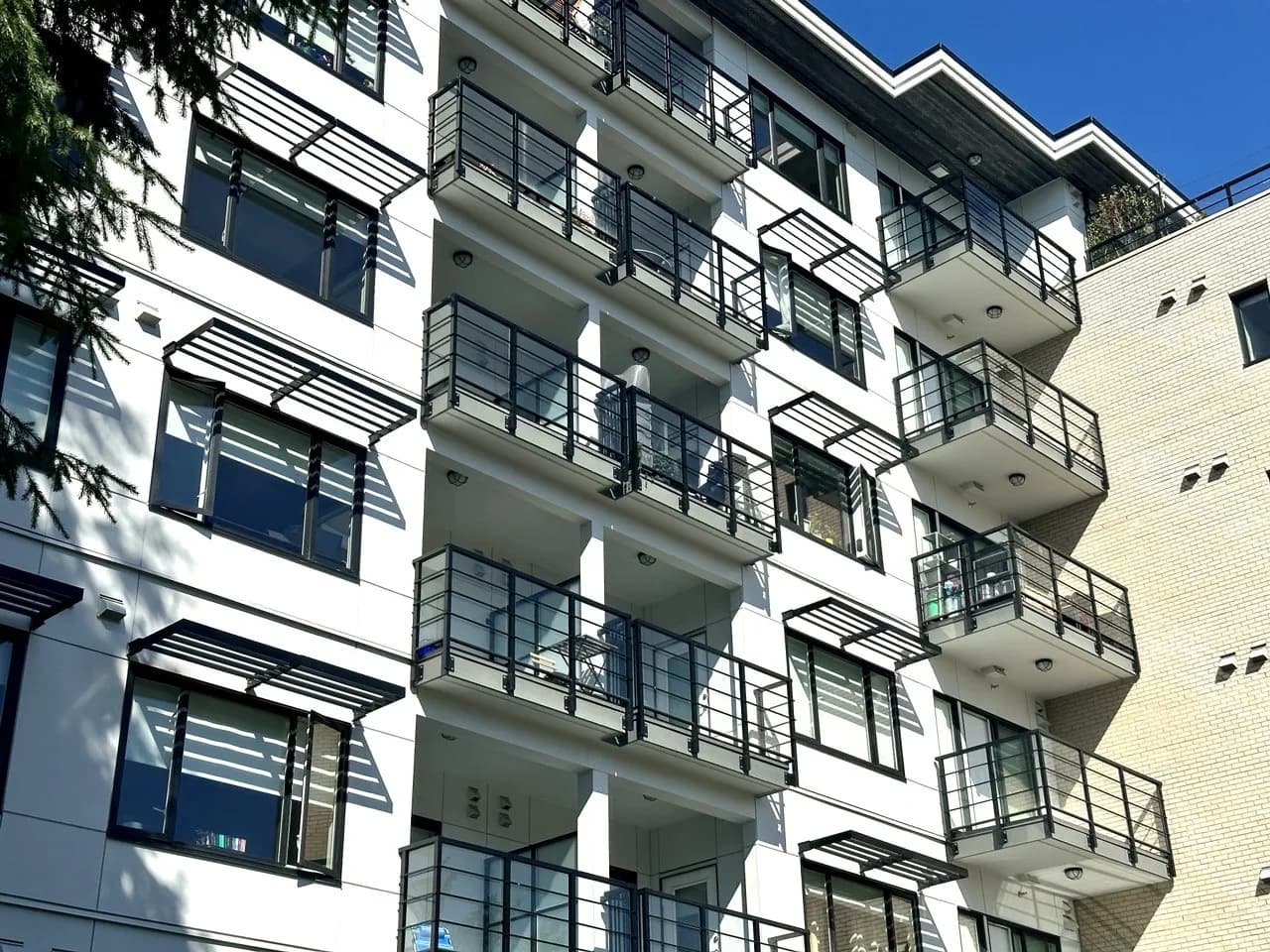
The waterfront buildings that need attention right now are the 1990s and early-2000s stock along Bayview and through the village. Wood frame, four storeys, balconies on the water side, guardrails anchored through the deck.
Those anchors are the problem. A guardrail post base plate sits in the wettest part of the building, gets hit with salt spray, and is fastened through a membrane into framing or a concrete topping. Water follows the fastener down. Once corrosion starts at that anchor it works in two directions at once, expanding and pushing the deck material apart while quietly cutting the fixing that keeps the rail standing. The rail looks solid from the walkway. It moves when you lean on it.
We have pulled base plates in Richmond where the visible powder-coated post was in good condition and the anchor behind it had lost most of its section. That combination is common enough near the water that any building envelope assessment on a waterfront strata should include pulling a sample of railing anchors rather than inspecting from the deck. It is a two-hour exercise that changes the scope of a multi-year capital plan.
What Richmond's ground adds to it
Richmond sits on Fraser delta silt, most of it at or barely above sea level behind roughly 49 kilometres of dike. Two things follow from that for exterior work.
The water table is high. Splashback at the base of a wall is worse here than on a sloped lot in Coquitlam, because there is nowhere for water to go quickly and the ground stays saturated through the winter. The bottom 600 millimetres of the wall assembly takes more wetting than any other part of the building, which is where base flashings, weep screeds and foundation parging start to matter more than they do inland.
The ground also moves. Differential settlement on delta soil opens joints, and open joints let salt-laden water into places the designer assumed would stay dry. A hairline crack at a window corner in Richmond is not the same event as the same crack in Kitsilano. Here it is a delivery route.
Permits, flood levels and the village character rules
Most exterior work in Richmond is straightforward on the permitting side, with two local wrinkles worth knowing before anyone orders material.
Richmond's flood plain bylaw sets a flood construction level that governs where habitable floor area can sit. A straight cladding replacement does not usually engage it. The moment a project touches the foundation, adds enclosed space at grade, or converts a crawlspace, it does, and that discovery in week six is expensive.
The second is Steveston Village. The village core carries design direction tied to its cannery-era character, and exterior changes visible from the street get looked at with that in mind. It constrains colour, profile and material more than people expect. It does not constrain what you put behind the cladding, which is where the corrosion work actually happens. We have done Steveston projects where the finished building looked untouched from the boardwalk and every piece of metal in the assembly had been replaced with a different specification.
What a corrosion-aware scope specifies
On a Richmond waterfront renovation, the scope document does the work. A practitioner reading it should be able to tell which elevations are exposed without being told.
Stainless fasteners, 316 where they sit on the exposed face of weather elevations, hot-dip galvanized as the minimum everywhere else. Stainless or PVC stucco accessories in place of galvanized corner bead and casing bead, which is the single change that prevents the rust streaking you see on older Steveston stucco. Isolation between dissimilar metals at every contact point. Flashings with end dams and generous laps, because sealant is a maintenance item near salt water, not a permanent detail. A drained cavity behind the cladding, which Richmond's rainfall already requires and salt exposure makes more valuable.
Then the part almost nobody writes down: a rinse schedule. Fresh water on railings, hardware and exposed metal twice a year removes accumulated chloride before it does damage. It costs a strata almost nothing and it extends the life of a guardrail system by years. Property managers along the waterfront who do this have noticeably better-looking buildings at the fifteen-year mark.
What it costs
Full cladding replacement on a Richmond waterfront building runs roughly $30 to $55 per square foot of wall area in 2026, depending on the cladding, access and how much sheathing has to come off. The corrosion-resistant upgrades add somewhere between 50 cents and $1.50 per square foot. That is the cheapest insurance on the project.
Guardrail replacement on a 1990s balcony generally lands between $150 and $300 per linear foot installed, more where the deck membrane and topping have to be rebuilt behind it. Anchor repair caught early, before the surrounding material spalls, is a fraction of that.
The pattern we see across exterior renovation work in Richmond is that owners who scope corrosion properly the first time spend maybe four percent more and skip an entire repair cycle. Owners who do not spend the difference twice, plus scaffolding, plus the disruption of a second project.
MV Construction has worked exterior assemblies across Greater Vancouver for more than ten years, including waterfront and near-waterfront buildings in Richmond and Steveston. We are fully licensed and WCB-insured, we put the material specification in writing before work starts including fastener grades, and the workmanship is warranty-backed. Strata councils get a written scope their engineer can review, not a verbal estimate.
If you are looking at rust streaks on a Steveston building or planning capital work on the waterfront, request a fixed-scope estimate or call (778) 375-5672. A site visit takes about an hour, and the fastener question gets answered on the spot.