Nobody calls a contractor about parging. They call about the grey skirt below the siding that has gone patchy, or the flakes collecting in the flower bed, or the hollow sound when a kid kicks the wall on the way past. That skirt is a parge coat, and on most Lower Mainland houses it is the only thing standing between the concrete and 1,200 millimetres of annual rain.
Parging a foundation in BC is simple work that gets specified badly more often than any other exterior finish we touch. It costs a fraction of what siding or stucco costs, which is exactly why it gets treated as a cosmetic decision and handed to whoever is already on site. Then it debonds in four years and the owner assumes parging is just a short-lived product.
It is not. Bad parging is short-lived. Correctly bonded parging on a dry, properly drained foundation stays put for twenty years.
What is parging and when does a foundation need it?
Parging is a thin cement-based coat, usually 6 to 12 mm thick, troweled over exposed concrete or block to give it a finished face and shed water. A foundation needs it when the concrete above grade is spalling, honeycombed, stained, or simply raw after a siding replacement exposed more of the wall than expected. Parging is a finish and a minor water-shedding layer. It is not waterproofing, and it will not stop a wet basement.
That last sentence is where most of the trouble starts. Owners are sold a parge coat as a fix for moisture in a crawlspace, the parge goes on over a wall that is actively wicking water from the outside, and the coating pops off in sheets within two winters because water moving out of concrete has nowhere else to go.
What parging costs in BC in 2026
Current Lower Mainland pricing, based on what we are quoting and what subtrades are charging us this year:
| Finish | Installed cost per sq ft | Realistic service life |
|---|---|---|
| Standard two-coat cement parge | $9 to $14 | 10 to 20 years if drainage is right |
| Polymer-modified parge (acrylic-fortified) | $13 to $19 | 15 to 25 years |
| Fibre-reinforced parge over lath | $17 to $24 | 20 to 30 years |
| Stucco system over foundation with lath and drainage mat | $19 to $27 | 30 years plus |
| Adhered stone veneer over concrete | $38 to $68 | 40 years plus |
Those are square feet of exposed foundation face, not floor area. A typical Vancouver house with 18 inches of concrete showing on three elevations and a walk-out at the back is somewhere between 180 and 320 sq ft of face. Standard parge on that is $1,900 to $4,200. Stone veneer on the same wall is $8,000 to $19,000.
Add a mobilization floor. Almost nobody will bring a crew, a mixer and a compressor for less than $2,200 even if the actual patch is 40 sq ft. If you have a small area of damage, the economics push hard toward doing the whole elevation while the crew is there.
Excavation changes the number entirely. If the parge failure is a symptom of water sitting against the wall below grade, fixing it properly means digging, cleaning the concrete, applying damp-proofing or membrane, replacing the drain tile and the filter rock, and backfilling. In Metro Vancouver that runs $180 to $320 per linear foot of wall depending on depth, access and whether the landscaping and hardscape have to be restored. Nobody wants that number. Sometimes it is the honest one.
Why parge coats fail on the coast
Four causes, in the order we see them.
Water leaving the concrete. A foundation with poor drainage stays saturated. Water moves through the concrete toward the drier side, hits the back of the parge coat, and pushes. Every freeze cycle expands it. Parging debonds from the top down or in map-shaped sheets, and the concrete underneath comes off looking damp and dark. This is the one that cannot be fixed with a better parge coat.
Dirty or sealed substrate. Parging is a mechanical bond. It needs an open, clean, slightly rough concrete surface. Form release agent, efflorescence, old paint, or a previous acrylic sealer all cut that bond. The wall gets a quick pressure wash, the parge goes on, and it holds until the first real cold snap.
Wrong mix, or the right mix applied too thick. A single 20 mm pass will crack. Parging wants two thin coats with a scratch coat keyed properly and time between them. In our climate the second coat should not be going on in direct September sun or in 4-degree November mornings without protection. Cold-weather parging is real work with hoarding and heat, and it is priced accordingly.
No termination detail at grade. The parge coat should stop with a clean edge above finished grade, ideally 150 mm, with soil or gravel sloping away. When landscaping gets built up over the years and soil sits against the parge, the coating wicks and stays wet. We have pulled parge off walls where the failure line matched the old mulch height exactly.
Freeze-thaw gets blamed for most of this. On the coast, freeze-thaw is the trigger, not the cause. The cause is that the assembly was wet in the first place.
Choosing the finish: four honest options
Straight cement parge is the right answer on a dry foundation where the exposed height is under two feet and the look does not matter much. It is the cheapest thing that works. Specify a two-coat application, a polymer-modified mix rather than plain sand and Portland, and a clean grade termination. Done that way it is not a compromise.
Polymer-modified or acrylic-fortified parge buys flexibility. The additive lets the coating move slightly with the wall instead of cracking, which matters on block foundations and on anything that has already shown hairline cracking. Roughly 40 percent more than standard and worth it on most projects.
Fibre-reinforced parge over metal lath is what we use when the concrete itself is in poor shape. Spalled, honeycombed, previously patched with three generations of mismatched product. Lath gives the coating something to hold onto that is not failing concrete. It also lets us build out the face to a consistent plane, which matters visually when the foundation meets new siding.
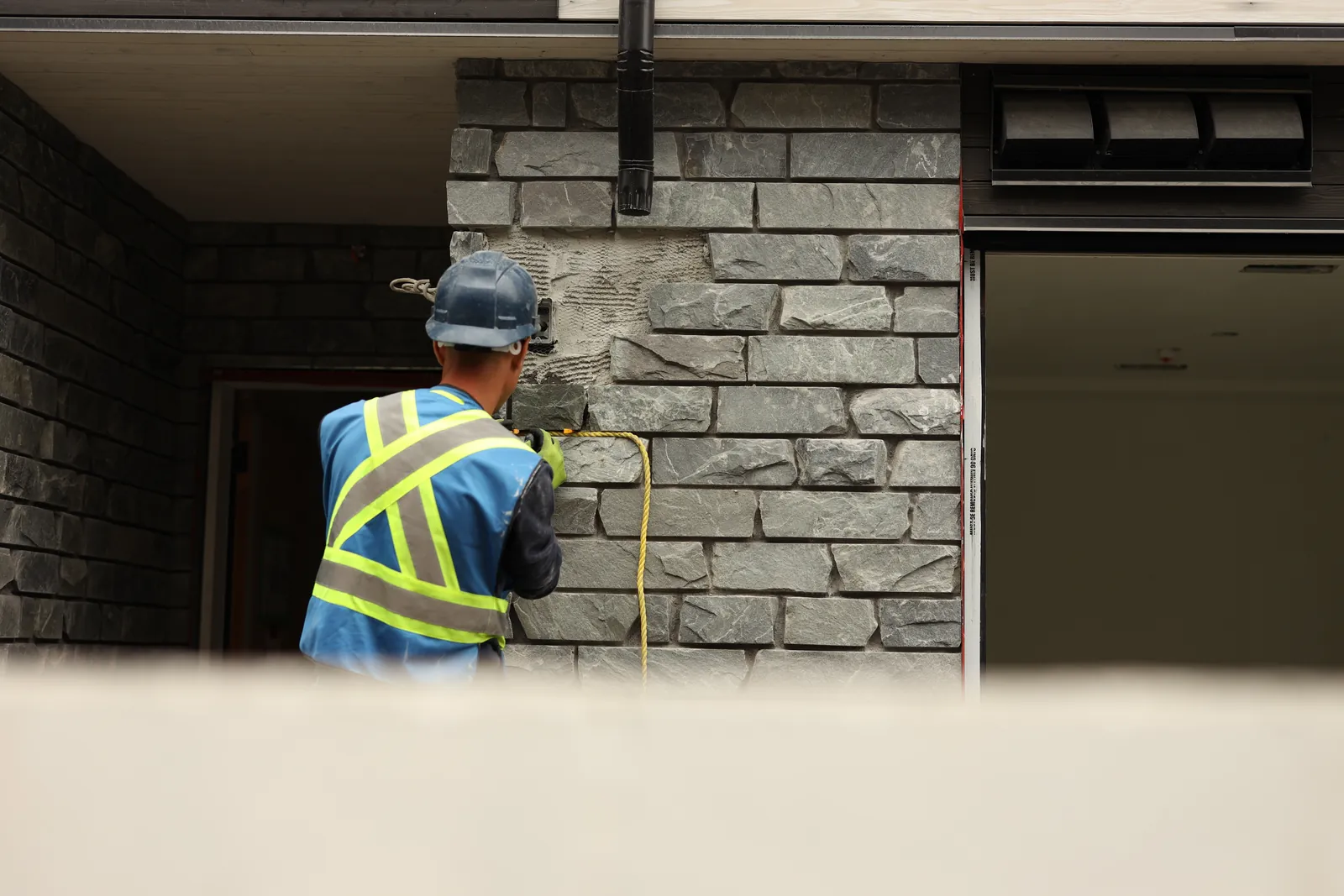
Stone veneer is a different decision. It is not a repair, it is an architectural choice that happens to be durable. On a Point Grey or West Vancouver house where the foundation face is 30 inches tall and highly visible, veneer changes how the whole elevation reads. It also demands the same drainage detailing as any adhered masonry, which is where most veneer jobs go wrong. Our write-up on stone veneer failure and drainage covers the weep screed and membrane details that decide whether the install lasts. If you are weighing veneer, talk to a masonry and stone contractor before the siding trade starts, because the weather-resistive barrier lap at the top of the veneer has to be coordinated.
There is a fifth option people ask about: leave it. Bare concrete does not fail. It just looks like bare concrete. On a rental duplex in Surrey where the foundation is clean and the budget is going toward the roof, leaving it bare is a defensible call, and we will say so.
Block and poured walls behave differently
A poured concrete foundation is a monolithic surface with predictable absorption. Prep it, key the scratch coat, and the parge behaves.
Concrete block is another matter, and there is a lot of block in Burnaby, New Westminster and the older parts of Richmond. Block walls have mortar joints that absorb at a different rate than the units, so a thin parge coat over unprepared block telegraphs the joint pattern within a year. The cores also move water vertically. If the top course is not capped and the wall is not drained, block will hold moisture long after a poured wall has dried out.
On block we parge with a polymer-modified mix at a slightly heavier scratch coat, and we do not skip the bonding agent. Where the block is old and previously coated, lath goes on. It adds roughly $3 to $5 per sq ft and removes the guesswork.
One more variable that changes pricing: insulated concrete forms. ICF foundations have exposed foam above grade that has to be protected from UV and impact. That is not parging in the traditional sense, it is a coating system over foam with mesh reinforcement, and it needs a manufacturer-approved product rather than a site-mixed parge. Budget $14 to $22 per sq ft and check the ICF manufacturer's approved finish list before anyone orders material.
The part nobody prices: what is behind the parge
Before quoting any foundation finish we want to know three things about the wall.
Is there damp-proofing on the below-grade portion, and is it intact? On anything built before 1990 in the Lower Mainland, assume the original spray-applied damp-proofing has degraded. That does not mean it has to be replaced. It means the interior condition of the basement or crawlspace tells you whether it matters.
Where does roof water go? A downspout discharging at grade 300 mm from the wall will undo a parge job on that elevation and only that elevation. We see it constantly. The failure is always localized to one corner and the owner cannot understand why the rest of the wall is fine. Extending the discharge or tying it into a properly sloped leader costs a few hundred dollars and protects everything above it.
Is the perimeter drain functional? A scope camera run costs $350 to $600 in Metro Vancouver and answers a question that otherwise gets guessed at. If the drain tile is crushed or root-invaded, parging over the symptom is money burned. The seasonal checks in our fall exterior maintenance list include the surface-level version of this.
Surface finish on a wall with a water problem is decoration on a leak.
Prep is 60 percent of the job
The sequence that produces a twenty-year parge coat is not complicated and it is not fast.
Pressure wash at 3,000 psi minimum to remove laitance, efflorescence and biological growth. Mechanically abrade any area with old coating or sealer, which usually means a grinder with a dust shroud, not more washing. Chip out unsound concrete until you are into solid material. Repair spalls and honeycomb with a structural patching mortar and let them cure, which is a day, not an hour. Dampen the substrate to saturated surface dry condition so the concrete does not pull water out of the fresh mix. Apply a bonding agent where the wall is old or dense. Scratch coat. Cure. Finish coat. Moist-cure the finish for 48 hours minimum, longer in dry conditions.
A crew doing this properly on a 250 sq ft foundation face is on site four to six days. Anyone quoting a day and a half is skipping the cure windows, and the coating will tell you about it in year three.
We have a rule internally: if the substrate prep cannot be done properly because of access, weather or schedule, we do not put parge on the wall that season. Coming back in April beats a warranty call in February.
Strata and multi-family foundations
On multi-family buildings, the exposed foundation band takes a different kind of abuse. Vehicle spray from the parkade ramp. De-icing salt tracked in through the winter. Landscaping crews with line trimmers hitting the same 200 mm strip every three weeks for fifteen years. Mechanical damage accounts for more foundation-band failures on strata property than weather does.
For strata work we usually specify the fibre-reinforced system over lath, or a hard-wearing stone or precast band in the first 600 mm on high-traffic elevations. It costs more at the outset and it stops the annual patch-and-paint cycle that eats operating budgets without ever finishing the job.
Foundation-band work also has a habit of appearing in depreciation reports as a small line item next to much larger envelope items. When the building is already scheduled for cladding or balcony work, folding the foundation finish into that scope saves the mobilization and the scaffolding twice. That coordination is a normal part of any building envelope project and it is worth raising with the consultant early rather than treating it as a separate tender.
Who is doing the work matters more than the product
Parging is one of the few exterior trades where the material cost is trivial and the outcome is almost entirely workmanship. A bag of polymer-modified parge mix is under $30. The difference between a job that lasts four years and one that lasts twenty is prep discipline, mix consistency, and whether the crew respected the cure.
MV Construction has been doing exterior work across Greater Vancouver and Vancouver Island for more than ten years. We are fully licensed, WCB-insured, and every foundation finish we install is warranty-backed with the scope written down before anyone mixes anything. On a job this small that written scope is the part that protects you, because it is where prep, cure time and grade termination get committed to instead of assumed. Our full exterior renovation services cover the coordination between foundation, cladding and drainage when more than one is in play.
FAQ
How long does parging last in BC?
Ten to twenty years on a dry, well-drained foundation with correct prep. Four to six years when applied over a wall with a drainage problem or a contaminated substrate. The variance is almost entirely about water and preparation, not about which product was used.
Can you parge over old parging?
Sometimes. If the existing coat is sound, well-bonded across the full surface, and free of coatings, a new coat can be keyed into it after abrading. In practice, if more than about 20 percent has debonded, the rest usually goes too. Removing all of it is cheaper than coming back.
Does parging stop a wet basement?
No. Parging is an above-grade finish. Water entering a basement comes through the below-grade wall, the footing joint or a failed perimeter drain. Fixing that means excavation, membrane and drainage. Any contractor who sells a parge coat as a basement moisture solution is selling you the wrong thing.
What is the best time of year to parge in the Lower Mainland?
May through early October. The mix needs temperatures above 5 degrees for the full cure window and protection from both direct sun and rain for the first 48 hours. Winter parging is possible with hoarding and heat, and it costs roughly 25 to 35 percent more.
Is stone veneer worth it over a parge coat?
On a visible elevation where the foundation face is tall enough to read as part of the architecture, yes. On an 18-inch band hidden behind a hedge, no. Veneer is three to five times the cost and the durability gain only pays off where the wall takes abuse or where the appearance changes the property's value.
If the foundation band on your house or building has started flaking, the useful next step is having someone look at where the water is coming from before anyone quotes a finish. Call (778) 375-5672 or request a fixed-scope estimate and we will check the grade, the downspout discharge and the substrate condition, then put the prep sequence and the finish in writing on separate lines so you can see what you are actually paying for.